

When people talk about kombucha, the phrase comes up almost automatically:
“It’s good for digestion. “
You discover it in the course of a conversation, you read about it in certain blogs, sometimes you even find it on labels. Who doesn’t dream of lazier meals, less cluttered windows and a more comfortable daily commute?
But beyond this reputation, there are real questions.
What exactly does “facilitating digestion” mean in the case of kombucha?
Is it simply a pleasant impression after eating, or can we talk about more precise mechanisms?
And above all, how can we integrate kombucha into our routine without creating a miracle solution and without causing mistakes in its use?
To answer this, it is important to understand what kombucha really is, how it is brewed, what happens in the bale before it reaches your fridge and in your body after the first brew.
The aim here is not to turn kombucha into a medicine, but to give you clear explanations so that you can make informed decisions on how to use it, especially if you prepare your food at home with a SCOBY sain, such as a Natural Probio culture.
Before talking about kombucha, it is important to clarify a word that is used for everything and anything: digestion.
In everyday language, “avoir une bonne digestion” means several things at once.
For many people, this means :
The same label applies to different realities, sometimes related to the content of meals, sometimes to stress, sometimes to the intestinal microbiota, sometimes to specific pathologies. It is important to bear this in mind, because kombucha can act on certain dimensions of digestive comfort, but it cannot, of course, solve all possible causes.
For some years now, there has been a lot of talk about the gut microbiota. This is the group of micro-organisms that live in our digestive tract.
Today we know that it plays a central role in :
A varied diet, rich in fibre and lightly processed foods, helps this microbiota to remain diversified and functional. Fermented foods, such as kombucha, add to this landscape. They provide additional micro-organisms and metabolites produced by fermentation.
To say that kombucha “aids digestion” is, in most cases, to say that it can contribute to a more favourable overall dynamic for the microbiota and intestinal comfort. But this participation is particularly important if it is part of a coherent whole: balanced meals, rhythm of life, correct hydration.
To understand why kombucha is considered to be more digestive than soft drinks or very sweet fruit juices, we have to go back to the way it is prepared.
Originally, it is a classic sweet tea. If you prepare this type of tea, your digestive system must be able to handle all the sugar it contains, as well as the caffeine and the tea’s constituents.
When you add a SCOBY of kombucha and a kombucha mother, as in a Natural Probio culture, another scenario occurs.
Dans le bocal :
You are then served a sweet that is no longer a simple sweet, but a liquid in which part of the transformation work has already been done by the cultivation.
One can imaginatively speak of pre-digestion. Kombucha is not digested at your place, but part of the chemical transformation of the sugar takes place before it reaches your body.
In practice, the potential effects are as follows:
For many people, this translates, after a meal, into a feeling of lightness or “better digestion” simply by comparison with what they ate before.
Kombucha is rich in organic acids produced by fermentation. It is not necessary to mention all of them to understand their function in concrete terms.
When you buy a small amount of acidic beverage :
This acidity, associated with a slight taste, is one of the reasons why kombucha is often described as a “digestif” in the sensory sense of the term.
Beaucoup de personnes aiment :
It is not magic, it is simply the combined effect of acidity, flavour and contrast with other flavours.
Organic acids increase the pH of the beverage. Well-fermented homemade kombucha becomes too acidic a medium, generally unfavourable for the development of many undesirable micro-organisms.
This does not mean that the acids in kombucha will “disinfect” your digestive tract – far from it. But it does explain why, in reasonable quantities, kombucha is well tolerated by many people: the acidic environment of the drink limits certain undesirable growths in the bottle itself, resulting in a stable drink with a relatively consistent composition once prepared with SCOBY sain Natural Probio.

If the kombucha is not pasteurised or excessively filtered, as is the case with a homemade kombucha prepared from a SCOBY, it contains even more..:
Upon reaching the digestive tract, these micro-organisms are reincorporated into a much larger ecosystem, the gut microbiota.
We cannot promise that all of them will be permanently implanted. Many of them simply die, have a short life, are eliminated. But this step also adds additional actors to the system, accompanied by metabolites already present in the food.
After a few weeks of regular consumption of kombucha maison, some people notice a subjective improvement in their transit:
There is a fine line between what is due to the food itself and what is due to the behavioural changes it brings. Boire régulièrement un verre de kombucha maison, c’est souvent :
In this context, it is logical that it improves digestive comfort. Kombucha is therefore both an actor and a sign of global change.
For some consumers, kombucha is associated with :
Cela peut s’expliquer par :
In addition, replacing a very fatty or very sweet dessert with a small bowl of kombucha maison can reduce the overall digestive load and thus the risk of discomfort.
Conversely, some people report:
This phenomenon is very common when fermented foods are introduced into a diet that previously contained very little fermented foods. The gut has to adapt to these new exposures, and the microbiota has to react through a transition phase that is not always comfortable.
To limit this, it is preferable to :
With a Natural Probio kombucha, the fermentation profile is stable enough that you can do these tests progressively.
Many people spontaneously adopt the phrase “kombucha after raclette” or “kombucha after a festive meal”. They speak of an impression of less saturation, of a greater ability to get moving.
Cela peut s’expliquer par :
However, it is important not to see kombucha as an antidote to excess. Drinking a litre of kombucha does not “cancel out” a very rich meal, just as eating a savoury meal after a fast-food meal does not cancel out everything.
Kombucha is now a companion. It allows :

The best way to integrate kombucha for digestion is not to set a high volume target all at once. It is best to proceed in stages.
Par exemple :
This progressive rhythm gives your intestines time to get used to this new arrival. It also allows you to check more easily whether kombucha is good for you or not.
For their digestive comfort, some people are entitled to..:
With a kombucha maison prepared from a SCOBY Natural Probio, you can keep a bottle in the fridge and dispense small amounts at those special moments, instead of preparing it all at once.
In the idea of “aiding digestion”, a simple element is sometimes overlooked: the pleasure of drinking. Kombucha should not become an additional obligation.
If you appreciate it :
a cela also counts. The pleasure and relaxation that accompany a meal are part of the digestion equation. A meal eaten under stress, even with the best food in the world, does not have the same impact as a meal eaten in peace and quiet with food you really enjoy.
Although kombucha can improve the digestive well-being of many people, there are situations where caution should be exercised.
In case of :
it is preferable to seek advice from your doctor or specialist before introducing kombucha.
La boisson en elle-même n’est pas extrême, mais elle reste :
Many of these elements may be well tolerated by some patients, but not by others.
Kombucha is tea-based and contains caffeine. Fermentation does not eliminate it completely.
Si vous êtes très sensible à la caféine :
With a Natural Probio culture, you can keep the same SCOBY and simply adjust the tea base, which makes adaptations easier.
Kombucha always contains a little alcohol, even if the taste is low when the fermentation is controlled.
In case of :
It is best to avoid kombucha or talk to a health professional.
All “kombuchas” are not worth it. A pasteurised industrial kombucha does not have the same digestive dynamism as a live domestic kombucha. In the same way, a kombucha factory prepared with a fragile or unbalanced soup can be less stable, more unpredictable and sometimes less tolerable.
A healthy SCOBY, like a Probio Natural culture, has several advantages:
This means that, for digestion, you are exposed to a food whose composition is more predictable. You can test, adjust and observe your reactions from one food to another without being disturbed by extreme variations in fermentation.
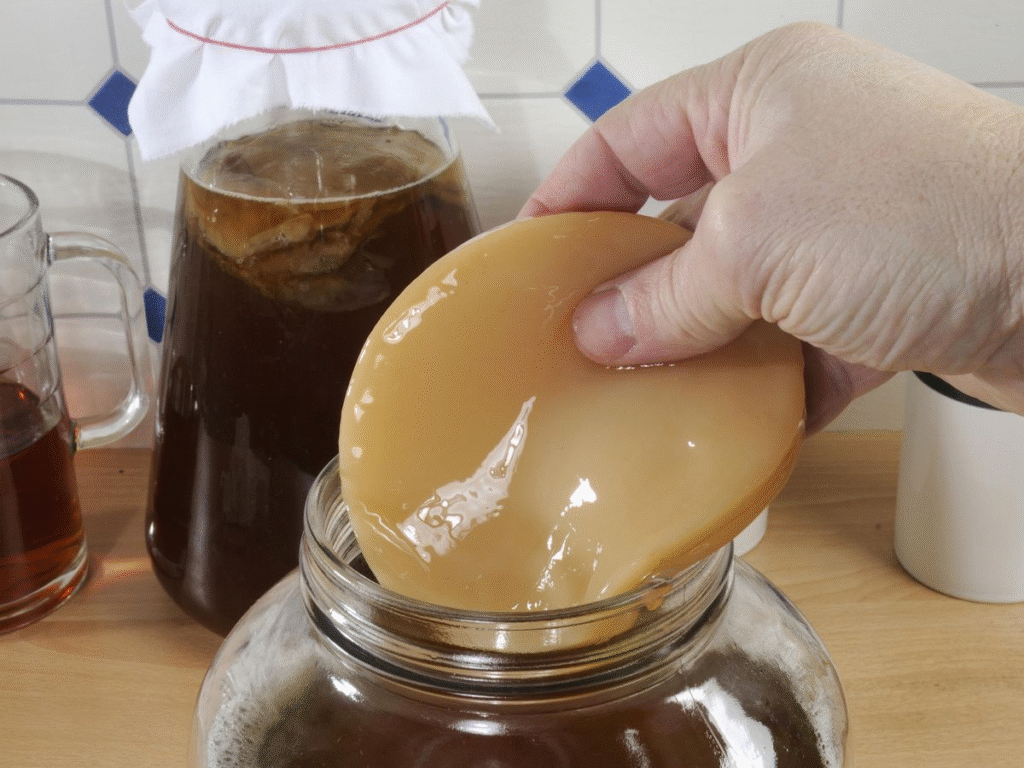
Knowing that the base of your kombucha is clean will save you weight. You will no longer have to wonder if the problem is with the SCOBY or with your organism. You can simply :
This clarity makes it easier to establish a routine in which kombucha becomes an ally of your digestive comfort, rather than a source of discomfort.
Finally, here’s a simple way to integrate kombucha into your life if you want it to help your digestion.
Kombucha will not “repair” in a few seconds a digestive system that has been damaged for years. On the contrary, carefully integrated into an overall more attentive way of life, it can be one of the small foods that, day after day, make digestion more comfortable, meals more leisurely and the relationship with your food more conscious.
A healthy SCOBY, like a Natural Probio culture, gives you the technical basis. The rest is your body, your feelings, your curiosity and your ability to adapt. That’s where the real answer to the question comes in, for everyone:
“Le kombucha aide-t-il ma digestion ?”
The only honest way to find out is always the same: try calmly, learn and let time answer with you.