
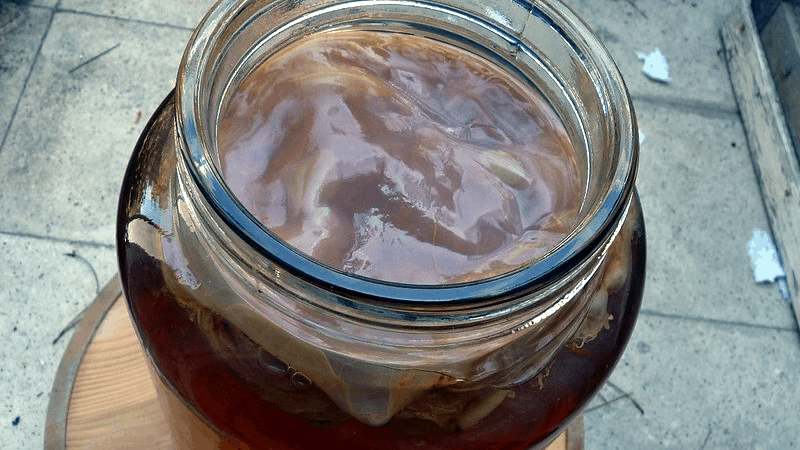
All is well until one day, when you lift the cloth from your kombucha jar, you see something that wasn’t there last time. A strange stain, a fuzz, a smell out of nowhere, a SCOBY that looks more like an old glove than a healthy ‘pancake’. It’s often at this precise moment that a question arises: “Is my kombucha contaminated? And if so, can I save my strain?”
The good news is that kombucha that looks ‘weird’ isn’t necessarily lost. Sometimes it’s just too much yeast, a slightly tired SCOBY or fermentation gone wrong in a single jar. Sometimes, on the other hand, there is genuine contamination, particularly by mould. In this case, the priority is no longer to save the liquid, but to protect your health and get off to a safe start.
In this article, we take a step-by-step look at :
The idea is not to turn your kitchen into a laboratory, but to give you clear guidelines so that your cultures – including a culture of Natural Probio kombucha – are at once lively, productive and safe.
The word “contaminated” is often used when a jar no longer resembles what we imagined. However, it covers very different situations.
There are cases where kombucha is simply :
And then there are the cases where we see real undesirable contaminants:
In the first case, we’re talking about an imbalance or a weakened strain. In the latter case, we’re talking about real contamination, which calls for radical measures.
To determine whether a strain can be saved, this distinction must first be made.
Before you panic, it’s important to know what’s normal in healthy kombucha, even if it’s a bit confusing.
At the bottom of the jar, you can see brown filaments, deposits that look like dregs. These are very often :
This is a sign of activity, not infection. You can filter slightly at bottling time if you want a clearer drink, or simply leave these deposits alone.
The surface of SCOBY is not always perfectly smooth. We can observe :
All this is normal, especially if the crop is active and a new film is forming on the surface. These are not moulds, they are not foreign fungi, they are simply manifestations of the life of your crop.
A healthy SCOBY can :
You can’t judge its health from its position. What counts is the smell of the kombucha, the formation of new films on the surface and the evolution of the taste.
To determine whether contamination has occurred, we need to focus on a few clear signals.
You can recognise mould on kombucha by several characteristics:
Mould doesn’t just look like a thicker area of SCOBY. It has that “fluffy” appearance reminiscent of forgotten jam or mouldy bread.
As soon as you see this type of stain, the rule is simple: the jar is no longer fit for consumption. Even if part of the SCOBY appears intact, the contamination may have spread.
Healthy kombucha can smell :
But it shouldn’t smell like rubbish, rotten eggs, ammonia or any other aggressive and frankly unpleasant odour. A truly disgusting smell indicates that undesirable micro-organisms have taken over.
Here too, the rule is clear: you don’t “save” this liquid. Avoid prolonged contact, protect yourself, clean up and move on to something else.
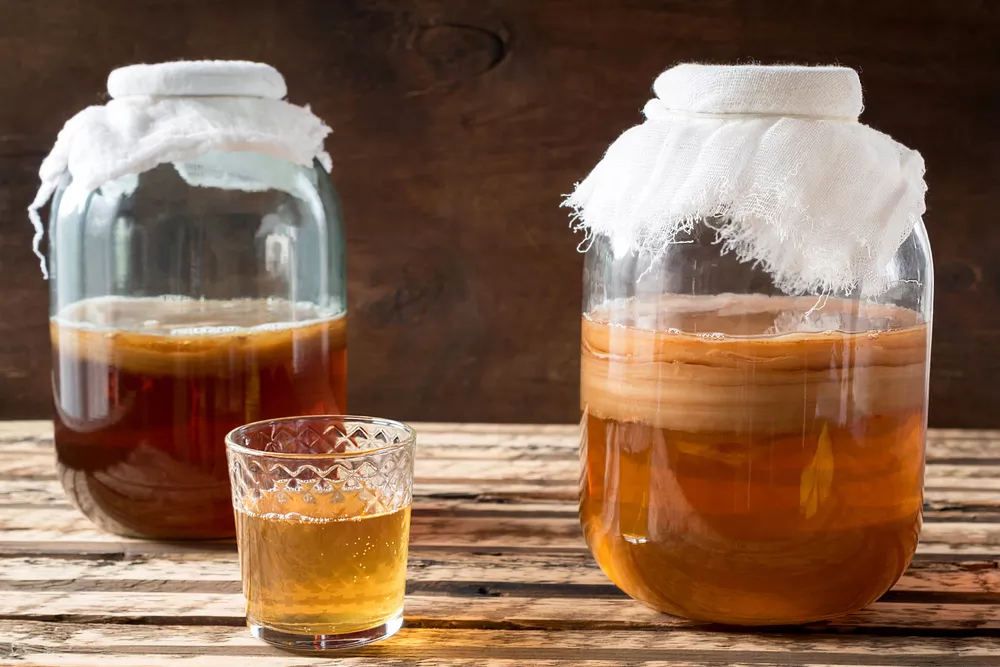
Drosophila (small fruit flies) love kombucha. If they manage to get into the jar, they can lay their eggs there, and you can end up with :
In this case, there’s no discussion: throw out the contents of the jar, clean thoroughly and reinforce the protection (clean cloth, tightened with a rubber band, no partially open lid that lets insects through).
The answer may disappoint, but it’s an important one: no, you can’t ‘save’ a mouldy jar.
As soon as mould is visible :
Trying to scrape off the stain and keeping the rest of the SCOBY is not a good idea, especially if you intend to drink the kombucha afterwards.
In this case, what can be saved is not the strain in the jar, but the lineage, if you have been prudent enough to keep it elsewhere:
If you don’t have any back-up strains, the only really safe option is to start with a new, healthy SCOBY from a reliable source.
The real possible “safeguard” concerns strains which do not appear to be contaminated by mould, but which are showing signs of fatigue or imbalance.
Your crop may need help if :
In these cases, the strain is not necessarily ‘contaminated’ in the strong sense. It is simply unbalanced or exhausted.
To help a tired strain, you need to provide it with optimum conditions:
The idea is to start again from a clean, well-acidified base, to give the strain favourable conditions with no competitors.
In the days that follow, observe :
If, after a week or so, no new film appears and the tea remains almost as sweet, it is possible that the strain has been too badly damaged to restart properly.
If, on the other hand, you see a film forming, even a very thin one, this is an encouraging sign. The strain is being reconstituted.
Over time, some SCOBYs become very thick and heavy, with several superimposed layers. Some of these old layers may not be very active.
In a “rescue” approach, it is sometimes useful to :
This is a way of ‘rejuvenating’ your strain. You retain the best of its microbial composition, while eliminating structures that no longer contribute much.
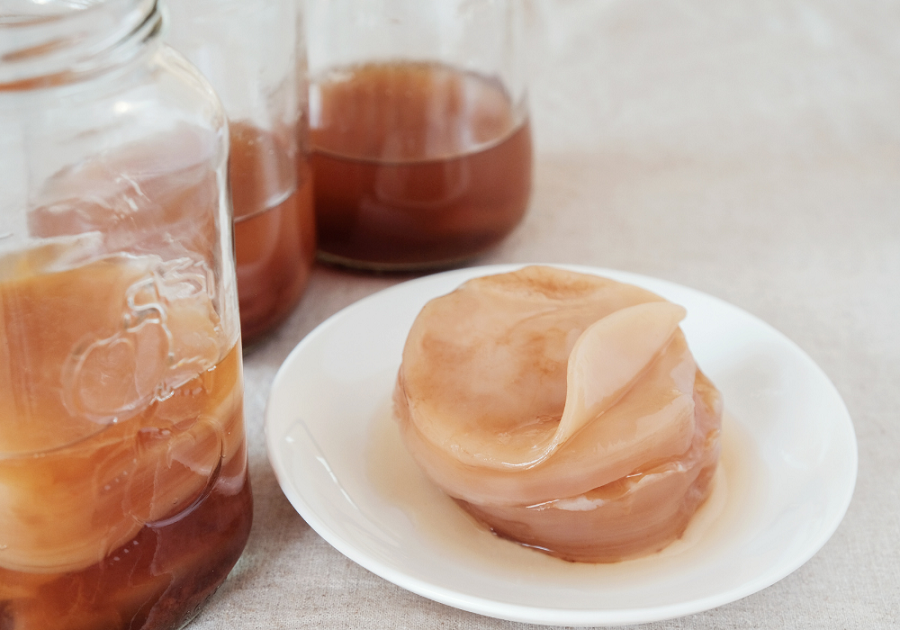
One of the best ways to avoid panicking when a jar seems contaminated is to have anticipated the situation. That’s where the idea of aSCOBY hotel comes in.
A hotel in SCOBY is simply :
This jar is not intended to produce kombucha for everyday drinking. It serves as a stem bank. You keep it:
If one day one of your fermentations becomes contaminated, you can throw it all away without hesitation, knowing that you still have it in your hotel :
When you receive a Natural Probio kombucha culture, you can :
Then, with each new generation of SCOBYs (the “babies” that form on the surface of the fermenting jars), you can decide to place some of them in the hotel rather than using or throwing them all away.
So even if one day you have an accident in a jar (mould, insects, recipe error), your line of kombucha is not lost.
Saving a stump is good. But avoiding having to save it is even better. Prevention is based on a few simple rules.
Before each new batch:
You don’t need to disinfect everything with aggressive products. Normal kitchen hygiene, rigorously applied, is sufficient in the vast majority of cases.
Use :
Avoid :
The better protected the jar, the less chance contaminants will have of taking hold.
Highly chlorinated or chloraminated water can hinder cultivation. If necessary, leave the water to stand, use a suitable filter or water with a low mineral content.
Choose simple teas, with no added essential oils, especially in the initial fermentations. Once you’ve settled into a routine with your SCOBY Natural Probio, you’ll be able to experiment more, but in the beginning, sobriety will give you the best chance of success.
Sometimes, the reality is simple: the strain is too damaged or dubious, you don’t want to take any more risks, and you decide to start again with a new SCOBY. But that doesn’t mean that everything you’ve produced so far is useless.
Kombucha that has been forgotten for too long and has become very acidic can be :
It may no longer be pleasant to drink as it is, but its acidic composition makes it a potentially interesting condiment.
Every ‘failed’ jar is also a source of information:
By pinpointing what may have gone wrong, you build the security of your future fermentations. Coupled with a healthy, robust kombucha culture, such as a SCOBY Natural Probio, this learning process quickly produces reliable routines.
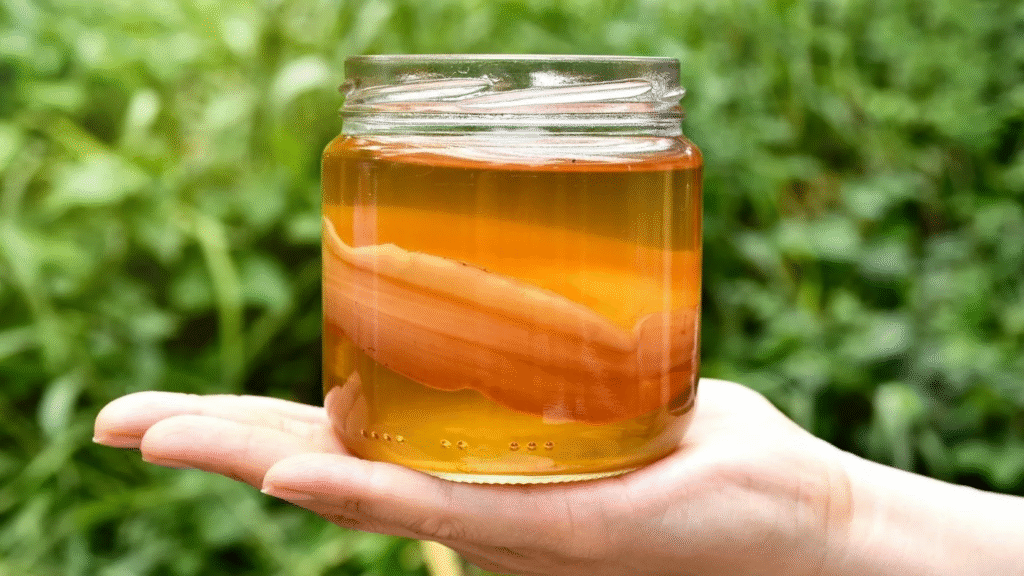
There comes a time when “saving a strain at all costs” becomes more risky than useful. That moment comes when :
In these cases, the best decision is sometimes the simplest:
This is precisely where specialist players such as Natural Probio have a role to play: providing a stable basis, accompanied by advice, so that you’re not constantly in doubt.
Starting from scratch doesn’t mean losing everything. You keep :
With this new base, you’ll have more peace of mind.
Saving a contaminated strain of kombucha doesn’t mean playing sorcerer’s apprentice in a dodgy jar. It means :
Sometimes, the best way to ‘save’ your kombucha adventure is to stop trying to save the impossible, and start again from a healthy, balanced SCOBY, such as a Natural Probio culture, knowing that this robust base will drastically reduce the risk of repeated contamination.
The next time you lift the cloth from your jar and see something that worries you, you’ll have some reference points. You’ll know when to say “stop”, when to try a recovery protocol, and when to take advantage of what you’ve learned for the next batch.
Kombucha is a living drink, and like all forms of life, it sometimes requires attention, clear choices and a bit of renewal. The most important thing is that, jar by jar, you remain confident with what you’re making… and with what you’re drinking.