
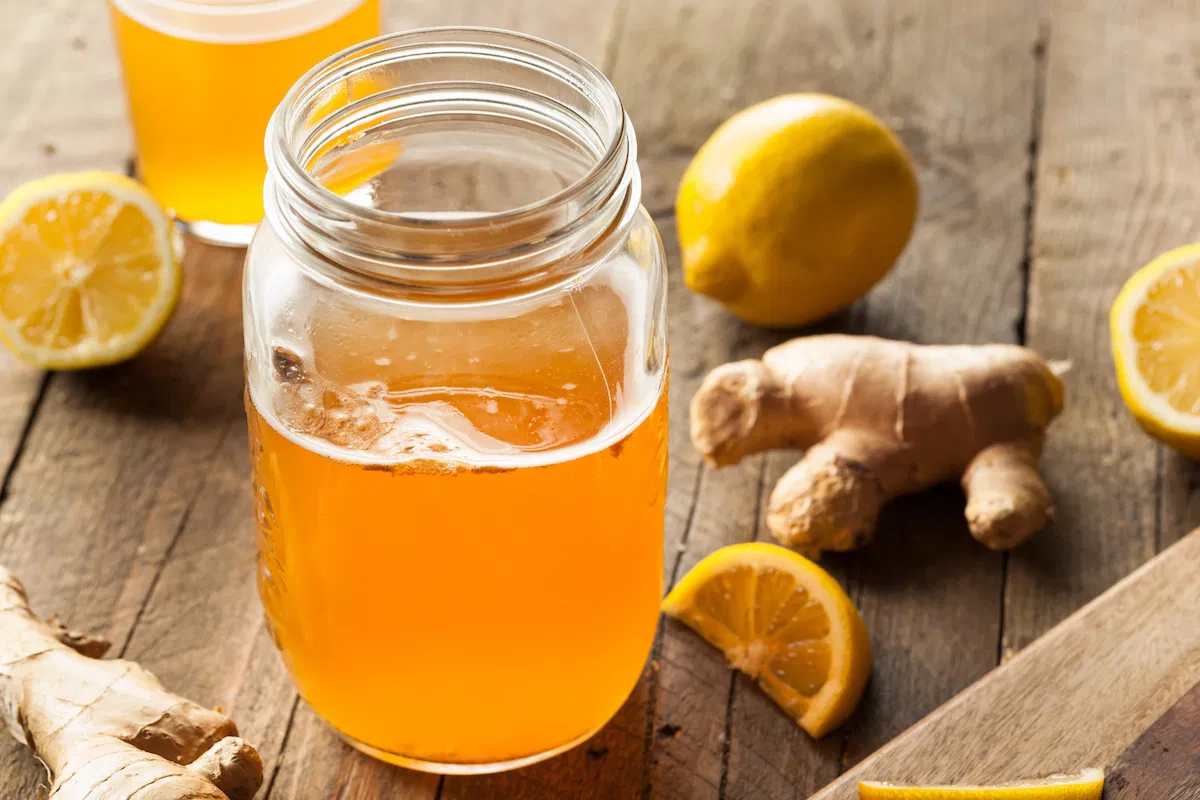
Over the last few years, kombucha has been everywhere. It can be found on organic shelves, on café menus, in non-alcoholic cocktail recipes, and even in cooking videos where we see a strange beige disc floating in a jar. This new visibility sometimes gives the impression that kombucha is simply a trend. However, behind this lifestyle image lies an ancient fermented beverage that has been prepared for generations, and which is now making a comeback because its profile fits in well with modern expectations.
Many people are interested in it for its potential benefits: better digestion, an alternative to soft drinks, support for the microbiota, a feeling of lightness after meals, adding variety to everyday drinks. Others see it above all as a pleasant way of introducing a fermented drink into their routine, without having to eat quantities of sauerkraut or kimchi.
It’s important to keep things in perspective. Kombucha is not a medicine, nor does it replace treatment or medical advice. On the other hand, when properly integrated into a balanced diet, it can be an interesting addition to many people’s lives, especially when prepared at home with a healthy SCOBY, such as a Natural Probio kombucha culture, which allows you to control what you put in your glass.
So let’s take a step-by-step look at what you can reasonably expect from kombucha, and how to enjoy it in a simple, practical way.
The first, very tangible benefit of kombucha is not to be found in the intestine, but in everyday life. Many people know that they drink too many soft drinks or very sweet beverages, but can’t manage to go back to plain water alone. There’s something missing in the taste, the mouthfeel, the little pleasure of the moment.
Kombucha offers a credible alternative. Visually, it looks like a fizzy drink, with an amber or golden colour. Its taste is tart and slightly sweet, sometimes flavoured with ginger, citrus or red fruit. It therefore occupies the same sensory territory as a soft drink, but with a different nutritional profile.
When you prepare your homemade kombucha with a SCOBY Natural Probio, you can adjust the fermentation time to obtain a drink that’s less sweet than a soda, while retaining that refreshing fizz that sometimes makes water monotonous for some people.
A classic soft drink is based on a simple principle: lots of sugar, gas and flavourings. The sugar adds flavour, masks the acidity, and creates a frequent return reflex. In kombucha, the sugar is present from the start, but it’s there to feed the fermentation process.
Over time, some of this sugar is transformed into organic acids. The final drink retains some sweetness, but gains in complexity. So, instead of opening a can, you can make a habit of pouring a glass of homemade kombucha, with a more moderate amount of residual sugar.
In practice, some people find that they reduce their consumption of soft drinks almost effortlessly, simply because they have bottles of homemade kombucha ready in the fridge. This simple regular replacement is already a tangible benefit to a balanced diet, regardless of any more sophisticated promises.
Kombucha is a fermented beverage. Some of the work done by the SCOBY yeasts and bacteria takes place in the jar, before you drink it. This means that the initial sweet tea is partly “pre-digested” by the culture.
The result, for some people, is a drink that is easier to tolerate than a very sweet soda or a large quantity of fruit juice. The acidity and organic acids produced sometimes give the impression of a smoother digestion, especially when kombucha is consumed:
Obviously, every body reacts differently, and it’s important to test gradually. But the fact that kombucha is already a product of controlled fermentation changes the way the body perceives it.
Many people who add kombucha to their meals report a feeling of lightness: less heaviness, less of a ‘block’ after a rich meal, especially when they used to replace very sweet drinks or large quantities of alcohol with a glass of kombucha.
It’s not a question of promising a magical disappearance of all digestive discomforts, but simply of noting that :
With homemade kombucha made from SCOBY Natural Probio, you can also tailor the drink to your tolerance: more or less acidic, more or less fizzy, more or less flavoured. This possibility of personalisation helps you to find a profile that’s really comfortable for you.
The microbiota has been at the heart of health news in recent years. We now know that an intestine well-stocked with a diversity of micro-organisms is linked to many aspects of well-being. In this context, fermented foods are once again playing a natural role in our diet.
Kombucha is part of this family. When it is unpasteurised and prepared at home with a live SCOBY, it still contains yeast and bacteria in suspension. It is not the only food to play this role, but it provides an additional source of micro-organisms, in a liquid form that is easy to integrate.
However, it is important to avoid two pitfalls. Kombucha :
It can be seen more as a routine complement: a regular glass of homemade kombucha, combined with food choices that are generally favourable to the microbiota, helps to maintain a dynamic intestinal environment.
Everyone finds their own balance. Some people already eat yoghurt, kefir and lacto-fermented vegetables. Adding kombucha allows you to :
A homemade kombucha prepared with SCOBY Natural Probio fits in well with this idea of diversity. You can adjust the frequency of consumption over the weeks to see what suits you, without trying to revolutionise everything at once.

Part of the problem with hydration is simply boredom. Many people know that they don’t drink enough water, but don’t naturally feel the urge to pour themselves a glass of still water several times a day.
Kombucha, especially when homemade, becomes a pleasant way to hydrate. It’s no longer just a case of “I have to drink”, but “I want that sparkling, slightly tangy taste”.
For example :
In any case, having this drink on hand often helps to naturally increase the total volume of fluid drunk, which is good for the body as a whole.
Another interesting aspect is the time spent with family and friends. Kombucha is an option for :
By placing a bottle of Natural Probio homemade kombucha on the table, you offer a choice that can satisfy both those curious about new flavours and those looking for lighter options.
High-sugar drinks, consumed in large quantities, can cause rapid variations in blood sugar levels. You feel stimulated for a moment, but then the curve drops again, leaving you feeling low, tired or lacking concentration.
Kombucha, especially when sufficiently fermented to contain less sugar, is different. The sugar intake is more moderate, the acidity gives an impression of tonicity, and the drink does not set off the same energy rollercoaster as a very sweet drink.
Without promising a spectacular ‘boost’, it’s fair to say that replacing high-sugar drinks with kombucha on a daily basis helps to stabilise the way you feel about your energy levels throughout the day.
Because kombucha is made from tea, it contains caffeine (or theine). Fermentation does not completely eliminate this molecule. As a result, after a glass of kombucha you may feel a slight sensation of clarity and concentration, comparable to that of tea, but with a different texture.
For people who are sensitive to caffeine, it is a good idea to :
With a SCOBY Natural Probio, you can experiment with different types of tea, while maintaining a stable culture, and observe how your body reacts.
The benefits of kombucha are not just measured in grams of sugar or lists of micro-organisms. They are also to be found in the act itself.
Making homemade kombucha with a SCOBY is :
This contact with living fermentation reintroduces a kind of presence to time and processes in the kitchen. Many people describe this moment as a ‘ritual’, a parenthesis in what are often very numerical days, which creates a different relationship with what we drink.
Filling a glass with kombucha, knowing that it has come from your jar, your SCOBY, your tests, brings a satisfaction that goes beyond the simple content of the glass. You’re no longer just a consumer, you’re a player.
This is also one of the aims of Natural Probio: to provide quality kombucha cultures that enable everyone to achieve successful fermentations without having to improvise with uncertain strains. By starting with a healthy SCOBY, you can concentrate on learning, tasting and adjusting, rather than on the survival of a fragile culture.
This psychological dimension is not a ‘health benefit’ in the strict sense, but it is a very real part of the pleasure of making kombucha part of your daily routine.
Although kombucha may be less sweet than a soft drink, it does contain sugar, to a greater or lesser extent depending on the length of fermentation. It also contains traces of alcohol, produced by yeast and then partly transformed by bacteria.
This means that kombucha :
Here again, preparing your kombucha at home with a SCOBY Natural Probio gives you the chance to pay close attention to the fermentation parameters, the taste and the sensations, rather than drinking a drink whose dynamics you are completely unaware of.
As with any fermented food, reactions to kombucha are personal. Some people quickly feel at ease, while others need to introduce the drink more gradually, in small quantities, especially if they hardly ever consumed fermented products before.
It may be useful to :
If you’re undergoing treatment, or have any specific medical conditions, it’s always a good idea to talk to your healthcare professional, who will be able to put kombucha in its proper context.

All the potential benefits mentioned above are based on a simple starting point: quality kombucha, fermented regularly, with controlled parameters. If each batch is completely different because the strain is unstable, it becomes difficult to build a habit or understand what you’re experiencing.
This is where the origin of your crop makes a real difference. A SCOBY Natural Probio:
This stability makes the idea of ‘benefits’ over time more credible. You’re not juggling a completely different drink with each jar, you’re gradually refining your recipe until you find what suits you.
Knowing that the culture is healthy and suitable for kombucha takes a lot of the stress away. You no longer have to wonder if your SCOBY is “really made for it”, if it comes from an industrial bottling, or if it’s too weakened. You can concentrate on :
This shift from worry to pleasure is a benefit in itself. Drink ceases to be a source of tension and becomes an everyday companion.
Finally, here are a few simple ideas for enjoying the benefits of kombucha on a daily basis, without making it a totem or an obligation.
Drink a small glass of kombucha:
The key is to incorporate it where it replaces less desirable habits, rather than simply adding one more glass to a day that’s already full of calorie-packed drinks.
With a homemade kombucha prepared with SCOBY Natural Probio, you keep control of all the parameters that count: residual sugar, acidity, fizz and flavour. In this way, you can make kombucha an ally that’s both indulgent and sensible, and whose potential benefits are long-lasting, in harmony with the rest of your diet.
Kombucha doesn’t solve everything, but it can, jar by jar, subtly transform the way you drink, digest, share and live in your kitchen. And it’s often these simple, repeated transformations that end up making the real difference.