

When you first discover kombucha, there’s always a moment when you come across this strange word: SCOBY. Sometimes it’s pronounced ‘scobi’, sometimes ‘skobi’, and you’ll see it written on recipe cards, on specialist websites or on bags of kombucha cultures. But until you see a SCOBY for yourself, it remains abstract, almost mysterious.
Then comes the first encounter: at the bottom of a jar of sweet tea, we discover a gelatinous, beige, slightly translucent disc, floating or sinking. Some find it fascinating, others a little disconcerting. Yet this disc is the heart of the whole process: without it, you can’t really ferment kombucha at home.
Understanding exactly what a SCOBY is, what is normal about its appearance and what is not, what it does during fermentation and how to live with it on a daily basis is the basis for preparing a serene homemade kombucha. It’s also what makes it possible to choose a quality kombucha culture, such as those offered by Natural Probio, rather than taking a chance with a fragile strain picked up at the corner of an industrial bottle.
SCOBY stands for Symbiotic Culture Of Bacteria and Yeast. In French, it means symbiotic culture of bacteria and yeast. This expression sums it all up.
A SCOBY is not a fungus in the traditional sense, nor is it simply a “skin” covering the tea. It’s a community of micro-organisms that live together and cooperate:
This matrix forms the famous gelatinous disc that floats on the surface of the jar. The SCOBY is therefore not just an inert object; it is the ‘home’ and structure of this community, the visible result of the activity of the culture.
The term symbiotic reminds us that yeast and bacteria do not work separately. They do each other mutual favours:
This system creates a relatively stable environment for growing kombucha. It’s this stability, built up over generations of SCOBY, that makes the difference between a robust strain from a long, well-maintained line (like those used by Natural Probio), and a hesitant strain started from a bottle of industrial beverage with little activity.
When you open your kombucha jar and look inside, a healthy SCOBY usually looks like :
The thickness varies according to the age of the culture and the number of fermentations: a young SCOBY is thin, almost transparent; an older SCOBY becomes thicker, sometimes consisting of several superimposed layers.
It’s normal for a SCOBY not to be perfectly round or perfectly uniform. It’s not a factory-made object but the result of organic growth, in your jar, at your temperatures, with your water and your tea.
A question that often comes up is whether a SCOBY should float or sink. In reality, both situations are normal:
What counts is not the position of the SCOBY, but the general activity of fermentation: the formation of bubbles, the appearance of a new film on the surface, changes in the taste of the kombucha. A sinking SCOBY is not a “failed” SCOBY; it’s simply a denser SCOBY, while a new disc is often being prepared at the very top.
Without SCOBY, sweet tea remains a simple mixture of tea and sugar. As soon as you introduce kombucha culture, everything changes:
The SCOBY is the driving force behind fermentation. It provides the initial population of yeasts and bacteria that will transform the sweet tea into kombucha. Without this culture, fermentation would be uncertain and even risky, as other micro-organisms could take hold.
During fermentation, a fascinating phenomenon occurs: a new layer of SCOBY forms on the surface of the jar. Gradually, a very thin film appears, then thickens to become a new “pancake” of kombucha.
This leaves us with :
This ability to constantly renew itself makes SCOBY an organism that can be passed on, shared and multiplied. It’s also what makes it possible to start several jars from the same original strain, as long as the culture is healthy and well maintained.
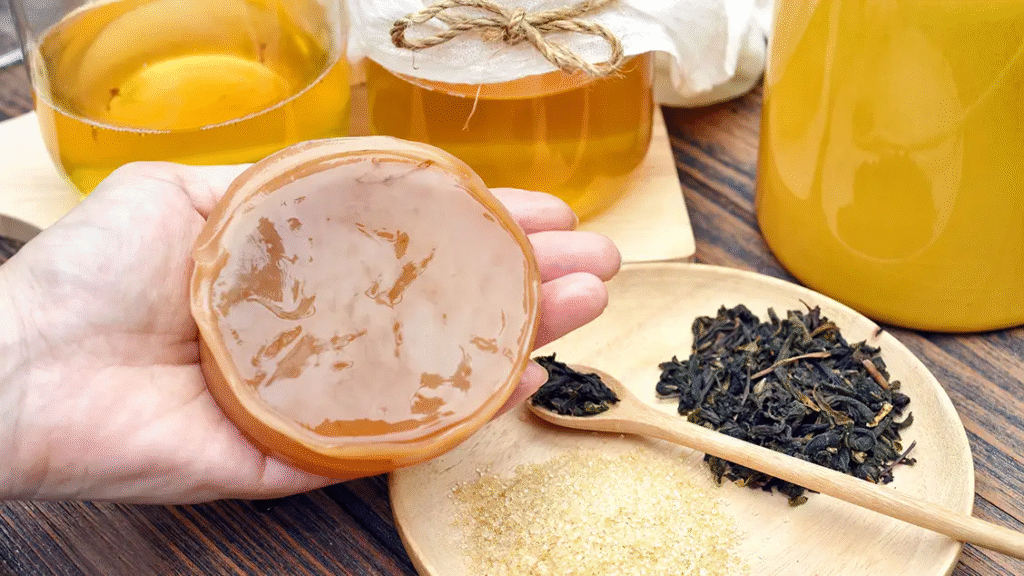
When you receive a kombucha starter kit, you’ll usually find :
It is important to understand that the culture is not limited to the gelatinous disc. The liquid that accompanies it also contains a significant quantity of yeast and bacteria. The two are complementary.
In practice, when preparing a new jar of kombucha :
That’s why a good culture kit, like those offered by Natural Probio, provides not just a dry disc, but a living SCOBY, immersed in its kombucha mother, ready to sow a new volume of sweet tea.
Some beginners think that the disc alone is enough to start fermentation. In reality, the starter plays a crucial role:
So when we talk about SCOBY, we’re really talking about a whole: the disc + the liquid. The two form a single kombucha culture, in two different forms.
Through successive fermentations, a SCOBY can become very thick. Each new batch of kombucha adds an extra layer, stacked on top of the previous ones. You can then :
This stratification logic explains why some SCOBYs seem to have several “floors”: they are simply successive generations, welded together more or less firmly.
When starting a new fermentation with a healthy SCOBY :
This baby SCOBY will then serve as the new culture for the next jars. In some cases, it separates naturally from the layer underneath; in others, you help it a little by gently peeling it off with clean hands.
A healthy SCOBY generally presents :
The resulting kombucha should taste somewhere between a slightly sweet tea and an acidic drink such as sweet cider or light vinegar, depending on the length of fermentation.
Many things surprise beginners when they are perfectly normal, for example:
As long as the smell remains pleasant (acidic, but not putrid), the colour is not overtly green, black or fluffy, and the taste develops normally, the SCOBY generally does its job.
However, there are some warning signs:
In such cases, to be on the safe side, it is advisable to discard the SCOBY and the liquid, clean the jar thoroughly and start afresh with a healthy culture. Having a reliable source of SCOBY, such as a Natural Probio kit, means you can start afresh with a clean slate.
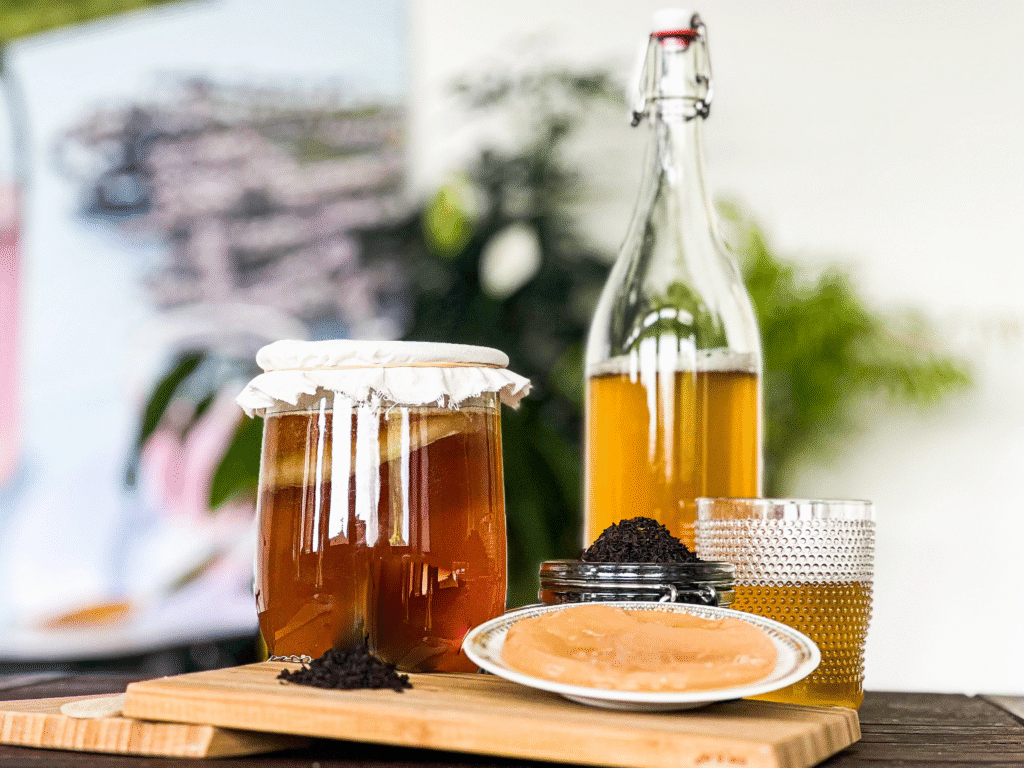
Historically, SCOBYs of kombucha were handed down like sourdough bread:
Each lineage has its own particular characteristics, the result of a blend between the original culture and the environment in which it evolved (water, tea, temperature, frequency of fermentation).
When you get a SCOBY, you get a history of fermentation, with characteristics that have taken time to stabilise. That’s why the provenance of the crop is so important: the more rigorously it comes from a carefully nurtured line, the more robust it is likely to be.
You can sometimes try starting a SCOBY from a bottle of store-bought kombucha, as long as it’s unpasteurised and unfiltered. But the results vary greatly:
So you end up with capricious fermentations, fragile SCOBYs and doubts about the composition of the culture.
On the other hand, choosing a SCOBY kombucha from a maintained and tested line, such as those offered by Natural Probio, gives you a solid base from the outset, with a tried and tested yeast/bacteria balance. This makes the first steps much easier and reduces the stress associated with failed attempts.
The term “kombucha mushroom” is sometimes used. This term is a historical shortcut, but it can be confusing. SCOBY is not a mushroom like a button mushroom or a single yeast: it is a community of varied micro-organisms, housed in a cellulose matrix.
It used to be simpler to say “mushroom”, but it’s better to keep in mind the modern definition: symbiotic culture of yeast and bacteria.
A very thick SCOBY is not necessarily better. It simply indicates that the culture has built up layers over time. A thin, young SCOBY from a healthy strain can produce excellent kombucha, as long as the fermentation conditions are well managed.
It is often more practical to work with a SCOBY that is the right size for your jar, rather than a huge mass that is difficult to handle. Hence the importance of separating the layers regularly and keeping the most harmonious ones for active fermentation.
This is one of the most common misinterpretations. Sinking is not a sign of death. It’s a question of relative density in relation to the liquid. A perfectly active SCOBY may be at the bottom, while a new film forms quietly on the surface.
To find out if your culture is alive and kicking, check out :
Buoyancy is simply a physical characteristic, not a health diagnosis.
Having a SCOBY at home is a bit like looking after sourdough or a plant: it’s not complicated, but it does require a certain amount of regularity. Over time, you develop a routine:
The more you repeat this sequence, the more natural it becomes. That’s another reason why clear explanations and practical advice, such as that provided by Natural Probio, are invaluable: they avoid months of trial and error.
When faced with a SCOBY, it’s tempting to worry about the slightest detail. But the most important thing is toobserve calmly:
Once you’ve got used to it, you’ll realise that a SCOBY is tougher than it looks, as long as you follow a few basic rules: keep your equipment clean, make sure your tea is properly cooled before introducing the culture, and avoid aggressive products or extreme temperature variations.
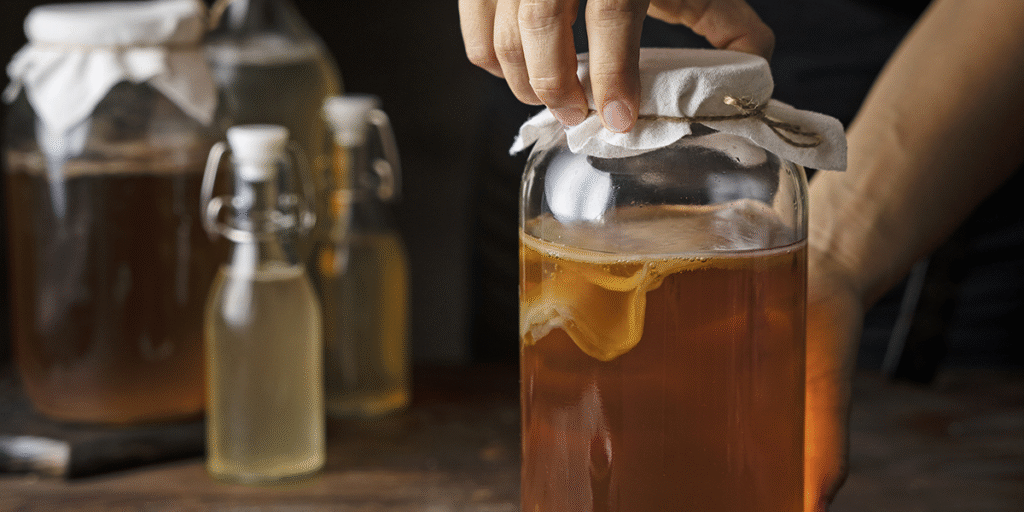
A SCOBY of kombucha is not just a gadget to decorate the bottom of a jar. It’s a real fermentation partner, a living culture that :
Knowing exactly what it is allows us to look at it differently: no longer as a strange and slightly worrying mass, but as an ally with whom we can learn to collaborate.
To sum up, remember this:
By choosing a healthy, well-maintained kombucha SCOBY, supplied with a suitable starter liquid and clear advice like that provided by Natural Probio, you’re giving yourself a reliable starting point. The SCOBY then becomes the companion of a fermenting adventure that can last for years, with litres of homemade kombucha at the end of the day and the pleasure of keeping a culture… very much alive.