
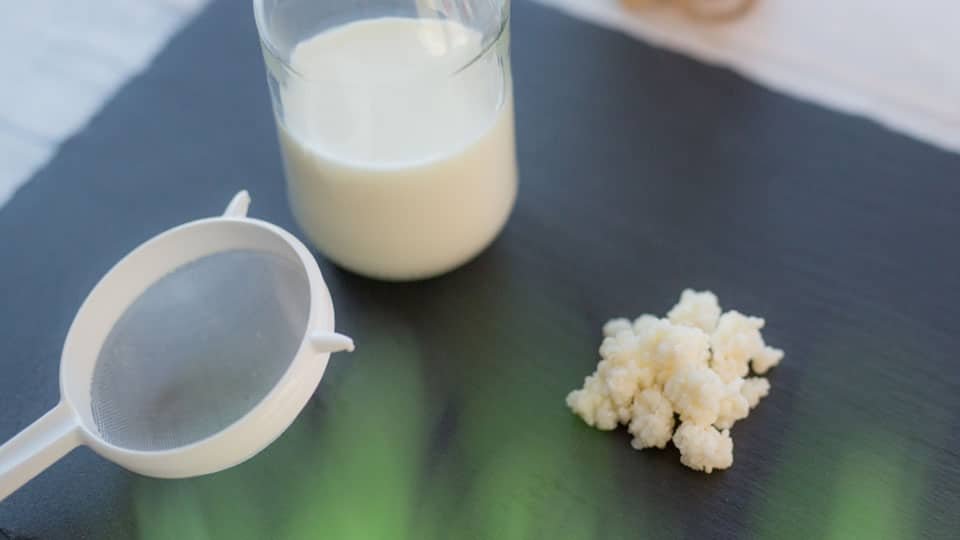
When you start making milk kefir, the first question that comes up after measuring the grains is almost always the same: which milk should you use? And very quickly, this question turns into a long list of doubts. Whole or semi-skimmed milk? Raw or pasteurised milk? Cow’s, goat’s or sheep’s milk? And what about plant milks? Will the grains survive? Will it taste good? Will the texture be right?
These questions are normal. Milk is not simply a neutral medium for kefir grains. It’s their living environment, their food, and the main factor influencing the final texture, acidity, aromas and even the speed of fermentation. Two people can use exactly the same amount of grains, at the same time, in the same room, and get very different results simply because they’re not using the same milk.
In this comprehensive guide, we’ll take stock of the situation without cutting corners. We’ll compare the different types of milk used for milk kefir, explain how each influences fermentation, and above all help you choose the milk best suited to your goals: mild or stronger flavour, fluid or thick texture, easy digestion, simple daily routine or more advanced experimentation.
And if you’re keen on home fermentations in general, you should know that many kefir lovers also like to vary with other fermented drinks. For example, starting a kombucha with a reliable culture like our SCOBY Kombucha (an authentic natural kombucha strain) is the perfect way to round off a kefir routine, while exploring another family of natural fermentations.
If you’re new to milk kefir and want a stable, simple and predictable result, the safest choice is still whole cow’s milk, preferably unflavoured and with no additives.
Whole milk offers a good balance between sugars (lactose), proteins and fats. This balance allows the kefir grains to work comfortably, without stress, and results in a kefir that is generally smoother, more stable and easier to adjust.
This doesn’t mean that other milks don’t work. But whole cow’s milk is often the most tolerant of small errors in dosage or duration, especially when you’re learning.
Kefir grains feed mainly on the lactose present in milk. When they consume it, they produce lactic acid, carbon dioxide, aromatic compounds and a small amount of alcohol. The composition of the milk directly influences this activity.
Milk rich in lactose and protein provides a favourable environment for regular fermentation. Conversely, milk that is low in sugars or highly processed can slow down fermentation and even weaken the grains over the long term.
The texture of kefir depends very much on the partial coagulation of milk proteins during fermentation. Fat also plays a role in giving a rounder mouthfeel.
This is why kefir made with whole milk will often be thicker and creamier than kefir made with skimmed milk, even though the fermentation process is identical.
As well as technique, the choice of milk is also a question of taste. Goat’s milk has stronger, sometimes more ‘animal’ notes. Sheep’s milk produces a very rich, mild kefir. Cow’s milk remains the most neutral and the most consensual.
Understanding these differences allows you to choose according to your preferences, not just theoretical rules.
Whole cow’s milk is the most commonly used for milk kefir, and that’s no accident. It contains enough lactose to feed the grains properly, and enough fat to give a pleasant texture.
With this milk, fermentation is generally regular. Kefir gradually thickens, developing balanced acidity and a mild flavour. It’s the ideal choice for daily consumption.
If you’re looking for a simple, repeatable routine, this is often the best place to start.
Semi-skimmed milk also works very well for kefir. Fermentation is straightforward, but the texture is generally a little more fluid. The flavour can be slightly more acidic, as there is less fat to round out the acidity.
Many people appreciate this lighter result, especially if they drink kefir every day.
Skimmed milk is possible, but requires more attention. Fermentation works, but kefir is often more liquid and can separate more quickly.
This type of milk is recommended for people who already know how to adjust their fermentation or who are looking for a very light kefir, more like a drink than a thick fermented milk.
Raw milk can produce a very rich and aromatic kefir, as it contains its own natural flora. However, it requires impeccable hygiene and a good knowledge of fermentation.
Pasteurised milk is more stable and predictable. For most people, it’s the simplest and safest choice, especially on a day-to-day basis.
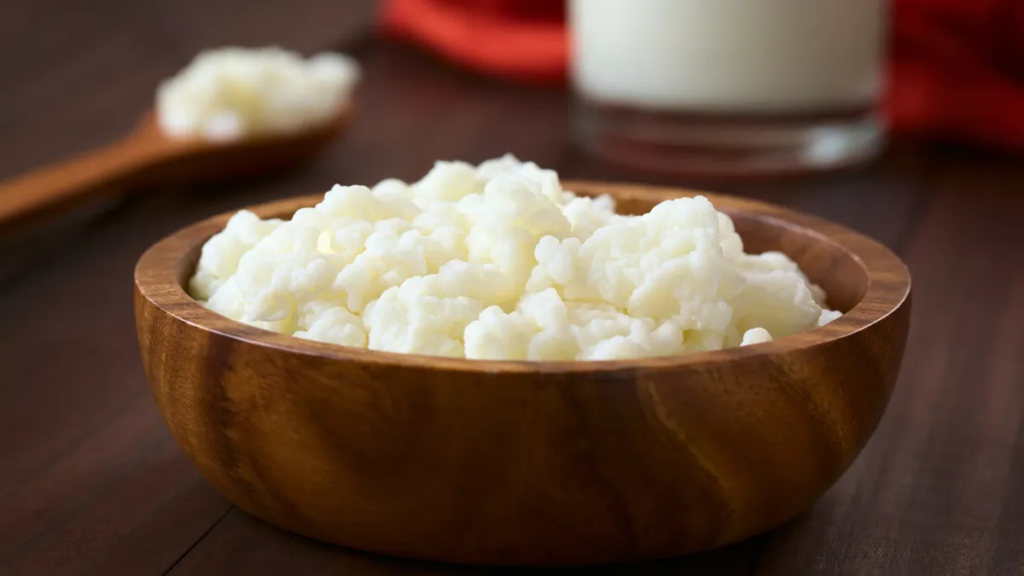
Goat’s milk produces a more fluid kefir with a stronger flavour. Even after fermentation, the texture often remains more liquid than that obtained with whole cow’s milk.
The taste is more distinctive, which is very appealing to some people, but may surprise those used to very mild kefir.
Many people who have difficulty digesting cow’s milk tolerate goat’s milk better. This is due to the different structure of the proteins and fats.
Goat’s milk kefir is often appreciated for its light digestive qualities, especially when properly fermented.
With this type of milk, it is often best to keep a close eye on fermentation. Separation can happen more quickly. Adjusting the quantity of grains and the duration is essential to avoid kefir that is too acidic or too runny.
Sheep’s milk is naturally richer in fat and protein. This creates a very favourable environment for kefir grains.
Fermentation is often regular, and the resulting texture is particularly creamy.
Sheep’s milk kefir is smooth and creamy, with moderate acidity. It is often very popular with people who like thick textures and round flavours.
The main obstacle is availability and price. But if you have access to quality sheep’s milk, it’s an excellent option for milk kefir.
Plant milks (almond, soya, rice, oat, etc.) do not contain lactose. Yet lactose is the main source of energy in milk kefir grains.
This means that the grains cannot sustainably feed on plant milk. The fermentation observed is often limited and unstable, and can weaken the grains over the long term.
You can ferment plant milk with kefir grains, but only occasionally. The best practice is to alternate: one cycle in plant milk for the taste, then one or more cycles in animal milk to ‘recharge’ the grains.
If you’re looking for a 100% plant-based fermented beverage for the long term, kombucha is often more suitable. Using a reliable culture such as an authentic strain of kombucha means you can ferment sweet tea without milk, while enjoying a lively, digestive drink.
UHT milk works for milk kefir. It is very stable, which reassures many beginners. Fermentation may be slightly slower at first, but it’s still perfectly viable.
Microfiltered milk often gives very good results, similar to fresh milk, with a good texture and regular fermentation.
Fresh pasteurised milk is often considered an excellent compromise between taste and safety. It produces an aromatic and stable kefir.
Whole cow’s milk or sheep’s milk, moderate fermentation, well-active grains.
Semi-skimmed milk or goat’s milk, shorter fermentation.
Goat’s milk or well-fermented kefir, whatever the milk, with gradual adaptation.
Pasteurised cow’s milk, easy to find and consistent.
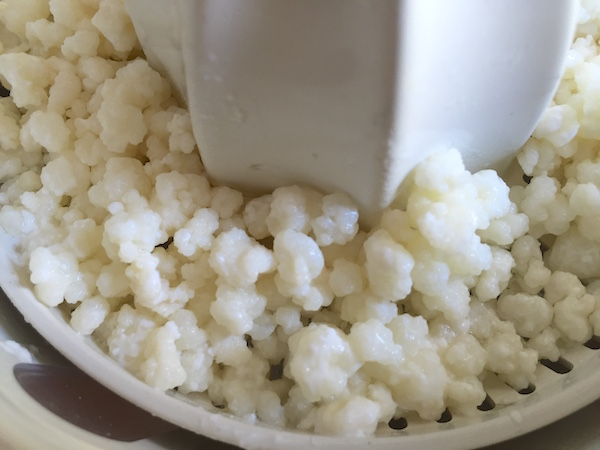
The type of milk influences the speed of fermentation. With rich milk, you can sometimes reduce the quantity of grains slightly. With lighter milk, you may need to increase the dosage slightly or lengthen the fermentation time.
The important thing is to observe and adjust. Kefir is not a fixed science, but a living practice.
Many people change milk without adjusting the rest of the recipe, and then think there’s something wrong with their grains. In reality, each change of milk requires a phase of adaptation.
It is advisable to change only one parameter at a time and to observe at least one or two cycles before drawing any conclusions.
Yes, but it’s best to avoid too sudden and too frequent changes. Alternating gradually is more comfortable for the grains.
Technically, not in the long term. It’s a one-off fermentation, but the grains need lactose to stay healthy.
In general, sheep’s milk, followed by whole cow’s milk.
Organic milk without additives is often easier to ferment, but this is not an absolute requirement.
There is no “best” universal milk for milk kefir. The right choice depends on your tastes, your digestion, your access to products and your pace of life.
To get off to a good start, whole cow’s milk is a safe bet. After that, it’s up to you to explore goat’s milk, sheep’s milk or even occasional alternatives, always keeping an eye on how your grains react.
And if you like to explore the world of home fermentation beyond kefir, discovering another living drink can be very rewarding. Starting a kombucha with our SCOBY Kombucha (a natural, authentic strain of kombucha) allows you to vary the pleasures, while remaining true to the natural, controlled approach to home fermentation.