
When you look at a bottle of kombucha in the shop and a jar of homemade kombucha on your worktop, you might think they are the same drink, presented differently. In both cases, the label or jar reads “kombucha”, the colour is the same and the promise is similar: a fermented drink made from sweet tea.
However, as soon as you look at what’s behind the word “kombucha”, the differences become apparent.
They concern :
Understanding these differences is not about drawing up a simplistic ‘match’ with a winner and a loser. It’s about learning to choose consciously. Industrial kombucha offers useful convenience and standardisation. Homemade kombucha, when made with a healthy SCOBY such as a Natural Probio culture, offers a different relationship to the drink: more alive, more evolving, more customisable.
The first objective of an industrial kombucha brand is simple: to offer the same drink to every customer, in every shop, with every purchase.
To achieve this, the company needs to master :
An industrial kombucha is therefore designed to be :
To achieve this level of control, producers use a combination of processes: defined fermentation times, analytical controls, filtration, sometimes pasteurisation, and sometimes the addition of carbon dioxide or flavourings afterwards.
As a result, industrial kombucha looks more like a manufactured food product than a living organism left to grow in a jar.
In most cases, the process looks like this (with variations depending on the brand):
In the end, the drink is “fixed” in a given state. It hardly ever changes, even if it stays on the shelf for weeks, especially if it has been pasteurised.
From the consumer’s point of view, it’s comfortable: you know what to expect. From the point of view of fermentation, the momentum is largely over.
You might think that “kombucha = living drink” by definition. But this is not always true.
You can check this indirectly:
if the drink has been kept at room temperature for months, without any particular indication, there is a good chance that it is pasteurised or highly stabilised.
Conversely, kombucha made from a living SCOBY, such as a Natural Probio culture, is a drink that continues to evolve right up to the moment you drink it.
The process is very different in spirit:
As long as the drink remains at room temperature, the culture continues its work to some extent:
the sugar continues to decrease, the acids increase and the fizz strengthens. In the fridge, the process slows down, but never comes to a complete halt.
Homemade kombucha is therefore a living drink, in the strictest sense of the word:
the yeasts and bacteria present in the SCOBY and the liquid are still active.
As a result, two bottles from the same batch may be slightly different, depending on :
This variability may come as a surprise to people used to uniform industrial drinks. But it’s part of the artisanal nature of homemade kombucha.
With a well-balanced, selected and stabilised SCOBY (such as a Natural Probio culture), this variability remains within acceptable limits: the taste may vary, but the drink remains consistent and controlled.
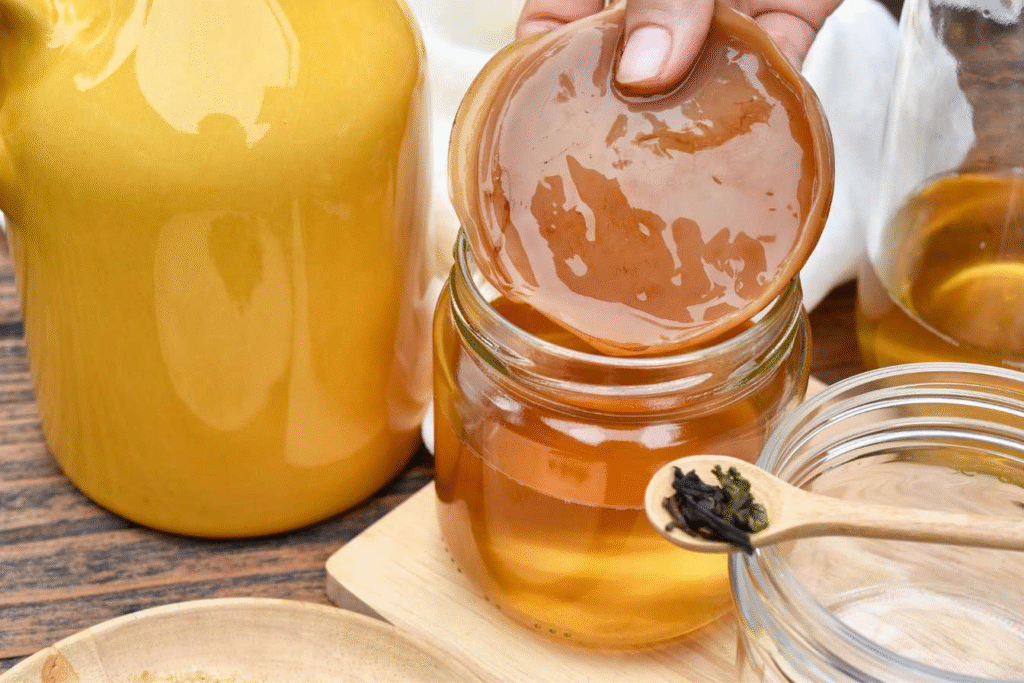
In pasteurised industrial kombucha, the microbial flora is inactivated. The drink no longer ferments or changes (or changes very little) in the bottle.
You’re drinking a fermented beverage that no longer ferments.
Even in unpasteurised kombuchas, some work has been done to limit activity:
the drink is chilled quickly, transported and stored cold, and sold with a relatively short use-by date.
In a homemade kombucha, as long as you’re working with a live SCOBY and you haven’t heated the drink :
Your kombucha is not a fixed product, but an evolving organism.
That’s why fermentation time, temperature and hygiene are so important. It’s also what gives homemade kombucha its unique character, a bit like a baker’s sourdough: you’ll never have exactly the same loaf, but you’ll recognise the “house touch”.
The sugar content of industrial kombucha is set by the brand.
It depends on the :
You can read it on the label, but you can’t change it. If you find the drink too sweet or not sweet enough, your only option is to change brands or dilute with water.
In homemade kombucha, the residual sugar can be adjusted entirely by :
Would you like a very mild kombucha for your first taste?
Stop the fermentation early.
Do you want a very lively, almost dry drink?
Let the fermentation process continue.
Working with a stable kombucha culture like SCOBY Natural Probio gives you a reliable basis for these adjustments: fermentation is more predictable, so your tests are more reproducible.
In industrial production, alcohol content is a major issue.
Above a certain threshold, the drink changes regulatory category. Brands must therefore :
This is one of the reasons why some brands shorten the fermentation process: less time, less risk of the alcohol exceeding a given limit.
In homemade kombucha, alcohol is present in trace amounts if the fermentation is classic and balanced. But it is modulated by :
With a healthy SCOBY, yeast and bacteria share the work:
the former produce the alcohol, the latter transform it into acids.
If you keep to reasonable fermentation times, in a kitchen at a moderate temperature, the content will generally remain low. But this is a point to be aware of, particularly for :
Here again, the difference is clear: industrial manufacturers have to comply with a precise legal threshold; homemade kombucha gives you more freedom, but also more responsibility.
An industrial kombucha is designed to :
It’s also very practical. You can buy a case, keep it in the fridge or cupboard, and enjoy the same drink long afterwards.
To achieve this stability, you need :
The price to pay is the loss of evolution: the drink is no longer truly alive.
In homemade kombucha, stability is relative:
This requires a minimum of follow-up:
In exchange, you get a drink that really belongs to you. With a SCOBY Natural Probio, the idea is precisely to simplify your life: the culture is stable enough so that you can concentrate on learning the time and the parameters, without fighting against a capricious strain.
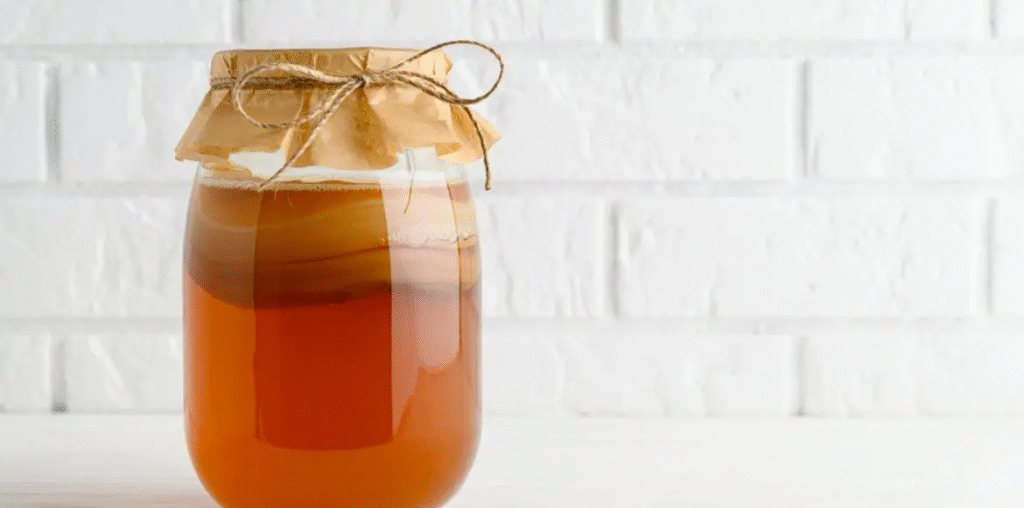
Industrial kombucha offers you :
You can change the brand or the flavour, but not the internal recipe. You don’t decide the actual quantity of sugar, tea or fermentation time. You don’t see the crop, you never touch it.
With homemade kombucha, the scope for customisation is almost limitless:
That’s where having a reliable SCOBY like a Natural Probio culture comes into its own: you no longer have to doubt your base. You can explore the variations with confidence, knowing that the culture that transforms your sweet tea into kombucha is healthy and balanced.
In general, industrial kombucha, especially pasteurised kombucha or kombucha adjusted with sweetened juices, has :
It’s pleasant, accessible and close to the codes of the modern soft drink.
Homemade kombucha:
With the right start-up culture, nuance becomes an asset rather than a flaw.
You can create a very sweet kombucha for a snack, a drier kombucha for an aperitif, a very flavoured kombucha to replace a soda, a more ‘natural’ kombucha to accompany a meal.
Industrial kombucha can be :
It is not “bad in principle”: it responds to another logic, that of a ready-to-use consumer product.
Homemade kombucha offers :
The starting point is a reliable culture. And that’s exactly what Natural Probio provides: a robust SCOBY, accompanied by its mother kombucha, so that the difference between home-made and industrial kombucha is not a vaguely unattainable dream, but a concrete experience in your own kitchen.
In the end, the big difference between homemade kombucha and industrial kombucha comes down to a simple question:
Do you prefer a stabilised, ready-to-use, standardised drink, or a living drink that you learn to tame and personalise?
Both have their place. But if you want to go from being a simple consumer to being a player in the fermentation process, to see a SCOBY Natural Probio transform a sweet tea into a tangy, fizzy drink before your very eyes, then homemade kombucha opens a door that no industrial bottle will be able to reproduce exactly.