
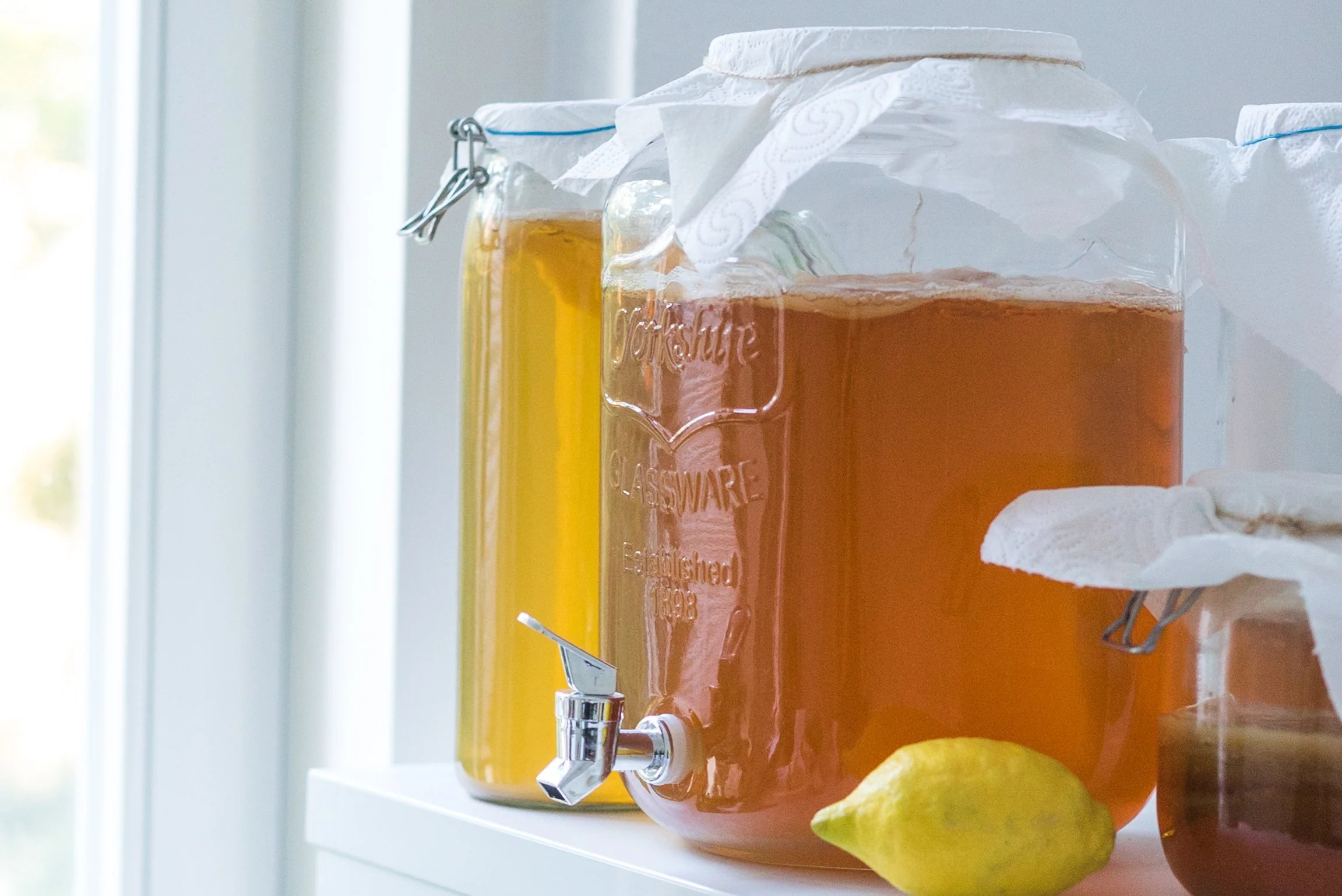
If you come across kombucha in an organic aisle, on a coffee card or on social networks, you may have the impression that it’s a ‘new’ trendy drink. The label is pretty, the flavours are modern, and the promises about microbiota and digestion speak to today’s consumer. Yet behind this contemporary presentation lies a much longer story.
Kombucha has long been part of the daily lives of families and communities who, long before the current probiotic craze, knew that a slightly acidic, fermented tea could be part of an everyday diet. Before it was aligned with the buzzwords of the moment, it was a kitchen drink, passed from hand to hand, often without a brand, without packaging, without storytelling.
Asking “Where does kombucha come from?” means tracing the history of this beverage through several continents, several eras and several names. It’s also about understanding that when you prepare a jar of sweet tea with your Natural Probio kombucha culture, you’re part of a chain of actions much longer than your first fermentation.
One of the few points on which the different historical versions agree is that kombucha is rooted in Asia, in a region where tea was already central to daily life. Without tea, there’s no kombucha. So it’s logical that this drink should have emerged where the art of infusion had already been mastered.
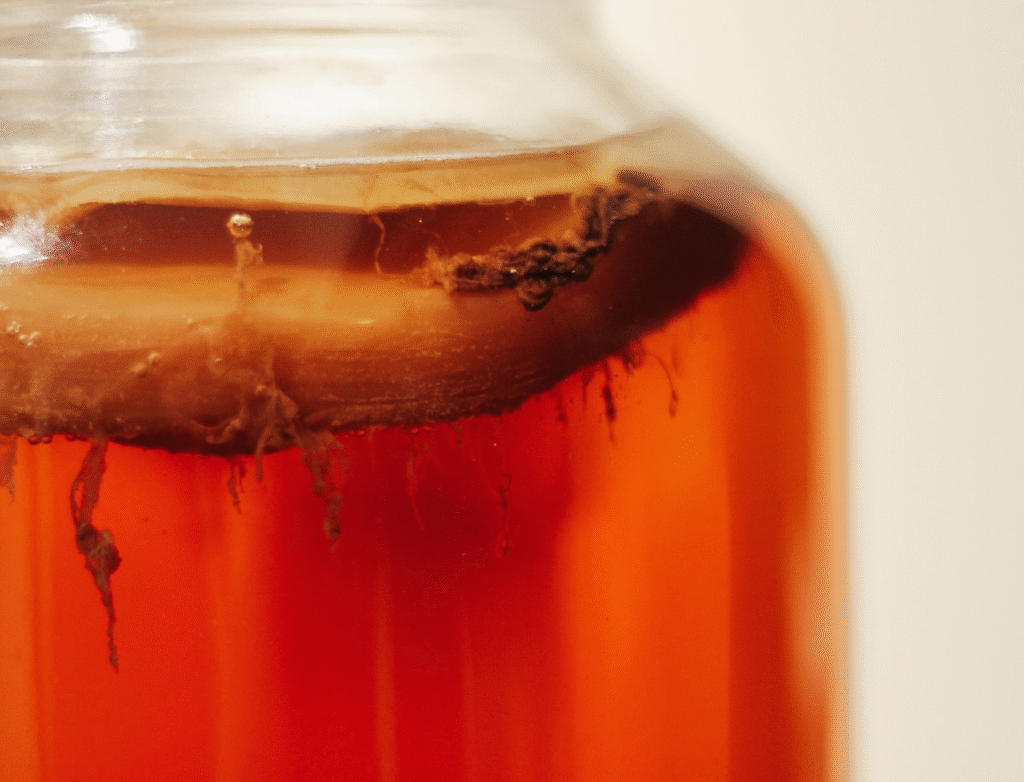
Several accounts place the birth of kombucha in north-east China, in Manchuria, several centuries ago. Here, tea infusions were prepared and given time to ferment, in the presence of a culture of yeast and bacteria that gradually developed into SCOBY. At the time, of course, we weren’t yet talking about “SCOBY” or “microbial symbiosis”, but we did observe that a gelatinous disc appeared on the surface, and that this disc enabled the preparation to be restarted in a new container.
It is assumed that these fermented tea-based beverages were appreciated for their acidic taste, for being “safer” than poorly preserved raw water, and for the invigorating effect they seemed to provide.
As is often the case in Asia, drinks that are a little out of the ordinary are surrounded by stories of varying degrees of legend. Kombucha is no exception. Some texts popularised in the 20th century mention a doctor named “Kombu” who brought the drink to an ailing emperor, which would explain the name “kombucha”. Other accounts speak of “longevity tea”, an imperial drink reserved for a privileged few.
It is difficult to verify these stories in detail. What we can say, however, is that kombucha is sufficiently old to have become part of oral tradition and to have been associated, at one time or another, with promises of vitality and health. Understanding this helps to put its current presentation as a ‘wellness innovation’ into perspective: for many Asian families, it was simply an everyday drink, part of a more global vision of diet.
When kombucha is placed in the Asian context, it is naturally part of a long series of fermented preparations:
There was nothing extraordinary about the idea that a food could be left to ferment, under controlled conditions, to develop its flavour and texture. So growing kombucha was not an isolated curiosity, but just another variation on the general theme of fermentation.
Today, when you watch your SCOBY Natural Probio floating on the surface of a sweet tea, you are reproducing, in a modern domestic version, what generations of Asian families have already done with their own strains, often without even giving it a specific name.
Over time, trade and population movements have taken kombucha out of its Asian cradle. One of the major stops on this journey was Russia and several Eastern European countries. Here too, fermentation was already part of eating habits, notably with kvass, a drink made from fermented bread or cereals.
Kombucha fits into this landscape as a tea-based variant. It is known by various local names, sometimes related to kvass because of its fermented nature. It can be found in kitchens, on windowsills, in glass jars where gelatinous discs can be seen floating. Families pass on the strain, nurture it, feed it sweet tea, then share litres of the drink over the months.
In this context, kombucha is not a niche drink. It’s a familiar presence, in the same way as other fermented preparations popular in the region.
One of the reasons why it is difficult to write a precise history of kombucha is its profoundly domestic nature. There are few detailed records of it in official or scientific documents prior to the twentieth century, not because it didn’t exist, but because it was relegated to the category of everyday necessities.
On the other hand, there are testimonies from people who talk about the jars of fermented tea prepared by their grandparents or great-grandparents, the stumps of kombucha that were passed from one neighbour to another, and the way in which this drink was integrated into the table.
This informal, word-of-mouth approach is very similar to the way many people discover kombucha today: not through an academic treatise, but because a friend, colleague or family member hands them a jar and says “Would you like a piece of my kombucha culture?
At the beginning of the 20th century, kombucha began to appear in certain European texts, particularly in Germany. Doctors and biologists became interested in this unusual drink, which was acidic, slightly fizzy and linked to an intriguing gelatinous disc. Work is being carried out to try and identify the micro-organisms involved, understand the chemical composition of the liquid after fermentation, and document any possible effects on health.
This work remains ad hoc, often driven by scientific curiosity rather than a genuine industrial project. However, they already show that kombucha is circulating beyond the domestic sphere. It is no longer just a kitchen drink, it is becoming an object of study, an interesting case study for exploring the relationships between yeast, bacteria and sugary substrates.
Over the course of the 20th century, kombucha experienced several waves of limited popularity in Europe. At times, it was presented as a health drink, sometimes with exaggerated promises. It can be found in naturopathic circles, in certain alternative communities, or in the homes of individuals curious about fermentations.
But these waves are often fragile. They are based on relatively small networks, with no real large-scale commercial structure. Kombucha circulated, disappeared and came back again, according to the interests and fashions of the time.
The generations who lived through these first waves sometimes remember the “tea mushroom” that used to sit on a sideboard or in the larder. For them, seeing the word kombucha on a modern can is nothing totally new. Rather, it’s proof that what used to be done discreetly at home now appeals to a much wider audience.
The rise of soft drinks and industrial beverages in the second half of the 20th century considerably changed the landscape of everyday beverages. In many countries, the arrival of lemonades, colas and other aggressively marketed ready-to-drink beverages meant that homemade preparations took a back seat, as they were seen as less practical, less ‘modern’ and sometimes associated with a rural lifestyle that people wanted to leave behind.
Kombucha has not been immune to this trend. In many homes, the jar of fermented tea has given way to colourful, standardised bottles. For a time, fermentation in the kitchen seemed like a relic of the past, something we were abandoning at the same time as we adopted fridges, tins and processed products.
However, the practice has never completely disappeared. In some families, people have continued to feed the SCOBY, to prepare a fermented tea from time to time, without trying to make it a flag of identity. Kombucha has become a thing of the past, but it has survived in kitchen corners, childhood memories and recipe books.
It was this partial memory that made it easier to return to the drink later on: when people started talking about kombucha again, some replied “Oh yes, my grandmother used to make that”.
From the 1990s onwards, and especially in the early 2000s, a number of trends converged:
Against this backdrop, kombucha is an ideal candidate for a comeback. It ticks several boxes at once: fermented beverage, alternative to soft drinks, related to tea, easy to prepare at home for those with a living culture. Entrepreneurs are starting to turn it into a commercial product, first on a small scale, then in an increasingly structured way.
The United States played an important role in this phase. Small kombucha brands developed, then became truly national players. Kombucha found its way into organic grocery shops and then into supermarkets. It comes in a multitude of flavours: ginger, lemon, red fruit, spices and aromatic plants.
With the export of these brands and the circulation of ideas via the internet, kombucha is once again leaving its geographical area of origin and establishing itself in many countries. At the same time, the practice of making kombucha at home is picking up again, supported by blogs, videos, workshops and fermentation communities.
It was at this point that a number of players specialising in live cultures began to emerge, including online shops offering SCOBYs of ready-to-use kombucha, complete with advice. Natural Probio is precisely part of this dynamic: making quality home-made kombucha available, without forcing everyone to ‘cobble together’ their own strain from uncertain bottles.
Today, in many European countries, kombucha occupies a rather special place. It can be found in :
It straddles the worlds of well-being, artisanal cuisine, mixology and nutrition. It can be presented as a pleasure drink, a ‘health’ potion, a gastronomic curiosity or a simple fermented refreshment.

As kombucha is a fermented beverage, there are a number of practical issues to consider:
Some kombuchas sold in bottles are pasteurised to make them easier to keep, which partially inactivates the living flora. Others are kept ‘raw’, with fermentation still present, but require a cold chain and rapid turnover in the shop.
For homemade kombucha, which you prepare with your SCOBY Natural Probio, these constraints are different: you are not industrialising a drink, but managing a small ecosystem in your kitchen. You can fine-tune the length of fermentation, the level of residual sugar, the fizz and the flavours, without trying to standardise excessively.
Knowing that kombucha comes from Asia, that it travelled through Russia, that it was prepared in European kitchens long before it reached the shelves, changes the way we look at it. It ceases to be just a trendy product and becomes what it has always been: a living heritage passed down through successive cultures.
Your SCOBY was not born in some abstract laboratory. It is part of a line of micro-organisms that have been able to live together, grow stronger and adapt to a variety of environments. By feeding it sweet tea and letting it work, you’re taking part in this story.
That’s why Natural Probio insists on the quality and stability of its kombucha cultures: having a healthy SCOBY from a well-maintained line means having the means to continue this heritage in good conditions, without starting from scratch with a fragile strain.
Once you understand where kombucha comes from, it’s easier to make the connection between :
The Natural Probio blog articles will help you put this into practice: once you’ve understood what kombucha is as a whole and what a SCOBY is, discovering its history will give you a framework. The next subjects, focusing on the composition of the culture, the difference with vinegar mother, managing fermentation problems or creating a SCOBY hotel, will go into more technical detail, without losing sight of this cultural dimension.
Industrial drinks are designed to be the same all year round, ready for immediate consumption. Kombucha, on the other hand, takes time. You have to let the culture work, accept that the taste on day 4 is not the same as on day 8, that the acidity increases, that the fizz develops.
This notion of taking a long time is even better explained when you look at the history of the drink: for generations, no one expected kombucha to be ready “straight away”. People knew that fermentation had to be allowed to take its course, that patience was part of the recipe.
Today, as part of this tradition, you are reintroducing a slower form of temporality into your cooking. Natural Probio helps you to get to grips with this rhythm by providing concrete guidelines, but the spirit remains the same: let a living organism work at its own pace.
In traditional cultures, losing a strain of kombucha meant losing an important part of everyday life. The culture was looked after, fed regularly, protected from contamination and sometimes kept several copies to prevent it from disappearing.
Nowadays, it’s easier to acquire a new culture, but this ease should not make us forget the importance of quality. Choosing a Natural Probio kombucha culture means returning to the idea that the strain counts at least as much as the recipe. Behind each disc you receive, there is a work of selection and maintenance that continues this ancient preoccupation.

The slightly tart, fizzy kombucha you’re tasting today, prepared with SCOBY Natural Probio, is not an isolated invention of the 21st century. It’s the result of a long journey:
Knowing this history doesn’t make kombucha any more ‘magical’, but it does make it more human. It ceases to be a simple product and becomes a thread that links your kitchen to those of families from other times and other countries.
By offering you quality kombucha cultures and developing a series of educational articles, Natural Probio is following in its footsteps: extending an ancient story by making it ready to live in today’s kitchens, with clear guidelines, practical advice and the freedom to experiment.
The next time you lift the lid on your jar and see your SCOBY floating on the surface, take a moment to think about it. This discreet record may be your first crop. But behind it, there have been many others. And with a little care, there will be many more after you.