
If there’s one question that divides people almost as much as « how long to ferment for », it’s this: should you rinse the milk kefir grains? There’s conflicting advice everywhere. Some swear you should rinse regularly « to clean » and avoid odours. Others say the exact opposite: don’t rinse at all, as it weakens the grains and upsets the balance of the culture.
The confusion stems from a very simple point: milk kefir grains are not a simple ‘object’ to be washed like a sieve. They are a living community, structured in a gelatinous matrix. What you call a « grain » is actually a biological medium in which lactic acid bacteria and yeasts live, feed, protect and rebalance themselves. When you rinse, you’re not just removing residues. You’re acting on their immediate environment. Sometimes this is useful. Often it’s useless. And sometimes it’s downright counter-productive.
This guide will answer the question without dogma. We’ll distinguish the myth from the real need. We’ll explain what happens when you rinse, when it’s better not to, what are the rare situations where rinsing can help, and what gentler alternatives exist for keeping grains healthy over the long term.
And because many people who make kefir also love to explore other homemade fermentations, we’ll slip in a few points of « fermentation » logic that also apply to kombucha. By the way, if you like a variety of living drinks, you can round off your routine with our SCOBY Kombucha (natural authentic kombucha strain): a simple way to start a stable, regular fermentation, alongside kefir.
The most useful answer for 90% of situations is simple: no, you don’t need to rinse the milk kefir grains every time you make a round, or even regularly.
In a normal routine (daily or frequent fermentation, suitable milk, clean jar, clean filtration), rinsing is generally unnecessary. Above all, rinsing too often can :
That said, there are a few special cases where a gentle rinse (or rather a ‘refresh’) can be considered. But this is not the rule, it’s the exception.
It’s a human reflex. But in fermentation, hygiene doesn’t work the way it does in conventional cooking. Kefir is not a food that can be kept « neutral ». It is a living ecosystem. It partly protects itself through acidification and its flora.
Your objective is not to have « sterile » seeds. Your aim is to have stable, active, balanced seeds.
Historically, there have been recommendations for rinsing, sometimes linked to specific contexts: the use of very rich milk, a very hot environment, overly long fermentation, or storage habits that favoured the accumulation of residues. But these recommendations have often been taken out of context and turned into a general rule.
In practice, many people achieve stronger, more even grains by never, or almost never, rinsing.
Kefir grains are made up of a matrix (often described as a natural ‘gel’) that houses micro-organisms. This matrix also retains part of the milky medium: a microenvironment where bacteria and yeast are « at home ».
When you rinse heavily with water, especially chlorinated tap water, you brutally change this environment: osmosis, temperature, pH, presence of chlorine or minerals. This can put a strain on the crop.
What many people call « residue » is often :
This can give the impression that the grains are ‘dirty’, when in fact they are simply surrounded by a fermented product.
The right benchmark is not aesthetics. The right benchmark is: do the grains ferment well? Does it smell healthy? Does the kefir taste normal for your routine?
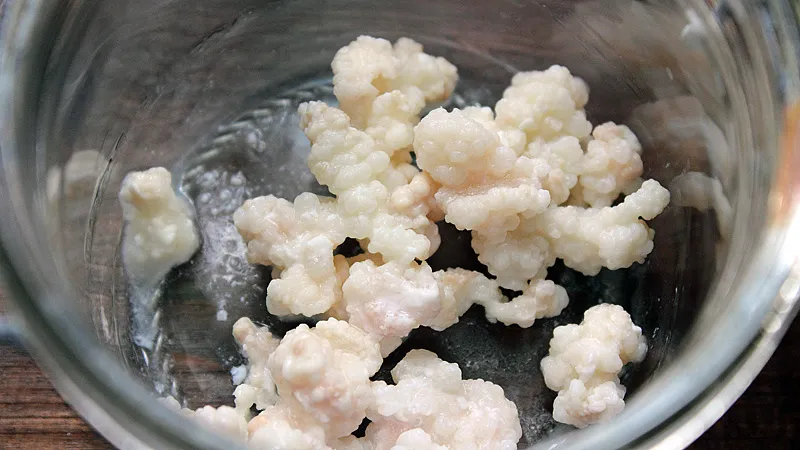
If your grains ferment regularly, give a pleasant kefir and multiply, there’s no reason to rinse. It’s like taking a perfectly working machine and dismantling a part « on principle ». You’re introducing risk without benefit.
At the beginning, the grains often go through an adaptation phase (new milk, new temperature, new rhythm). Rinsing at this stage can slow down stabilisation.
Many beginners rinse because « it doesn’t work properly ». But what’s most often missing is simply one or two cycles for the culture to settle down.
Chlorine can disrupt flora. This is not always dramatic, but it does cause unnecessary stress. If you rinse often with chlorinated water, you may see less active grains.
Some people rinse under a powerful jet, rubbing and crushing. This can damage the structure of the grains and reduce their longevity.
Kefir loves sweetness.
If the smell is really unpleasant (not just sour), and persists despite :
A gentle rinse can help to remove any unusual build-up.
But be careful: before rinsing, check the cause. Often, the smell comes from fermenting too long, too high a temperature, or the wrong milk.
Sometimes, the grains may become more « slippery », « stringy » or sticky. This may be due to a temporary imbalance (high temperature, fermentation too long, different milk, very tightly packed grains).
In this case, a very gentle rinse with a little milk (not water) is often the best option, rather than rinsing with water.
If you have left it to ferment for too long and you have a very curdled, thick mass which completely surrounds the grains, you may be tempted to rinse. Here too, the best option is often to gently loosen the curds with a little fresh milk, then restart a short cycle.
Rinsing with water can « clean », but it can also shock the grains. Cleaning with milk » is often more respectful.
If the beans have been stored for a long time, with milk that has turned very quickly, and you get a very strong smell, a gentle rinse can sometimes help before restarting. But here again, the most important thing is to get back into a routine of short, regular cycles to rebalance.
Milk is the grain’s natural environment. It maintains :
If you feel that your grains need to be « cleaned », the gentlest method is often :
This removes residues without disturbing the crop as much.
Kefir is controlled, not ‘purified’. If you find yourself rinsing every day, it’s a sign that something else is wrong: too many grains, too long a time, too hot a temperature, unsuitable milk, or a lack of regularity.
If you choose to rinse with water :
The aim is not to « sterilise ». It’s just to remove excess curds if necessary.
It may seem obvious, but it happens: soap, washing-up liquid, disinfectant… No. Never on the beans. The strainer and the jar can be washed, yes. Not the beans.
The grains break, become brittle and lose their structure. Culture doesn’t like this. Gentleness is your best friend.
In 95% of cases, the problems attributed to the grains come from the container: poorly rinsed jar, residual odours, microfilms, dirty lid, poorly washed utensils.
If you want a simple rule: wash and rinse the jar thoroughly. Keep the beans quiet.
Grains like to be fed regularly. If you leave it too long, the environment becomes very acidic. Some grains can cope with this, while others become more irregular.
Often, a daily or almost daily routine stabilises everything: texture, smell, taste, multiplication.
Too hot = fermentation too fast = high acidity = potential stress.
Too cold = slow fermentation = accumulation of poorly processed milk = sometimes less pleasant « milky » smells.
Balance is found by observing your home, not by looking for a universal rule.

In this case, rinsing won’t do you any good.
Before rinsing, adjust :
Kefir that is too acidic is generally not a problem of « dirtiness ». It’s a problem of adjustment.
Before rinsing, test:
Once again: texture ≠ hygiene.
Often: too hot, too many grains, or fermentation too long. Rinsing does not change this mechanism. Adjusting the speed does.
Sometimes, after a change of milk or a very long cycle, the smell can be stronger. The best response is often a short cycle with fresh milk, not a rinse.
When the beans are kept in the fridge (in milk), you can find a layer of very fermented milk, sometimes thick, sometimes with a stronger smell. The temptation to rinse is great.
In most cases, the simplest solution is :
If you rinse with water, do so only if the smell is really difficult, and very gently.

We live in a culture where ‘clean’ means ‘germ-free’. But kefir is all about controlled microbial activity. Your aim is to encourage good microbes, not drive them out.
It’s the same state of mind as with kombucha: you don’t ‘wash’ a SCOBY with water all the time. You protect the culture, nourish it and maintain a stable environment. If you like the idea of living cultures, you can vary your fermentations with our SCOBY Kombucha (natural authentic kombucha strain): a reliable culture to start a regular fermentation, without seeking sterility, but rather balance.
If your grains seem uneven, here’s a simple approach that’s often more effective than rinsing:
Slightly reduce the quantity of grains per litre, or reduce the time. The aim is to avoid extreme acidity.
Rather than pushing through a long fermentation, do shorter cycles, filtered earlier. This nourishes the grains without stressing them.
Changing milk every day can be disruptive. Stabilise a base.
Even a small change of location can change everything. Look for consistency.
Result: in many cases, the smell and texture are normalised without rinsing.
No, if you renew the milk correctly and your jar is clean, the grains won’t ‘rot’ simply because there’s still a little kefir around. On the contrary, an acidified environment and active flora protect the culture.
Kefir’s best protection against bad bacteria is its controlled fermentation (acidification) and the dominance of its flora. Rinsing does not guarantee greater safety. A stable routine and good equipment hygiene do.
The grains may change colour slightly depending on the milk, fermentation and time. This is not an automatic sign of trouble. Observe the smell, texture and fermentation.
This is often coagulated milk protein. Filter, relaunch, and keep fermentation shorter if necessary. No need to rinse.
In general, no frequency is necessary. Most people never rinse, or only in exceptional cases (abnormal odour, unusual build-up).
It’s possible, but it’s still a bigger shock than a milk refreshment. If you do rinse, do it quickly and gently.
Chlorine can disrupt the flora. This is not always dramatic, but if you rinse often with chlorinated water, you increase the risk of less active grains. Better to avoid it.
Before rinsing with water, try a ‘milk wash’: gently stir the grains in fresh milk, filter, then run a short cycle again.
Sometimes rinsing can temporarily slow down fermentation, resulting in a less acidic kefir… but this is not the right strategy. Adjusting the time and quantity of grains is more effective and more stable.
In general, no. Instead, go through 1 or 2 adaptation cycles: short fermentations, fresh milk, regular routine.
Not necessarily. Strain, discard the strong kefir if you don’t like it, then start again with fresh milk. If the grains are stuck together, removing them with fresh milk is often enough.
Occasional, gentle rinsing is not necessarily fatal. But frequent, vigorous rinsing or rinsing with chlorinated water can weaken the crop and make it more temperamental.

In the vast majority of cases, you don’t need to rinse your milk kefir grains. The best way to keep grains healthy is not to « wash » them, but to :
If you encounter a problem (strong smell, sticky grains, curdled mass), start by correcting the fermentation parameters. And if a ‘clean-up’ is necessary, first prefer milk cooling, which is more respectful of the culture.
Finally, if you like the idea of living cultures and simple routines, you can also explore another popular fermentation: kombucha. Getting started with our SCOBY Kombucha (a natural, authentic strain of kombucha) is a great way to vary your fermented drinks at home, while maintaining a stable, natural and easy-to-follow approach.
Sources :
📖 Go further: read our How to Make Kefir at Home: The Complete Guide, with a batch calculator, timings and troubleshooting.
Ready to try it yourself?
Discover our live milk kefir grains, shipped in 24/48h with a step-by-step English guide. And for the curious, the history of kefir is a fascinating read.