
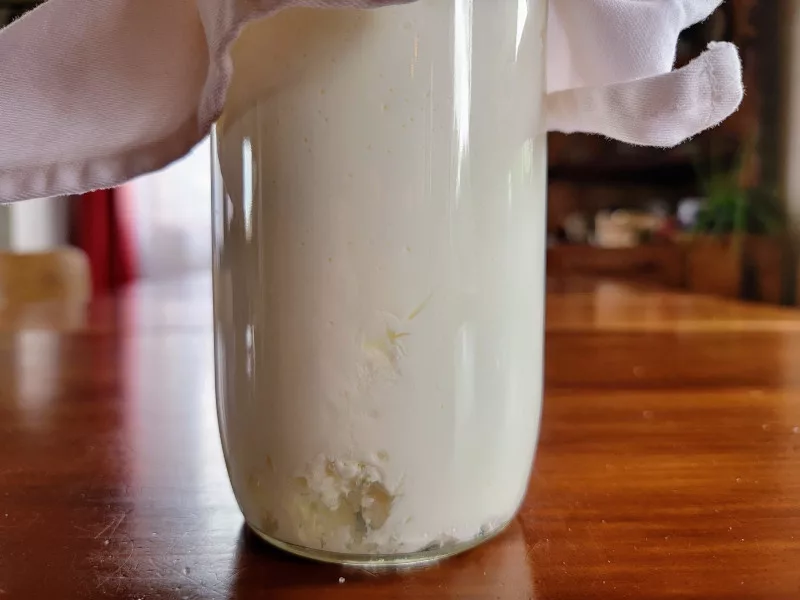
If you like the idea of milk kefir but have problems with lactose, you’re not alone. It’s one of the most frequently asked questions, especially among those who want to enjoy fermented foods without triggering digestive discomfort. The good news is that there are several ways to make ‘lactose-free’ or ‘very low-lactose’ kefir, depending on your level of sensitivity and what exactly you call ‘lactose-free’.
Because let’s be clear: milk kefir is basically made with milk, and milk naturally contains lactose. Fermentation transforms some of the lactose, sometimes a lot, but not always completely. So to achieve a truly lactose-free kefir, you either have to use lactose-free milk, or choose an alternative that doesn’t start with milk (like water kefir), or adopt a more advanced fermentation strategy.
In this comprehensive guide, we’ll look at :
What “lactose-free” means in practice
The different methods for making lactose-free kefir
The simplest method using lactose-free milk
How to adjust the fermentation time without making the kefir too acidic
Common mistakes
Alternatives if you don’t want dairy products at all
And how to incorporate all this into a homemade fermentation routine.
And if you like exploring lactose-free fermented beverages, you’ll most likely enjoy kombucha, which is a naturally lactose-free tea fermentation. For an easy start with a reliable base, Natural Probio offers a ready-to-use culture: an authentic natural kombucha strain. It’s an excellent complement to kefir when you want to vary your fermentations.
Before giving you the methods, we need to define the level of requirement. Because “lactose-free” means different things to different people.
Some people with lactose intolerance do not react to small quantities. They can eat a yoghurt, a mature cheese, and sometimes drink a well-fermented kefir without worry. In this case, you’re mainly looking for a kefir that’s ‘easier to digest’ and ‘low in lactose’, not necessarily an absolute zero.
Other people react to very small quantities. For them, the “I ferment longer” strategy may not be enough. Lactose-free milk then becomes the simplest solution, or they switch to fermented drinks without milk.
Milk kefir is no longer the answer. We turn to water kefir or kombucha. And that’s often a good thing, because it opens up other options, other tastes, other routines.
Many beginners get confused. Milk kefir grains and water kefir grains are not interchangeable.
They are designed to ferment milk. They live very well in milk, and produce a creamy, tangy, sometimes thick milk kefir.
They ferment sweetened water (often with fruit). They require no milk, so contain no lactose. They produce a light, fizzy drink.
So if your goal is ‘zero lactose’, the most direct solution is often water kefir. But if your goal is “I want the texture and taste of milk kefir”, then we work with lactose-free milk instead.
This is the most accessible and stable method, and often the one that gives the best compromise between taste and tolerance.
Lactose-free milk is milk in which the lactose has been ‘cut’ into simpler sugars (often glucose and galactose). This does not mean that there are no more sugars. It means that the lactose as it is is already pre-digested.
Kefir grains can ferment this milk. They often ferment even faster, because the sugars are simpler.
Then filter, collect the grains and chill your kefir.
With lactose-free milk, fermentation can become faster. Kefir can thicken quickly and become acidic sooner.
The best strategy is to monitor texture and smell rather than setting a rigid time limit. Looking for balance:
Slightly thickened
Acidic but not aggressive
Fresh, milky scent
Lactose-free whole milk often gives a creamier, more pleasant texture. Semi-skimmed gives a lighter result.
If you are sensitive to acidity, whole milk may be softer on the palate.
If the milk is labelled lactose-free, the residual amount is generally very low (but not always strictly zero). For most people with lactose intolerance, this is sufficient. If you are extremely sensitive, you will need to test in micro-doses.
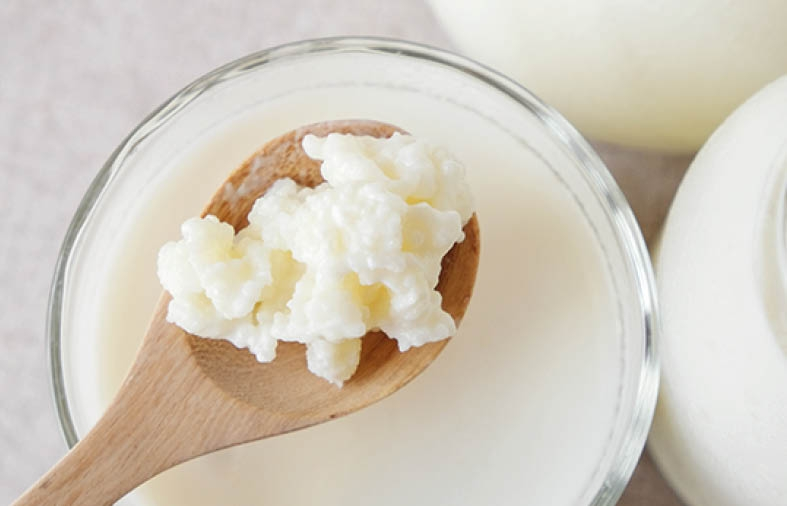
This method is ideal for people who tolerate a little lactose but want to minimise the risk.
The longer the fermentation process, the more the lactose is transformed. But be careful: the longer the fermentation process, the more acidic the kefir becomes.
So you need to find a compromise between :
Lactose reduction
Tolerance to acidity
Some very sensitive people cannot tolerate acidity, even if they are more tolerant of lactose. In these cases, long fermentation is not necessarily the solution.
Increase the amount of grain slightly rather than prolonging it too long.
This can speed up fermentation without necessarily pushing acidity to extremes.
Ferment in a stable area, not too hot.
Heat speeds up fermentation and acidity can rise quickly.
Finish in the fridge.
Once the texture is right, strain and chill to slow down.
It’s important to say that. You reduce, you don’t necessarily eliminate completely. This is often enough for many intolerant people, but not for everyone.
If your aim is really to avoid lactose, water kefir is the most logical option.
No milk
No lactose
Light, often fizzy drink
Easy to flavour
Water kefir is often more ‘refreshing’ than milk kefir. It’s very popular in summer, or when you want an alternative to soda.
Don’t expect the creamy texture of milk kefir. It’s more like a fermented lemonade.
But if you like fermented drinks, you may find it addictive in a good way: it’s a simple, natural, customisable alternative.
Kombucha is a sweet tea fermentation. It is lactose-free, and many people who are looking for digestible fermentations are interested in it.
If you want a solid base from which to start, Natural Probio offers a strain of authentic natural kombucha. It’s particularly useful if you’ve already been disappointed by “haphazard” trials and want to avoid wasting time.
Kombucha can complement a kefir routine, or replace milk kefir altogether if you don’t want milk at all.
Many people ask: can you make milk kefir with plant milks?
Plant milks do not have the same composition as animal milk. Milk kefir grains can sometimes ferment plant milk for a short period, but they don’t always stay there for long, because they don’t get the same nutrients.
A strategy sometimes used:
Ferment occasionally in plant milk
But regularly “rest” the grains in animal milk to keep them in shape
If you are strictly dairy-free, this strategy will not suit you. In that case, you’re better off turning to water kefir or kombucha.
Now let’s get practical. Here’s how to achieve consistent, pleasing results.
For lactose-free milk kefir: lactose-free milk.
For milk-free kefir: water kefir or kombucha.
Fermentation is your ally, but you don’t want to introduce bad smells or contamination that ruins the taste.
Clean jar
Clean utensils
Clean cloth
Heat speeds things up. If your kefir becomes too acidic, move to a cooler place or reduce the time.
The right time is when you like the taste. It’s as simple as that.
If you wait too long, you’ll end up with a very acidic kefir, sometimes separated.
After filtration, leave the kefir in the fridge. The taste will stabilise and the drink will become more enjoyable for many people.
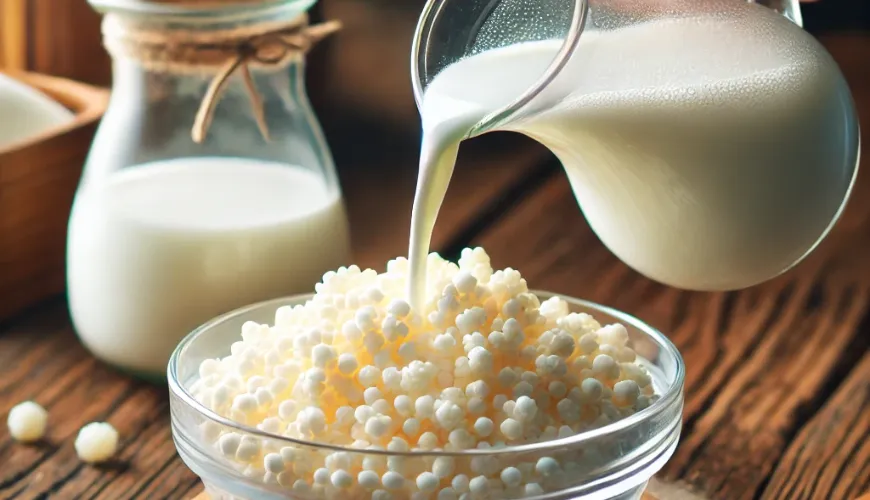
Even with lactose-free kefir, some people experience discomfort at first. It’s not necessarily the lactose. It could be :
Acidity
The novelty of the fermented food
Too much too quickly
Start with a small amount.
A few tablespoons.
Then gradually increase.
It’s a simple but highly effective method.
Many sensitive people prefer to eat it with a meal, rather than on an empty stomach. Test and adapt.
No. You often reduce, but it’s not an absolute guarantee.
Some people confuse a reaction to acidity with a reaction to lactose. If you’re sensitive, look for a milder kefir and finish in the fridge.
A large glass on the first day is often a bad idea, especially if you’re sensitive.
Grains that don’t ferment properly produce unstable kefir, which can have a strange taste. Take care of the grains.
Once you have your lactose-free kefir, you can use it in cooking.
Lactose-free kefir + banana + a little cinnamon.
Simple and filling.
Drained kefir (kefir cheese) + salt + dried herbs.
Perfect on vegetables.
Kefir + mild spices.
This can soften certain foods and add a touch of acidity.
If you’re looking for a lactose-free routine, the simplest combination is :
Daily water kefir
Kombucha to vary the taste and feel
Lactose-free milk kefir if you like a creamy texture
Kombucha is particularly interesting because it does not depend on milk. And if you want a reliable basis for getting started quickly, you can use the Natural Probio strain of kombucha. It’s the kind of product that saves you weeks of tinkering.
No, not totally. Fermentation often reduces lactose, but some may remain. The amount depends on the time and conditions of fermentation.
Use lactose-free milk with milk kefir grains. This is the simplest and most stable way of keeping the texture of milk kefir while avoiding lactose.
Milk kefir grains don’t always keep well in plant milks over the long term. For a strict milk-free diet, water kefir or kombucha is best.
Yes, it’s even the most direct alternative if you want to avoid lactose altogether. The drink is light, fizzy and easy to flavour.
Yes, kombucha is a lactose-free tea fermentation. For an easy start, you can use the authentic Natural Probio kombucha strain.
Making kefir without lactose is entirely possible, but the best method depends on your objective:
If you want the taste and texture of milk kefir: choose lactose-free milk.
If you want to avoid milk: opt for water kefir or kombucha.
If you can tolerate a little lactose: well-controlled fermentation may be enough, but it’s not a “zero” guarantee.
The most important thing is to progress gradually, keep an eye on the acidity, and find the version that gives you pleasure while remaining easy to digest.
And if you want to enrich your lactose-free fermented beverage routine, kombucha is an excellent addition. To get started with a reliable base, discover the Natural Probio strain of authentic natural kombucha.