

You prepare your kombucha carefully, lift the fabric of the jar… and there’s a surprise: brown filaments, suspended particles, a thick deposit at the bottom. At first sight, this might seem dirty, even worrying. Many beginners immediately think: “my kombucha is contaminated”, “it’s not clean”, or “I’ll get sick if I drink this”.
In fact, most of these deposits are simply a sign that your kombucha is… alive. By definition, a fermented beverage is not a perfectly homogenous, transparent liquid. It’s normal for yeast, bacteria and tea residues to leave visible traces.
The aim of this article is to help you distinguish between :
We’ll also look at how you can adapt your habits to limit visual surprises, while keeping your drink effective, aromatic and pleasant to drink.
To understand what you’re seeing, you first need to remember what kombucha is.
A jar of kombucha contains :
Yeasts consume the sugar and produce alcohol and CO₂. Bacteria transform the alcohol into organic acids and build the cellulose matrix that forms the SCOBY. This permanent work leaves traces in the form of :
So it’s logical that homemade kombucha should be livelier and more textured than a perfectly filtered industrial drink.
Industrial kombuchas are often :
At home, you work with a live culture and a glass jar. Everything that happens in the fermentation remains visible: it’s sometimes confusing, but that’s also what makes the experience interesting.
If you use a quality strain, for example a well-balanced live SCOBY and its starter liquid supplied by a specialist producer, at least you know that what you’re seeing comes from yeasts and bacteria adapted to kombucha, not unknown micro-organisms.
Before talking about contamination, let’s take a look at what is normally found in a healthy jar.
The famous “brown filaments” are one of the most common scenes. They can be seen :
These are generally :
These filaments can be :
This is all normal. You can filter them when bottling if their appearance bothers you, but they are not dangerous in themselves.
As the days go by, the yeasts multiply and then some of them die or detach. They then fall to the bottom of the jar, forming a deposit of varying thickness.
This deposit :
Again, this is not a sign of trouble. Many kombucha brewers even choose to remove some of this deposit from time to time, to rebalance the culture, but a certain amount of yeast at the bottom is perfectly normal.
You can also see :
These suspended particles sometimes give the drink a slightly cloudy appearance, rather like homemade cider. This does not mean that the drink is ‘dirty’, but that it is poorly or not at all filtered.
During fermentation, a thin gelatinous layer forms on the surface of the liquid. This is the beginning of a new SCOBY. This veil can :
This is not mould, but a cellulose matrix produced by bacteria. Over time, it thickens and becomes a new disc.
3. How can you distinguish normal deposits from a real problem?
The big question is: how do you know if what you’re seeing is healthy or worrying?
To do this, you can use three main criteria:
In general :
If you see a stain that looks like something growing on forgotten bread or stale jam, with the appearance of “dust” or a little hairy carpet, the alarm is more serious.
Normal yeasts and deposits are generally :
Worrying stains are often :
The nuance is important: a SCOBY can have darker, mottled or brown-stained areas without this being a problem.
Mould needs oxygen. So they grow :
The deposits at the bottom, the filaments hanging from the bottom of the SCOBY and the particles suspended in the kombucha are almost never mould.
If you see fluffy spots on the surface of the liquid, particularly if they are round, well-defined and green, blue or white in colour, it is probably mould.
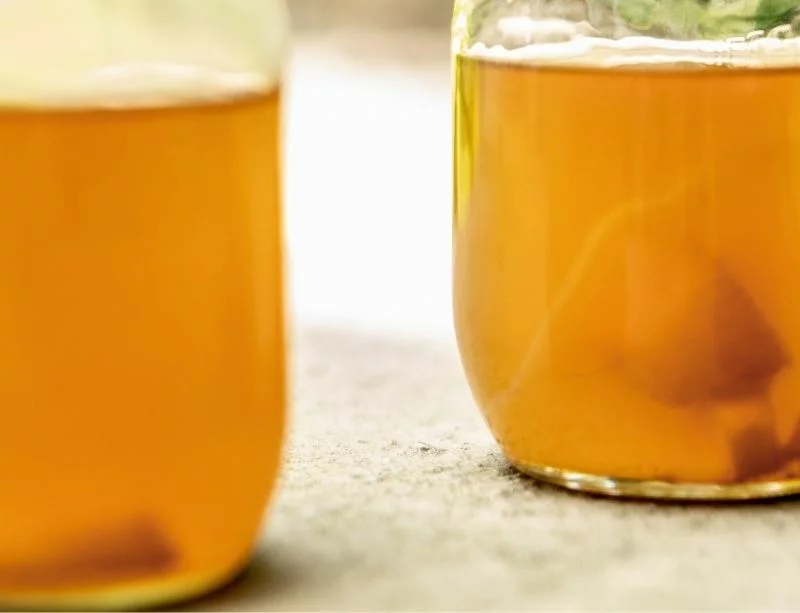
To make things more concrete, here are a few typical situations.
It’s practically the ‘postcard’ of homemade kombucha. In the vast majority of cases :
You can either :
This “mud” is nothing to worry about. It corresponds to :
If the jar has been left unstirred for a long time, it is normal for everything to accumulate at the bottom. You can :
These are often :
They may surprise you when you see them in the glass, but they are not dangerous. If you prefer a cleaner look, filter when bottling.
This time, the scenario is very different. A spot :
… is almost always mould.
In this case, don’t hesitate: throw away the SCOBY and the liquid, and clean the jar thoroughly before starting a new crop.
Once you’ve been reassured that your deposits are ‘healthy’, there are a number of options available to you to make the drink more enjoyable.
The simplest solution:
You can :
This filtration stage does not affect the quality of the kombucha; it only removes the most visible solid elements.
Some people prefer :
But be careful:
Part of the work involved in making homemade kombucha consists of :
If you feel the need for a perfectly clear kombucha, you can of course filter more finely, but bear in mind that each additional filtration step takes away some of that raw character.
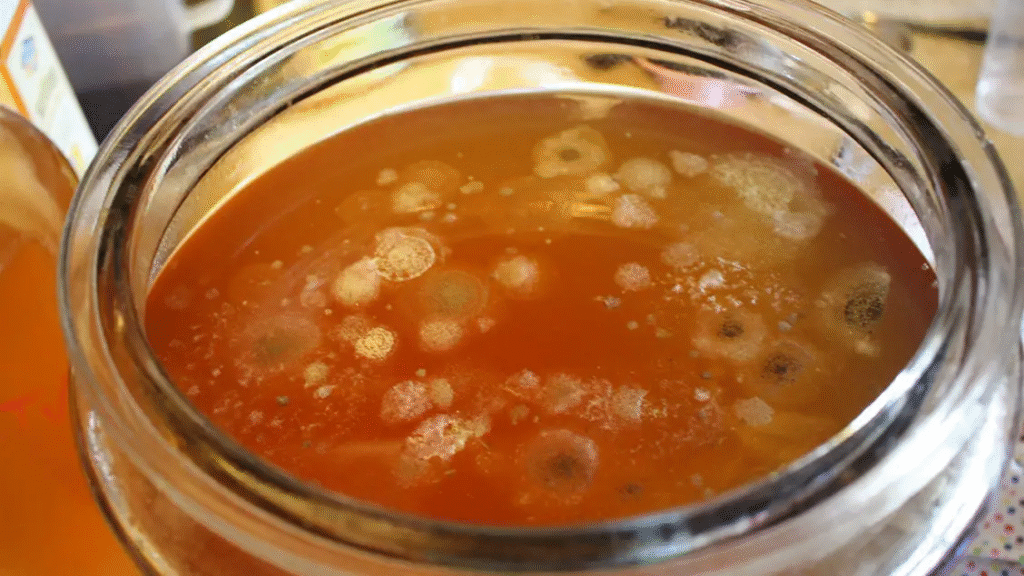
Although most deposits are normal, there are situations where the appearance of the kombucha should give you pause for thought.
If, in addition to the filaments, you notice that :
… so don’t rely on filaments alone. Smell is a very important indicator.
In this case, it’s best not to consume the drink, even if you don’t see any clear patches of mould on the surface.
Certain deposits may be cause for concern if :
If you are unsure, observe the surface for one or two days:
When in doubt, it’s best to err on the side of caution and throw everything away.
Very bright or unusual colours (fluorescent green, bright orange, intense pink) can also be a warning sign, particularly if they appear in small, well-separated patches.
Some infusions or fruit used in secondary fermentation can colour the drink, but in this case you know what you’ve added. If not, beware.
If you have trouble with the ‘living’ aspect of kombucha, a few good practices can reduce the amount of visible deposits without harming the fermentation process.
Before adding the SCOBY and starter fluid :
This avoids adding particles from the start that will later grow with the yeast.
Too much yeast can result in lots of filaments and a huge deposit at the bottom. To rebalance :
A good quality, well-balanced SCOBY naturally has a more harmonious relationship between yeast and bacteria, which limits these excesses.
The longer a batch is left to ferment, the more :
If you like a rather mild drink, stop the fermentation in time and make regular batches, you’ll generally have fewer impressive deposits than in a jar you’ve forgotten about for two months.
8. Practical checklist when you see filaments or deposits
To gain confidence, you can follow this little checklist every time a jar seems strange to you.
With practice, these steps will become almost a reflex, and the presence of filaments will no longer cause you to panic.
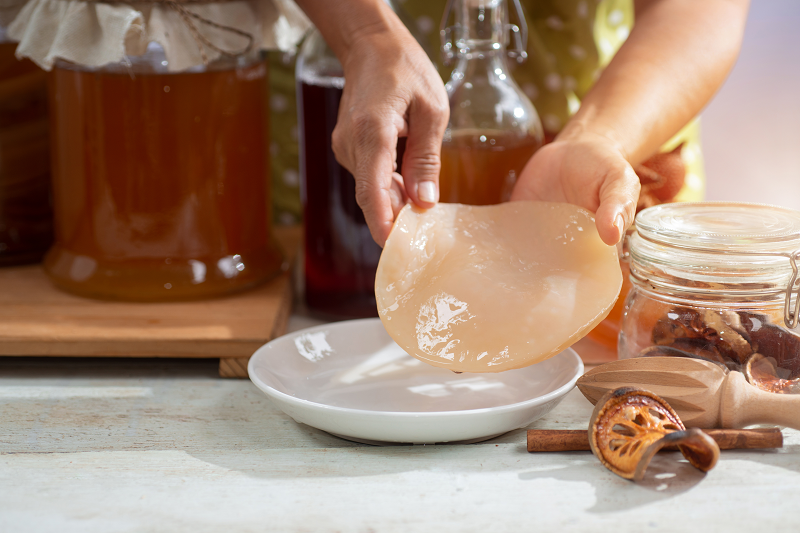
Technically, yes. Yeast filaments and fragments of SCOBY are not toxic in themselves, and some people eat them without any problem. It’s mainly a question of mouthfeel.
If it disgusts you, filter it. If you don’t mind, you can leave them in.
Not necessarily. The amount of visible deposits does not directly reflect the total number of micro-organisms. Well-filtered kombucha can be just as rich in beneficial bacteria as very cloudy kombucha.
The presence of deposits mainly reflects the way you handle the wine (filtration or not), the length of fermentation and the yeast/bacteria balance.
No. A brown filament, especially if it’s under the SCOBY, is almost always normal. It’s the combination of “filament + coloured fluffy spot on the surface + bad smell” that should make you throw it out.
Yes, if :
So the kombucha is edible. You can just strain it to make it look better.
It all starts with the culture:
By choosing a kombucha culture that has been tested, balanced and accompanied by its starting liquid, you know that the filaments and deposits come from yeasts and bacteria adapted to kombucha, not ‘wild’ micro-organisms.
Seeing deposits or filaments in your kombucha is a bit like seeing the rind on a good cheese or the deposit in a natural wine: surprising at first, but then you realise that it’s the sign of a living product, not a systematic defect.
Remember that :
With practice, you’ll be able to tell at a glance what’s healthy and what’s not. And your deposits will no longer be a source of anxiety, but simply a visual stage in the life cycle of your homemade kombucha.