
Milk kefir is a fermented beverage obtained by bringing milk into contact with kefir grains, then leaving it to ferment for several hours. The result, depending on the conditions, is a fermented milk that is thinner than yoghurt, often slightly acidic, sometimes delicately sparkling, and generally more aromatic than simple curdled milk.
However, this “short” definition is not enough to understand what makes kefir so special. Milk kefir is not just a “fermented milk product”. It’s also a method, a living culture, and a routine: you feed your grains, observe the fermentation, adjust the time, temperature and quantity of grains, and end up creating “your” kefir, to suit your taste.
If you’re already familiar with fermented beverages like kombucha, you’ll immediately see the common ground: you start with a simple ingredient, let a living culture transform that medium, and you get a more complex result that’s richer in character. In fact, many people who fall in love with kefir end up taking up kombucha as well, because both can be easily integrated into a ‘home-fermented’ daily routine. If you want a reliable base from which to start, you can start with an authentic, natural strain of kombucha to achieve more stable fermentation from the very first preparations.
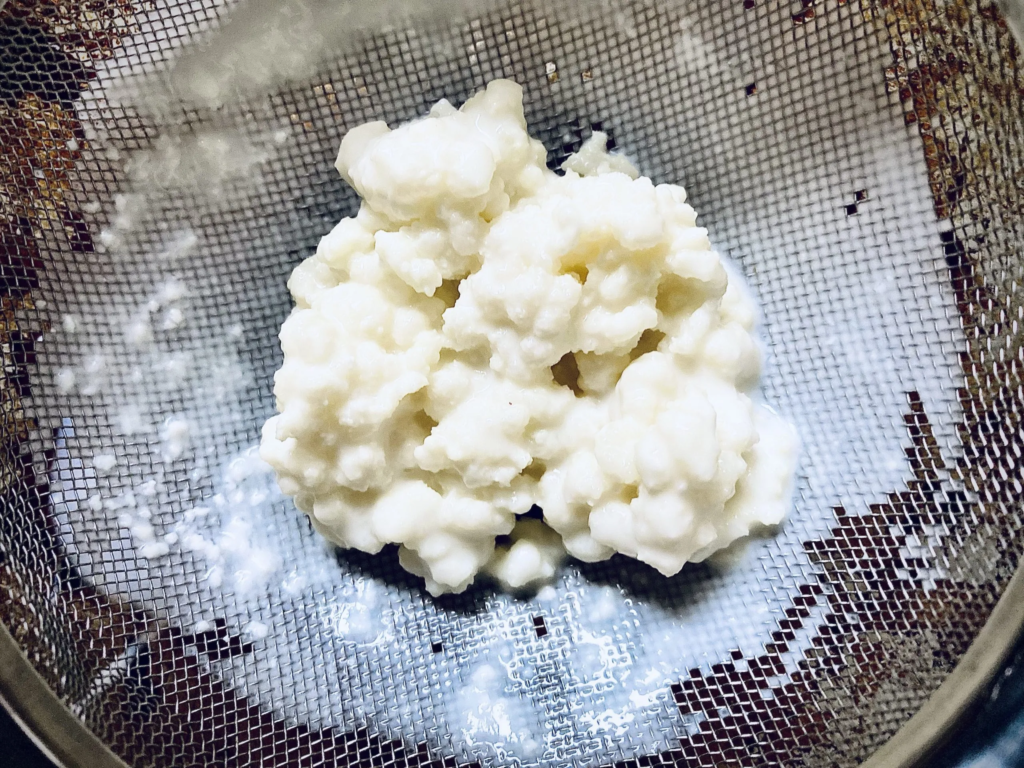
We call them “grains”, but they are not cereals, nor are they seeds in the botanical sense. Kefir grains look more like small, irregular, whitish clumps, sometimes compared to mini cauliflower florets. Their texture can be soft, slightly gelatinous, and they vary in size: some grains are tiny, others grow over time.
What makes these grains so special is that they contain a group of micro-organisms living together in a natural matrix. These are generally referred to as lactic acid bacteria (which produce lactic acid) and yeasts (which help to produce flavour and sometimes a little gas). This ‘ecosystem’ is the driving force behind kefir: it transforms milk into a fermented beverage with a unique profile.
Another important point is that kefir grains multiply. If you use them regularly and feed them properly, they grow and produce new grains. This explains why kefir has historically been passed down from family to family: the grains are alive, long-lasting and can be shared.
This ‘living culture that you nurture’ aspect is very similar to what you find in kombucha: here too, you nurture a strain, monitor the environment and seek balance. If you want to build a complete fermentation corner at home, the kefir + kombucha combination works very well, and a ready-to-use kombucha culture can help you get started in the right conditions.
The fermentation of milk kefir is based on a simple principle: the micro-organisms in the grains feed on the elements in the milk, transforming the environment over the course of several hours.
During fermentation, several phenomena can occur:
Lactic acid is produced by lactic bacteria. This is what gives kefir its slight acidity, comparable to some fermented milks. The longer it ferments, the higher the acidity.
Depending on the milk used and the parameters, the kefir can become thicker or, on the contrary, remain fairly fluid. Sometimes it separates slightly into two phases: a more liquid part (whey) and a denser part. This is not necessarily a “failure”. Often, a simple mix (or an adjustment of time and grains) is all that’s needed.
Fermentation creates new aromatic molecules. This is why milk kefir can have a more ‘complex’ taste than plain yoghurt. For some, it has a slightly buttery flavour, for others it has a tangy freshness, and for others it is slightly fizzy.
Yeast can produce a little carbon dioxide. As a result, some kefirs have a micro-stillness, especially if fermentation has been dynamic, or if the drink has been left to cool in a closed container.
This logic of “culture + transformation + balance” is also found in kombucha. The difference is in the medium: kombucha starts with a sweet tea, and its culture (SCOBY) transforms the sugar and develops a tangy drink. If you want a faithful, stable kombucha, starting with an authentic strain of kombucha is often easier than tinkering with random methods.
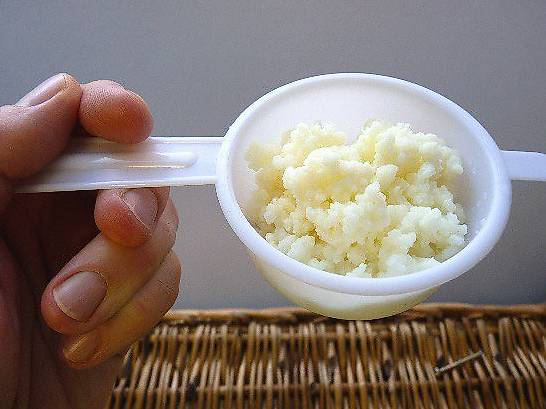
The taste of milk kefir depends very much on the fermentation process, but it can be described as follows:
If you leave it to ferment for a short time, you generally get a milder, less acidic kefir, with a texture closer to slightly thickened milk. If you leave it longer, the acidity increases, the drink becomes “sharper”, sometimes drier, and may separate more.
It’s useful to understand that kefir is not a standardised product. Two people can follow the same recipe and get a different result: more or less active grains, different temperature, different milk, different time. That’s what makes kefir so exciting: you learn to adapt it.
In the world of kombucha, we find exactly the same apprenticeship. And to avoid chaotic beginnings, many prefer to start from a secure base, such as a natural strain of kombucha already ready to ferment in the right conditions.
Milk kefir is often associated with the Caucasus, where this fermented beverage is said to have been preserved, passed on and protected like a treasure. In some traditions, kefir grains were not sold: they were given away. They were shared between families, because they multiply and because they allow regular fermentation without the need for sophisticated equipment.
The history of kefir, like that of other fermentations (sourdough bread, cheeses, lacto-fermented vegetables), tells an ancient story: preserving, transforming, improving palatability and making the most of living cultures.
Today, we are seeing a return to this logic, with a modern interest in home fermentations. Many people want to return to simple, non-industrial, more ‘controlled’ methods. And in this wave, kefir and kombucha often come back as a duo. For those who want to do both properly, an authentic kombucha culture is an excellent complement to well-tended kefir grains.
This question deserves to be developed further, because some people see a similarity in ‘taste’. However, in terms of fermentation, there are clear differences.
Traditional yoghurt is based on specific, often well-known ferments, which transform the milk in a relatively predictable way. The result is thick, consistent and fairly standard from one batch to the next.
Kefir, on the other hand, relies on a more varied community (bacteria + yeast) and can produce more aromatic diversity, sometimes a micro-stillness, and a more variable texture.
And if your overall aim is to build up a “home fermentation” routine, you can alternate very well: milk kefir on some days, kombucha on others. And for kombucha, a strain of kombucha ready to ferment helps to keep the results regular.
Yes, but generally less than the original milk.
During fermentation, some of the lactose is consumed by the micro-organisms. This explains why some people who are sensitive to lactose sometimes find kefir more tolerable than milk.
But be careful: reduction does not mean total elimination. The amount of lactose remaining depends on :
If someone is severely lactose intolerant or has a highly sensitive digestive system, the best approach is to start very gradually, observe their reaction and don’t force them.
Later on in your series of 30 blogs, you’ll have a topic dedicated to lactose and “lactose-free kefir”, so we’ll go into even more detail there, with some practical advice.
The word ‘probiotic’ is often used in everyday language to refer to foods containing living micro-organisms. Milk kefir is in fact a drink produced by living fermentation, and it contains micro-organisms as long as it has not been ‘sterilised’ or treated to eliminate them.
However, we must remain serious: the exact composition varies greatly depending on the bean and the method. That’s why, in clean SEO content, we prefer to talk about “living fermented beverage” and “culture”, rather than promising guaranteed effects.
The best way to present it (and this is what I’ll be doing throughout your series) is to explain clearly what it is, how it works, what people are looking for when they take it, and to remind people that it’s not a drug.
Kombucha follows a similar logic: fermented beverage, living culture, variability according to conditions. Here again, to stabilise quality, an authentic, natural strain of kombucha is a good starting point.
Many readers look to milk kefir for help with digestion, intestinal comfort or a balanced diet. It’s important to take a nuanced approach.
Avoid formulations such as “cures”, “cures”, “eliminates”, “treatment”. Stick to : “can support”, “can be interesting”, “can be integrated”, “according to tolerance”.
If you want to make kefir part of your daily routine, the best advice is often :
As part of a ‘gentle’ fermentation routine, many people also add a drink such as kombucha, in alternation. And to get off to a good start, a reliable kombucha culture helps to avoid unstable fermentations.
Milk kefir is generally consumed :
You can also use :
Kefir can replace some of the milk or yoghurt in a smoothie. It adds an acidity that goes well with sweet fruit (banana, mango, pear).
Some people use it for yoghurt-type sauces: herbs, lemon, salt and garlic. This makes for a lighter, more digestible sauce for some people.
Its acidity can help to tenderise certain dishes.
But while the main aim is to “enjoy kefir as a fermented drink”, many prefer to drink it straight, to get a better feel for its taste and adjust their fermentation.
Even if this blog is an introduction, it’s useful to lay the foundations so that things don’t go wrong.
Many people think “more grains = better kefir”. In reality, too many grains can speed up fermentation too quickly, make the kefir too acidic and cause marked separation.
Here again, the result can be very acidic and less pleasant.
The jars must be clean. Utensils too. And it’s best to avoid unnecessary contamination.
A slight separation can happen. This is not necessarily a problem. Often, a simple mix and adjustment of the parameters will suffice.
Kefir is alive. It varies. You learn to stabilise it by controlling the quantity of grains, time, temperature and type of milk.
These apprenticeships are very similar to those for kombucha. The difference is that with kombucha, the beginnings can be more sensitive. That’s why it’s often advisable to start with an authentic strain of kombucha rather than trying uncertain methods.
A successful milk kefir generally has :
Conversely, avoid consumption if :
When in doubt, don’t take any chances. Fermentation is a wonderful world, but you have to listen to the signals.
Milk kefir is a traditional fermented drink based on a living culture: kefir grains. In just a few hours, this culture transforms the milk to produce a tangier, sometimes slightly fizzy drink, often appreciated for its taste, simplicity and possible place in a daily routine.
Another of its strengths is its flexibility: you can adjust the fermentation, the quantity of grains, the duration, and get a result that suits your palate. The most important thing is to start gradually, to respect hygiene, and not to seek ‘industrial perfection’, but a personal balance.
And if you want to go further into the world of fermented drinks, kombucha is an excellent complement to kefir. To get off to a clean and stable start, I recommend using an authentic, natural strain of kombucha to promote the Natural Probio shop and help readers take action with a reliable product.
No. Sour milk is milk that has been “badly aged” or fermented in an uncontrolled way. Milk kefir is a voluntary fermentation, carried out using a culture (grains) and a controlled process.
No. It varies according to the length of fermentation, the temperature, the amount of grain and the type of milk used.
Not necessarily. It can be fluid or creamy. Some kefirs thicken more, while others are more like fermented drinking milk.
Fermentation reduces some of the lactose, but some often remains. Some people tolerate it better than milk, others not. You need to test gradually.
Yes, many alternate. Kefir is a milk fermentation, kombucha a sweet tea fermentation. For kombucha, an authentic ready-to-ferment culture can make it easier to get started.
For kefir, we’re looking for live grains. And for kombucha, Natural Probio offers an authentic, natural kombucha strain that’s easy to incorporate into your fermentation routine.