Seeing “hair” on your kombucha: a beginner brewer’s big scare
Everything seemed to be going well.
You had prepared your sweet tea, added your SCOBY, covered the jar, chosen a quiet corner… Then, when you came to have a look a few days later, you saw appearing on the surface of the liquid :
a downy, dry spot, sometimes white, sometimes green or bluish, which looks an awful lot like mould on bread.
This is the scene that every kombucha brewer dreads. You’re left with an avalanche of questions:
- Is it really mould or just SCOBY?
- Is it dangerous to your health?
- Do I have to throw everything away?
- Why did this happen when I “followed the recipe”?
The good news is that by learning to recognise mould clearly, understand why it appears and adopt a few preventive measures, you can avoid most contaminations. And, if it does happen, knowing what to do means you don’t have to panic.
Whether you’re working with a Natural Probio kombucha culture or a strain you’ve been given, the principles are the same:
mould is not inevitable, but it should always be taken seriously.
In this article, we’ll look at :
- how to distinguish between mould, yeast and healthy SCOBY
- why mould can grow on kombucha
- what to do if your jar is really mouldy
- how to prevent it from happening again
- when and how to start again with a healthy SCOBY (e.g. Natural Probio)
Mould or normal SCOBY? Learn to tell the difference
Before condemning a batch, you need to be sure that it is really mould and not just :
- yeast
- normal SCOBY irregularities
- of trapped bubbles
What does real kombucha mould look like?
Mould on kombucha has fairly consistent characteristics, very similar to those you see on mouldy bread or fruit.
In general, they appear :
- at the surface, never deep in the liquid
- in the form of well-defined patches, like small islands
- with a dry, fluffy, cottony texture
- with typical colours: pure fluffy white, green, blue, grey, black, sometimes several colours at once
Visually, they look like small, irregular circles or spots, with sharp edges, which appear to be placed on top of the SCOBY or liquid, and not integrated into the gelatinous mass.
If you can clearly see this type of stain, you are dealing with mould and there is a very strict procedure to follow: do not consume.
What does a healthy (and sometimes deceptive) SCOBY look like?
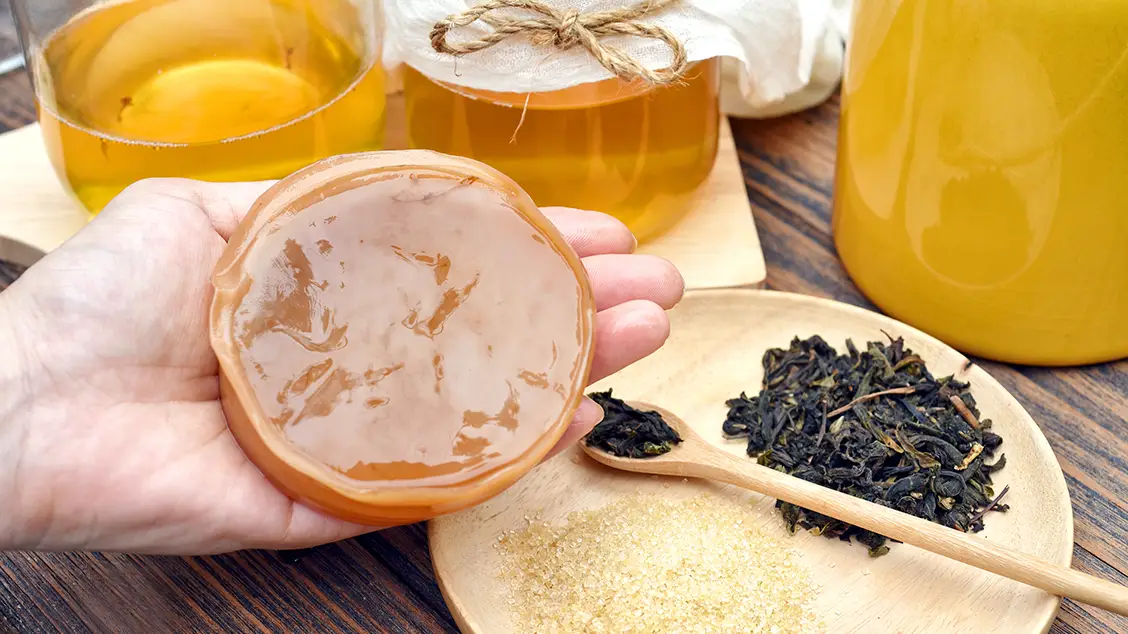
A healthy SCOBY looks more like :
- a continuous gelatinous pancake of varying thickness
- smooth or slightly bumpy
- beige, creamy, sometimes tending towards amber or brown
- moist, never fluffy, even when on the surface
There may be :
- bubbles trapped beneath the surface
- lighter and darker areas
- ripples, folds and scars from previous heating spells
All these irregularities may be worrying at first, but they are not mould.
And these brownish deposits, filaments, dark spots?
Very often, what worries beginners most… is perfectly normal.
What you can see without it being a problem:
- brown threads or “worms” at the bottom or attached to the SCOBY: these are clumps of dead yeast
- dark brown areas in the SCOBY mass: old layers integrated into the biofilm
- a deposit at the bottom of the jar: yeast, tea particles, normal fermentation residues
These elements :
- don’t float like islands on the surface
- are not fluffy
- do not draw circles with sharp edges
They indicate that your kombucha is alive, fermenting and that the yeast/bacteria community is at work.
Why does mould develop on kombucha?
Once the presence of mould has been confirmed, you need to understand why it has appeared. The causes are often linked to an environment that is too favourable to intruders, and not sufficiently protected by acidity and good practices.
Reason No. 1: kombucha is not acidic enough to begin with
Kombucha naturally protects its surface thanks to its high acidity.
At the start of a new batch, you mix :
- sweet tea
- pre-fermented kombucha (mother kombucha)
- the SCOBY
If you put in too little mother kombucha (or kombucha that isn’t acidic enough), the initial pH of the jar will be too high. Result:
- moulds, wild yeasts and airborne bacteria have an environment in which they can establish themselves
- by the time the SCOBY starts to acidify the whole thing, the mould has already gained ground
This is one of the main causes of contamination, especially in the early stages.
Reason No. 2: Temperature too low and slow start-up
Temperature has a direct impact on the speed of fermentation:
- below 20°C, the crop slows down
- at 17-18 °C or less, fermentation can be very slow
If your kombucha takes a long time to acidify :
- the air/liquid interface remains weakly acidic for several days
- mould spores in the air have time to settle and germinate
In winter, in an unheated kitchen, it’s a classic scenario:
SCOBY Natural Probio is healthy, but it doesn’t have what it takes to build up acidity quickly enough.
Reason no. 3: a jar poorly protected from flies and dust
Mould often comes from the air and from fruit flies (drosophila), which love :
- sweet smells
- slightly fermented media
If :
- the fabric is too loose or has holes
- the elastic doesn’t tighten properly
- the jar is left open for even a few hours
flies can get in, wander around, sometimes lay eggs, and above all deposit micro-organisms.
Even if there are no visible insects, a poorly covered jar will let in :
- dust
- mould spores
- various particles
This isn’t always a problem… as long as the acidity protects the environment. But if the kombucha is also low in acidity, the spores will find an ideal breeding ground.
Reason no. 4: inadequate equipment hygiene
The natural microbiota in kombucha is robust, but it doesn’t work miracles. If :
- the jar was very badly rinsed
- there were residues of food, soap and fat
- you put your unwashed hands directly into the jar
you introduce a high microbial load that is foreign to the kombucha ecosystem. Most of the time, the kombucha is fine, but sometimes another organism takes over: mould.
Reason no. 5: a surface exposed for too long
A SCOBY or part of a SCOBY left behind :
- half out of the liquid
- pressed up against the wall of the jar
- or in an almost empty jar of kombucha
can :
- partially dry
- become an ideal support for mould spores
The dry surface is much less protected by the acidity of the liquid, making it easier for intruders to cling to it.
Reason no. 6: a weakened, uncompetitive strain
If your SCOBY :
- has been kept in the fridge for a long time
- has been left for months in a barely nourishing liquid
- has been mistreated (unsuitable tea, almost no sugar, frequent changes)
it can become less vigorous. Its ability to acidify a new batch quickly diminishes, and moulds have an easier time of it.
With a SCOBY Natural Probio, you’re starting from a strong base, but even a good strain can weaken if kept for a long time in poor conditions.
What should you do if your kombucha is really mouldy?
This is the part that often disappoints: once the mould has set in, there is unfortunately no miracle solution to ‘save’ the batch.
Golden rule: you don’t scratch mould to “keep going”.
It’s tempting to say:
“I’ll just remove the stains with a spoon, and everything will be fine…”
Unfortunately, this is a very bad idea. Mould :
- is not limited to visible spots
- produces microscopic filaments (hyphae ) that can sink below the surface
- sometimes releases toxins and spores into the liquid
By simply scraping, you remove the visible part, but not the rest. The kombucha remains deeply contaminated, even if the surface appears cleaner.
For safety reasons, mouldy kombucha is considered :
- can no longer be consumed
- must not be used as a source of SCOBY
- is not a healthy environment in which to continue fermentation
What needs to be done
If you have identified real mould :
- Discard the entire contents of the jar:
- kombucha
- SCOBY
- surface dandruff
- Do not keep any part of the crop to “reseed” a new batch.
- Clean the jar in hot water with a little washing-up liquid.
- Rinse thoroughly.
- If this reassures you, you can then scald the jar (boiling water poured inside, then drying).
It’s the only way to be sure you don’t come away with a contaminated crop.
What if the mould has only appeared on part of the SCOBY?
Even if the spots seem to be limited to one area, the logic remains the same:
- the mould has had time to develop
- we don’t know how far it has spread into the mass
- we cannot guarantee the safety of what remains
So we throw away the whole SCOBY and start again with another one.
It’s painful at the time, but it’s safer and often simpler than trying to cut, sort and save pieces.
How can you prevent mould from returning?
Contamination can happen to anyone, no matter how careful you are. But a few simple steps can greatly reduce the risk.
1. Always start with enough acidic mother kombucha
For each new batch :
- use a large quantity of already fermented kombucha (mother kombucha)
- this liquid must be very acidic, with a distinctly vinegary taste
In practice:
- if you are working with a Natural Probio kit, be sure to use all the liquid supplied with the SCOBY for the first batch
- for subsequent batches, always keep a portion of kombucha from the previous batch to acidify the new batch
An acidic environment from the outset is the best barrier against mould.
2. Ensure the right temperature
Try to keep your jar:
- in a room at around 22-24 °C
- away from sources of cold (windowsills in winter, cellars)
If your house is cold :
- choose the most temperate place (sometimes bedroom, living room…)
- avoid extreme variations (near radiators, then cold draughts, etc.).
The faster fermentation starts, the less time moulds have to establish themselves.
3. Effective protection against insects and dust
To cover your jar:
- use a clean cloth (cotton or linen)
- held in place by a tight elastic band
- check that the weave is tight enough to prevent fruit flies from getting through
Avoid :
- ill-fitting lids
- fabrics with large holes or old fabrics, which let insects through
The surface of the kombucha should breathe, but not be open to the wind.
4. Clean equipment properly
Before each batch:
- wash the jar in hot soapy water
- rinse thoroughly
- avoid using greasy or very dirty sponges
You don’t need any chemical disinfectant, just good basic hygiene.
Then leave to dry or use a clean cloth.
5. Keep the SCOBY well submerged at all times.
For SCOBY :
- make sure it is always covered with liquid
- prevent a large part of it from remaining outside the kombucha and drying out
- if you store a SCOBY without stirring, keep it in a jar with enough acidic kombucha (SCOBY hotel)
A chaotic, dry surface stuck to the walls is a perfect breeding ground for mould. A well-submerged SCOBY is much better protected.
6. Avoid picking at the jar too often
Every time you :
- open the jar
- stir
- touch the SCOBY with your hands
you introduce the possibility of contamination.
Try to :
- limit openings to what is strictly necessary (taste, check the smell)
- don’t move the SCOBY if you don’t have to
- always wash your hands if you have to handle the culture
The fewer unnecessary gestures you make, the more stable the culture.
How do you get back on your feet after mould contamination?
Once you’ve got everything out of the way, the next step is to decide how to continue the kombucha adventure.
Option 1: you have a hotel in healthy SCOBY
If you had already set up a hotel in SCOBY:
- make sure there’s no mould in this particular jar
- smell: the odour should be vinegary, never putrid
- Observe: no fluffy patches on the surface
If everything is healthy, you can :
- pick up a SCOBY from the hotel
- use very acidic hotel kombucha as the mother kombucha
- relaunch a new jar in better conditions (temperature, cover, hygiene)
Your hotel then acts as an emergency stump bank.
Option 2: you start with a new culture
If you don’t have any healthy SCOBYs left, or if you have doubts about the health of what you have left, the easiest and safest thing to do is :
- leave with a new SCOBY, delivered in a very acidic kombucha-mother
This is precisely the advantage of a quality culture such as Natural Probio:
- the strain is healthy
- kombucha mother provides a safe initial pH
- the instructions guide you through the right steps
By starting again on this basis and correcting previous mistakes (lack of acidity, cold, insufficient cover…), you will greatly reduce the risk of mould developing again.
Frequently asked questions: mould on kombucha
Can I use a mouldy SCOBY if I cut out the infected part?
No.
Even if the visible area is small, the mould may have spread deep down.
For your safety, we consider a contaminated SCOBY… lost.
What if the spots are white but not fluffy?
Certain white, smooth, slightly translucent areas on the surface of the SCOBY or the liquid may be :
- the start of a new SCOBY
- a zone where yeasts concentrate
If the texture is :
- gelatinous
- wet
- stuck to the rest of the biofilm
it’s probably not mould.
If, on the other hand, the area is cottony, dry and irregular, then it is mould.
Are brownish filaments and deposits a sign of mould?
No.
Brown filaments, deposits at the bottom and dark areas in the SCOBY are usually yeast and old layers of biofilm. This is normal and common.
Can you drink kombucha that has had a little mould… but has been “cleaned”?
No.
Even if the idea of throwing away an entire jar is frustrating, safety comes first. Toxins or mould fragments may be invisible. It’s not worth the risk.
In conclusion: mould is a signal, not the end of the story
Seeing mould on your kombucha for the first time is always a shock.
You feel like you’ve ‘failed’, you doubt yourself, you wonder if it’s all too complicated.
In reality :
- mould is a clear signal that something in the conditions of the jar was not optimal (acidity, temperature, cover, hygiene, health of the SCOBY)
- it’s also an opportunity to learn: by correcting these parameters, your next batches will be much more stable
The procedure is simple:
- really recognise mould (downy, coloured, islands on the surface)
- dispose of the contaminated jar without hesitation
- clean equipment thoroughly
- leave with a healthy crop (ideally a SCOBY Natural Probio and its mother kombucha)
- adjust your actions: sufficient starting acidity, correct temperature, well-covered jar, SCOBY well submerged, SCOBY hotel for safety
Jar after jar, you’ll see that mould will become the exception, not the norm.
And the day you open your cupboard and see nothing on your kombucha but a beautiful, smooth, clear, gelatinous film, with no fuzz or coloured stains, you’ll know you’ve found your own way of working with living things.