
Everything seemed to be going well.
You had prepared your sweet tea, added your SCOBY, covered the jar, chosen a quiet corner… Then, when you came to have a look a few days later, you saw appearing on the surface of the liquid :
a downy, dry spot, sometimes white, sometimes green or bluish, which looks an awful lot like mould on bread.
This is the scene that every kombucha brewer dreads. You’re left with an avalanche of questions:
The good news is that by learning to recognise mould clearly, understand why it appears and adopt a few preventive measures, you can avoid most contaminations. And, if it does happen, knowing what to do means you don’t have to panic.
Whether you’re working with a Natural Probio kombucha culture or a strain you’ve been given, the principles are the same:
mould is not inevitable, but it should always be taken seriously.
In this article, we’ll look at :
Before condemning a batch, you need to be sure that it is really mould and not just :
Mould on kombucha has fairly consistent characteristics, very similar to those you see on mouldy bread or fruit.
In general, they appear :
Visually, they look like small, irregular circles or spots, with sharp edges, which appear to be placed on top of the SCOBY or liquid, and not integrated into the gelatinous mass.
If you can clearly see this type of stain, you are dealing with mould and there is a very strict procedure to follow. Do not consume.
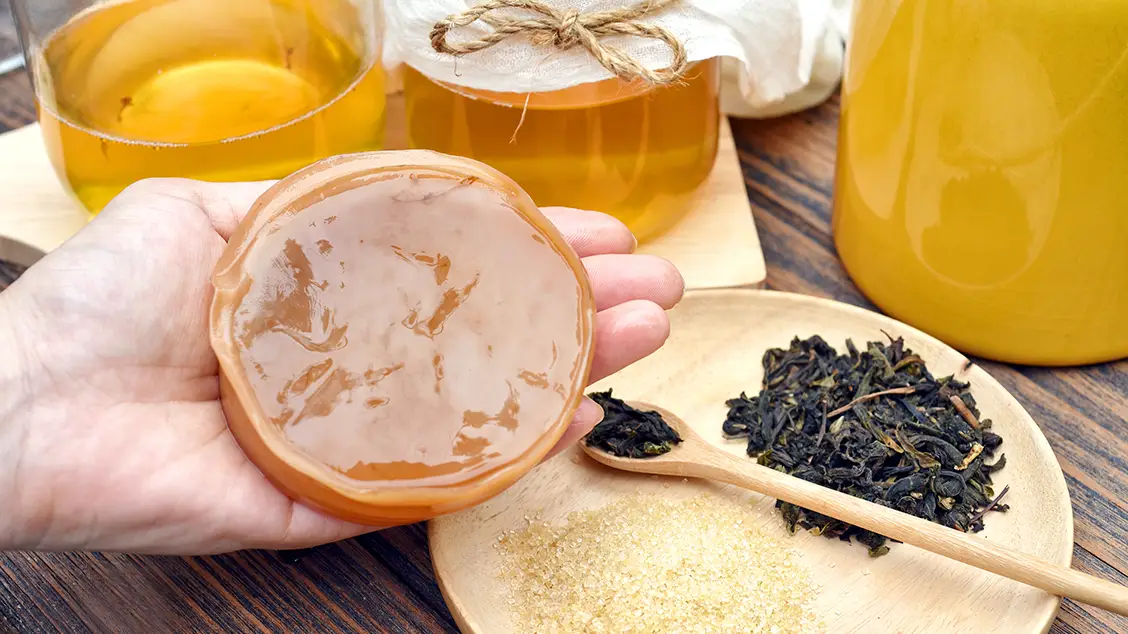
A healthy SCOBY looks more like :
There may be :
All these irregularities may be worrying at first, but they are not mould.
Very often, what worries beginners most… is perfectly normal.
What you can see without it being a problem:
These elements :
They indicate that your kombucha is alive, fermenting and that the yeast/bacteria community is at work.
Once the presence of mould has been confirmed, you need to understand why it has appeared. The causes are often linked to an environment that is too favourable to intruders, and not sufficiently protected by acidity and good practices.
Kombucha naturally protects its surface thanks to its high acidity.
At the start of a new batch, you mix :
If you put in too little mother kombucha (or kombucha that isn’t acidic enough), the initial pH of the jar will be too high. Result:
This is one of the main causes of contamination, especially in the early stages.
Temperature has a direct impact on the speed of fermentation:
If your kombucha takes a long time to acidify :
In winter, in an unheated kitchen, it’s a classic scenario:
SCOBY Natural Probio is healthy, but it doesn’t have what it takes to build up acidity quickly enough.
Mould often comes from the air and from fruit flies (drosophila), which love :
If :
flies can get in, wander around, sometimes lay eggs, and above all deposit micro-organisms.
Even if there are no visible insects, a poorly covered jar will let in :
This isn’t always a problem… as long as the acidity protects the environment. But if the kombucha is also low in acidity, the spores will find an ideal breeding ground.
The natural microbiota in kombucha is robust, but it doesn’t work miracles. If :
you introduce a high microbial load that is foreign to the kombucha ecosystem. Most of the time, the kombucha is fine, but sometimes another organism takes over. Mould.
A SCOBY or part of a SCOBY left behind :
can :
The dry surface is much less protected by the acidity of the liquid, making it easier for intruders to cling to it.
If your SCOBY :
it can become less vigorous. Its ability to acidify a new batch quickly diminishes, and moulds have an easier time of it.
With a SCOBY Natural Probio, you’re starting from a strong base, but even a good strain can weaken if kept for a long time in poor conditions.

This is the part that often disappoints. Once the mould has set in, there is unfortunately no miracle solution to ‘save’ the batch.
It’s tempting to say:
« I’ll just remove the stains with a spoon, and everything will be fine… »
Unfortunately, this is a very bad idea. Mould :
By simply scraping, you remove the visible part, but not the rest. The kombucha remains deeply contaminated, even if the surface appears cleaner.
For safety reasons, mouldy kombucha is considered :
If you have identified real mould :
It’s the only way to be sure you don’t come away with a contaminated crop.
Even if the spots seem to be limited to one area, the logic remains the same:
So we throw away the whole SCOBY and start again with another one.
It’s painful at the time, but it’s safer and often simpler than trying to cut, sort and save pieces.
Contamination can happen to anyone, no matter how careful you are. But a few simple steps can greatly reduce the risk.
For each new batch :
In practice:
An acidic environment from the outset is the best barrier against mould.
Try to keep your jar:
If your house is cold :
The faster fermentation starts, the less time moulds have to establish themselves.
To cover your jar:
Avoid :
The surface of the kombucha should breathe, but not be open to the wind.
Before each batch:
You don’t need any chemical disinfectant, just good basic hygiene.
Then leave to dry or use a clean cloth.
For SCOBY :
A chaotic, dry surface stuck to the walls is a perfect breeding ground for mould. A well-submerged SCOBY is much better protected.
Every time you :
you introduce the possibility of contamination.
Try to :
The fewer unnecessary gestures you make, the more stable the culture.

Once you’ve got everything out of the way, the next step is to decide how to continue the kombucha adventure.
If you had already set up a hotel in SCOBY:
If everything is healthy, you can :
Your hotel then acts as an emergency stump bank.
If you don’t have any healthy SCOBYs left, or if you have doubts about the health of what you have left, the easiest and safest thing to do is :
This is precisely the advantage of a quality culture such as Natural Probio:
By starting again on this basis and correcting previous mistakes (lack of acidity, cold, insufficient cover…), you will greatly reduce the risk of mould developing again.
No.
Even if the visible area is small, the mould may have spread deep down.
For your safety, we consider a contaminated SCOBY… lost.
Certain white, smooth, slightly translucent areas on the surface of the SCOBY or the liquid may be :
If the texture is :
it’s probably not mould.
If, on the other hand, the area is cottony, dry and irregular, then it is mould.
No.
Brown filaments, deposits at the bottom and dark areas in the SCOBY are usually yeast and old layers of biofilm. This is normal and common.
No.
Even if the idea of throwing away an entire jar is frustrating, safety comes first. Toxins or mould fragments may be invisible. It’s not worth the risk.

Seeing mould on your kombucha for the first time is always a shock.
You feel like you’ve ‘failed’, you doubt yourself, you wonder if it’s all too complicated.
In reality :
The procedure is simple:
Jar after jar, you’ll see that mould will become the exception, not the norm.
And the day you open your cupboard and see nothing on your kombucha but a beautiful, smooth, clear, gelatinous film, with no fuzz or coloured stains, you’ll know you’ve found your own way of working with living things.
📚 Read also :
Sources :
📖 Go further: read our How to Make Kombucha at Home: The Complete Guide, with a batch calculator, timings and troubleshooting.
Ready to try it yourself?
Discover our live kombucha SCOBY, shipped in 24/48h with a step-by-step English guide. And for the curious, the history of kombucha is a fascinating read.