
When you start making homemade kombucha, one of your first concerns is:
what do you do with your SCOBY when you’re not brewing?
As you read blogs and forums, you come across two opposing camps:
On the one hand, there are those who say:
« Put your SCOBY in the fridge, it’ll put it on pause ».
On the other hand, there are those who say:
« Don’t do it! You’ll kill it, keep it at room temperature ».
Result: you’ve got your SCOBY of kombucha, perhaps a freshly-arrived SCOBY Natural Probio, and you’re hesitating. You’re going on holiday, you’re short of time, or you simply don’t want to brew for a few weeks… and you don’t know what to do.
The truth is more nuanced. You can technically put a SCOBY in the fridge, but it’s neither the magic solution nor the ideal method in most cases. Depending on how you do it, the fridge can :
In this article, we will :
The aim is simple. For you to know when and how to use (or avoid) the fridge, to keep your culture healthy and ready to brew living kombucha, especially if you’re working with a Natural Probio strain.
Before talking about refrigerators, we need to go back to the very nature of SCOBY.
A SCOBY of kombucha is not just a gelatin disc that you put somewhere. It’s a living biofilm, made up of :
This ecosystem functions optimally in a mild temperature range, generally between 20 and 26°C. This is where :
This is what happens in your jar when you make homemade kombucha with SCOBY Natural Probio in a temperate kitchen.
The refrigerator is designed to slow down microbial life. At around 4°C :
The SCOBY is not necessarily « dead » in these conditions, but it is almost asleep. If the cold continues :
To sum up: SCOBYs don’t take well to major temperature shocks and don’t like living in a fridge for long.
It’s no coincidence that so many people think of the fridge. At first glance, the idea seems logical.
We tend to think of the fridge for several reasons:
On paper, it looks like a simple solution:
« I’ll put it in the fridge, and I’ll find it as is in a month. »
In practice, this « break » in the cold is not neutral:
When it’s time to take the SCOBY out of the fridge, you’re sometimes left with :
So it’s not a real ‘perfect backup’, but rather a solution of last resort, to be used with caution.
There are several scenarios where the fridge is clearly a no-go for your SCOBY, especially if you’re working with a healthy strain like the one supplied by Natural Probio.
When you have just received a SCOBY :
Put it in the fridge at this stage:
On the contrary, it’s better to bake a few times at the right temperature to consolidate the lineage.

Many novice brewers think :
« I don’t brew for a fortnight, I put the SCOBY in the fridge straight away ».
In reality, for a break of a few days to 3-4 weeks, it is much healthier to :
The fridge does nothing in this case, it simply adds unnecessary heat stress.
Putting a SCOBY in the fridge in a sweet, slightly acidic tea is particularly risky:
Before any chilling (if you really have no choice), the SCOBY should be surrounded by kombucha, which is already quite acidic and the result of complete fermentation.
Now that the framework has been established, we have to be honest. There are some specific situations where the refrigerator can be a lesser evil.
Assume that :
In this case, leaving a jar at room temperature, unattended, may be more risky than placing part of your culture in the fridge, in a very acidic medium, in the hope that it will survive in idle mode.
This does not guarantee perfect reactivation, but it can be an extra safety net, in addition to other measures (giving a SCOBY to a relative, for example).
If you live in an environment where the indoor temperature can rise well above 30°C for a long time, and :
then, under very strict conditions, refrigerated storage of a fraction of the SCOBY can be envisaged as a back-up solution.
But then again, it has to be :
If you’ve understood the limits but are in a case of force majeure, here’s how to minimise the risks.
Never use simple sweetened tea to store in the fridge. Instead, prepare :
You can add a small amount of cooled sweet tea, but the essential liquid must be very acidic, to keep the pH low and protect the SCOBY.
Don’t put your entire bloodline in the fridge. Keep :
Leave other discs in a SCOBY hotel at room temperature, if you can. This will increase your chances of recovering a healthy crop when you return.
Place the SCOBY in the jar of acidic kombucha:
Avoid jars that are too narrow or too wide, where the SCOBY could stick to the sides and partially emerge.
In the fridge, you can :
The jar does not need to be ventilated as much as at room temperature, as activity is very low. The main aim is to protect the culture from odours and possible contamination.
The longer SCOBY stays cold, the more :
If you can limit the time in the fridge to a few weeks, that’s better. After 2-3 months, the chances of full reactivation of the culture diminish significantly.

Imagine you’ve already stored your SCOBY in the fridge, or you’ve received it from someone who’s been keeping it there. How do you give it a real chance to restart?
Don’t suddenly move from the fridge to a very warm room. Take the jar out:
Observe:
If anything looks seriously wrong (mould, putrid smell), it’s best not to attempt reactivation and to start again with a healthy SCOBY, for example a new Natural Probio culture.
To give the SCOBY the best chance of getting back on track:
In this way, you create a :
A SCOBY out of the fridge won’t necessarily produce immediately:
The first batch after reactivation is often used to :
You can :
The second or third batch often has a more satisfactory profile.
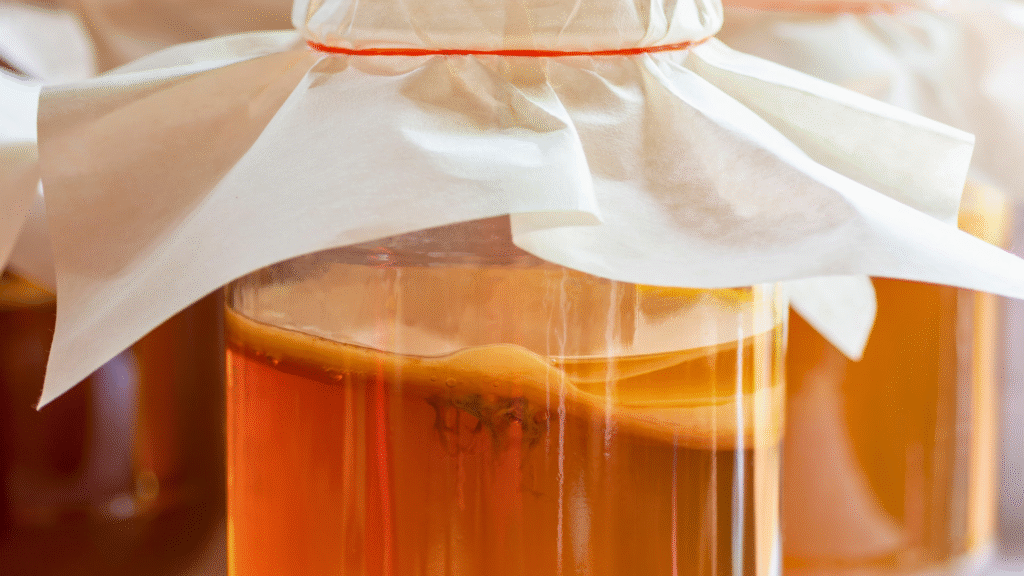
For the vast majority of home brewers, especially with a quality culture like a SCOBY Natural Probio, the best alternative to the fridge is the SCOBY hotel.
A hotel in SCOBY :
Under these conditions, your line of kombucha :
If you need to take a break for several weeks or months and still have the opportunity to take a look at the jar from time to time, the hotel at SCOBY is far superior to the fridge.
With a SCOBY hotel, you can keep several disks:
If one day :
you can return to your hotel and start afresh with a clean slate, without having to rely on the hypothetical survival of a SCOBY that’s been in the fridge for months.
To clarify things even further, here are a few frequently asked questions.
Yes, but it’s not the same thing.
Bottled, ready-to-drink kombucha keeps very well in the fridge:
Putting the drink in the fridge is normal.
Putting the culture (SCOBY) in the fridge is a different story, with the precautions we have seen.
It’s not ideal.
If you really have no other option for short storage, make sure you don’ t fill the bottle completely, and open it from time to time to release any excess pressure. But on the whole, a larger jar is still much more suitable.
« Death » is a strong word. If :
it’s worth trying to reactivate it by following the steps outlined above.
However, if :
it’s safer to throw it all away and start again with a healthy SCOBY. That’s when a new Natural Probio culture or a disc from a well-maintained SCOBY hotel makes all the difference.
Summing up everything we have seen, the reasonable position is as follows:
For a brewer starting out with SCOBY Natural Probio, the aim is not to look for complicated solutions, but to :
So you use the fridge where it excels, to store your bottles of ready-to-drink kombuchaand you keep your SCOBY in the environment it prefers. A glass jar, acidic kombucha, a temperate temperature, a living kitchen.

The question « Can you put a SCOBY in the fridge? » calls for a qualified answer.
Yes, it can be done, technically.
But no, it’s not the best way to look after your crop in most situations.
The fridge :
For everything else, room temperature care and a well-managed SCOBY hotel remain the safest, simplest and most respectful solutions for the living nature of kombucha.
By working with a quality SCOBY, such as those offered by Natural Probio, you’ll soon discover that the key is not to « chill » everything, but to learn how to support living things: provide them with a stable environment, feed them from time to time, observe their behaviour and build a relationship of trust with your jar.
The day you open a new bottle of kombucha, sparkling, balanced, born of a culture that you’ve been able to keep in shape month after month, you’ll see that this patient care was worth much more than the apparent ease of the fridge.
📚 Read also :
Sources :
📖 Go further: read our How to Make Kombucha at Home: The Complete Guide, with a batch calculator, timings and troubleshooting.
Ready to try it yourself?
Discover our live kombucha SCOBY, shipped in 24/48h with a step-by-step English guide. And for the curious, the history of kombucha is a fascinating read.