
For some years now, the word ‘kombucha’ has been appearing on labels, in cafés and on social networks. It is presented as a ‘living’, fizzy drink, sometimes as a healthier alternative to soft drinks. But behind this trendy image lies an ancient, highly codified fermenting tradition based on a very specific organism. The kombucha culture, often called SCOBY.
For many people, kombucha is first and foremost a curiosity. A slightly acidic drink with fine bubbles and a taste somewhere between tea, sweet cider and sometimes a hint of vinegar. For others, it’s become a part of their daily routine, to help with digestion, diversify their daily beverages and reduce their consumption of ultra-sweet drinks.
Understanding kombucha means understanding the drink, the culture that creates it and the fermentation logic behind it. It also means knowing what this drink really contains, what it isn’t, and how to approach it in an enlightened way.
Basically, kombucha is « just » sweet tea. An infusion of black, green or sometimes white tea is prepared, to which sugar is added. But instead of drinking the sweet tea as it is, it is fermented using a symbiotic culture of micro-organisms.
This fermentation transforms sweet tea into a drink:
So we’re talking about a fermented tea-based drink. Kombucha is not just « flavoured tea » or a simple flavoured fizzy drink. It is the result of living fermentation.
To transform this sweet tea into kombucha, a culture is needed. This is called SCOBY (Symbiotic Culture Of Bacteria and Yeast), or kombucha culture.
Visually, it is a gelatinous disc of varying thickness that floats or sinks in the liquid. This disc is made up of :
The SCOBY feeds on the sugar in the tea and gradually transforms it:
It is this dynamic that gives kombucha its characteristics. A slightly acid taste, fizz, a gradual reduction in sugar, the appearance of bubbles and complex aromas.
At Natural Probio, the whole approach to kombucha is based on this: a healthy, balanced and well-maintained SCOBY, because without good cultivation, it’s impossible to obtain regular, high-quality kombucha.
The exact origins of kombucha are still shrouded in mystery, but several sources suggest that it first appeared in Asia, probably in China or Manchuria, several centuries ago. There are references to fermented beverages made from tea, associated with the virtues of tonus and vitality.
At the time, there was no talk of « probiotics » or « microbiota », but people had already observed that a slightly acidic, fermented drink could be better tolerated than dubious water and could be incorporated into rituals for health and longevity.
The drink then travelled to Russia and Eastern Europe, where home-made fermented drinks were prepared from crops passed down from family to family. In these regions, kombucha is sometimes called « kvass tea » or referred to by local names.
In the 20th century, the drink spread to various European countries, often in the form of homemade preparations, before falling into decline with the arrival of industrial soft drinks.
Over the last fifteen years or so, kombucha has made a strong comeback:
This resurgence is part of a wider movement. A return to fermented foods, interest in intestinal microbiota, curiosity about drinks that are less sweet and less artificial.
To make a classic kombucha, all you need are a few ingredients:
The sugar is not there to ‘sweeten’ the final drink, but to feed the culture. By the end of fermentation, much of the initial sugar will have been consumed by the micro-organisms.
The first fermentation, often called F1, follows a fairly simple logic:
Taste evolves over time:
The role of the person preparing the kombucha is to adjust the fermentation time to achieve the desired flavour.
Many people then like to carry out a second fermentation (F2):
This step increases the fizz, as the carbon dioxide remains trapped in the bottle. It also allows kombucha to be made in a multitude of flavours.
In the following Natural Probio articles, these steps will be described in detail (choice of water, tea, maintenance of the SCOBY, problem solving, etc.), to provide step-by-step guidance for all those who want to make a success of their homemade kombucha.

Kombucha generally contains :
These acids are largely responsible for the acidic taste, as well as for certain properties traditionally associated with kombucha (sensation of a ‘cleansing’ drink, impression of digestive freshness, etc.).
Kombucha is not a « sugar-free » drink. The remaining sugar depends on :
A short fermentation will produce a sweeter, milder kombucha, sometimes more accessible to beginners. Long fermentation produces a much more acidic drink, with rarely more than a few grams of residual sugar per glass.
For those who watch their sugar intake, the advantage is that they can adjust the fermentation time by observing the taste that suits them best.
Because yeast produces carbon dioxide and alcohol, kombucha contains :
In a well-managed kombucha, drunk under normal conditions, the alcohol content is generally low. However, if fermentation is prolonged or poorly controlled, the alcohol content may increase. So it’s important to follow good practice and remember that kombucha is a fermented drink, not flavoured water.
Depending on whether it is pasteurised or not, kombucha may contain :
When you make your own homemade kombucha from quality SCOBY, you generally obtain a live, unpasteurised drink in which fermentation is still slightly active at the time of consumption.
Kombucha is often presented as a « miracle » drink. In reality, it is more accurate to see it as a traditional fermented drink, comparable in spirit to :
People who use it regularly often mention :
But it’s important to remember that kombucha is not a substitute for a balanced diet, medical advice or treatment. It is a lifestyle supplement, not a medicine.
One of the great benefits of kombucha, especially when you make it yourself, is that it can be used to diversify your everyday drinks:
For some people, this indirectly contributes to a healthier diet, simply by replacing ultra-processed drinks with a home-made fermented beverage.
Kombucha is often mentioned in connection with intestinal microbiota. In practice:
Once again, there’s no question of presenting it as a one-size-fits-all solution. But as part of a varied, high-fibre, plant-based diet, kombucha can contribute to a more diverse eating environment.
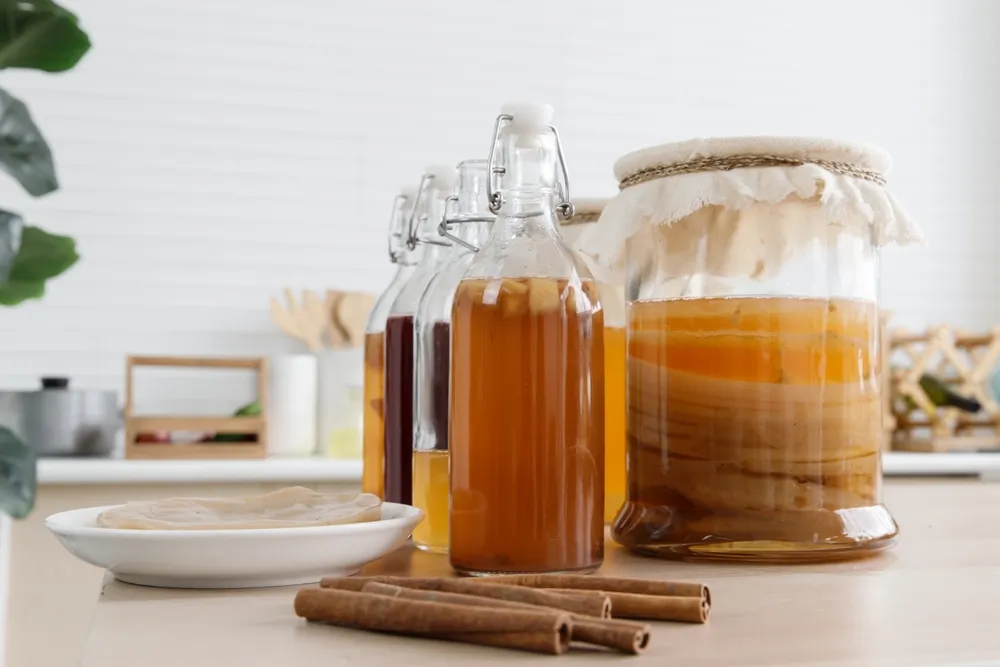
When you make your own kombucha at home, from a healthy crop, you keep your hands on :
This makes it possible to create a truly personalised drink, and to play with flavours. More or less acidic, more or less sparkling, with a wide variety of aromatic profiles (ginger-lemon, red fruit, citrus fruit, spices, aromatic plants, etc.).
At Natural Probio, the idea is to provide the most reliable basis possible: a SCOBY of stable, quality kombucha, with advice so that everyone can try it out without starting from scratch.
Small artisanal brands often offer kombuchas:
They’re an excellent way of discovering the drink before starting at home. You’ll often find the spirit of homemade kombucha, but ready to drink.
You can find kombuchas in some supermarkets:
They have the advantage of convenience, but are sometimes a far cry from traditional live kombucha. Understanding this helps us to choose better and not confuse everything: not all kombuchas are the same, in terms of process, sugar content and flora.
Although kombucha is a traditional drink, it is not suitable for all situations.
We generally advise caution or avoid kombucha in certain situations:
In all cases, when in doubt, it is wise to seek the advice of a health professional.
For the majority of adults in good health, when kombucha is prepared according to the rules of hygiene and consumed in a reasonable manner, it fits in without difficulty. But to be on the safe side, we often advise :
This allows the body to get used to it, especially if you don’t eat a lot of fermented foods.
There is no single rule, but one approach that is often suggested is :
The most important thing is to listen to your own sensations. Digestive comfort, energy, tolerance.
When you’re just starting out, you can :
Then, moving on to in-house preparation allows you to personalise even more.
On a site like Natural Probio, resources don’t stop at SCOBY itself. Guides and articles explain how :
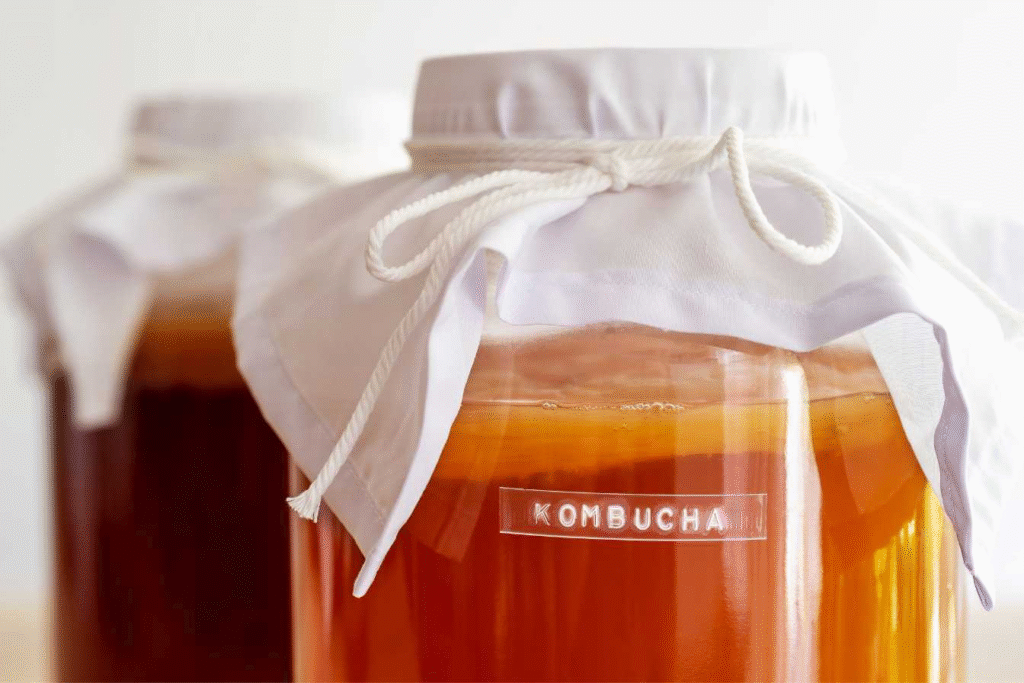
Many people try to start a kombucha from commercial bottles, without always knowing whether the drink still contains active micro-organisms. The result: capricious fermentation, fragile SCOBY, irregular taste.
Starting with a SCOBY of robust kombucha from a well-maintained lineage means :
That’s precisely what the Natural Probio kombucha offer is all about. Providing a reliable, controlled basis for creativity in recipes.
Selling a SCOBY for the sake of selling a SCOBY doesn’t make much sense. What really counts is the experience you have afterwards:
Future articles on the Natural Probio blog, following on from this first guide « What is kombucha? », will detail every aspect: the composition of SCOBY, the difference with a vinegar mother, the choice of water and tea, managing fermentation problems, maintaining a SCOBY hotel, etc.
A SCOBY of kombucha is not a simple « ingredient ». It’s a living culture that reacts to :
By learning to observe and understand it, you develop a certain intuition. Eventually, you’ll know at a glance whether everything is going well.
This is where the educational resources, explanation sheets and experience feedback come into their own. Natural Probio is destined to become a reference point for those who want to make fermentation a natural part of their daily lives.

Kombucha is more than just :
It’s an encounter between an ancestral gesture, a living culture (the SCOBY) and your domestic environment. Understanding what kombucha is is already an important step towards successful fermentations, balanced drinks and a more conscious relationship with what we drink.
In a nutshell:
With a quality SCOBY and clear explanations, it’s possible to transform a simple sweet tea into a homemade drink rich in flavour, nuance and satisfaction. This is precisely the adventure that Natural Probio is proposing to accompany you on, step by step, over the next few articles devoted to kombucha and its world.
If you’re just discovering this drink, this first guide lays the foundations. Subsequent guides will go into more detail on each of the questions that beginners ask themselves: SCOBY composition, choice of tea, dealing with problems, cultivation maintenance… making kombucha an everyday companion, not just a passing fad.
📚 Read also :
Sources :
📖 Go further: read our How to Make Kombucha at Home: The Complete Guide, with a batch calculator, timings and troubleshooting.
Ready to try it yourself?
Discover our live kombucha SCOBY, shipped in 24/48h with a step-by-step English guide. And for the curious, the history of kombucha is a fascinating read.