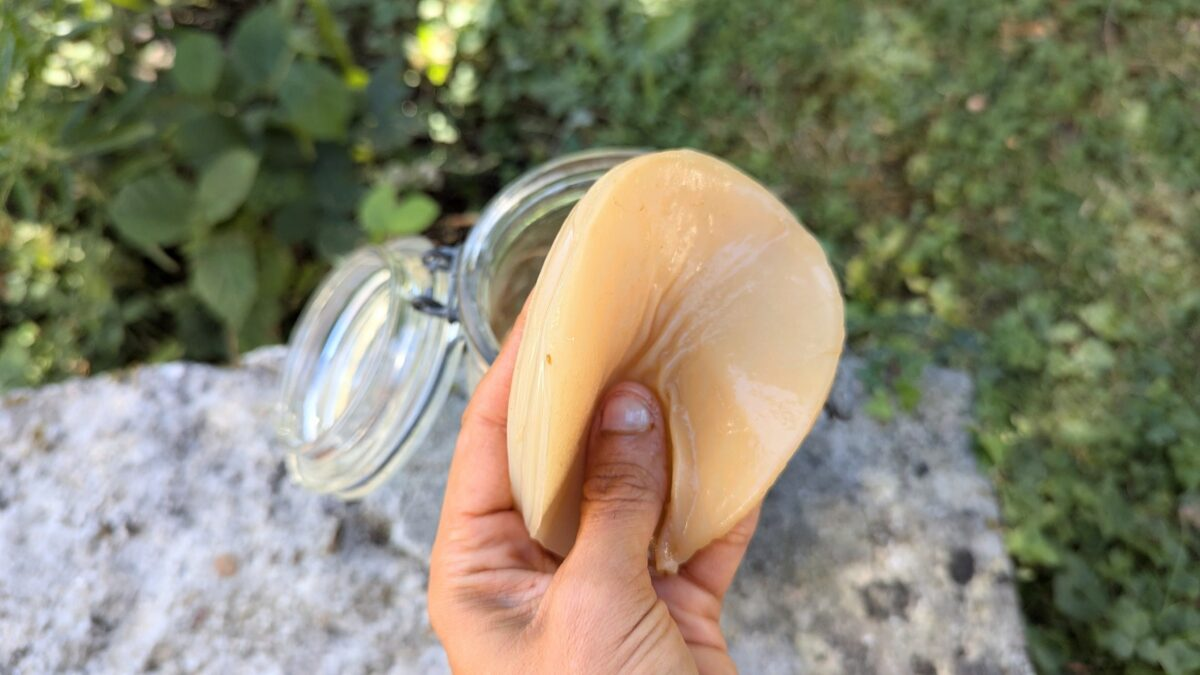
When you start making kombucha, you quickly become attached to your SCOBY. You watch him, you worry, you wonder if he’s all right… and sooner or later a question comes up. Is he still alive or has he ‘died’ for good?
This concern is normal. SCOBY is not a simple ingredient, it’s a living culture made up of yeast, bacteria and a cellulose matrix. It changes over the weeks, thickens, forms new layers, darkens a little and produces filaments. All this can easily confuse a beginner.
This guide is designed to help you tell the difference between :
a healthy SCOBY, even if it’s not « perfect ».
a tired SCOBY in need of a boost
a truly compromised SCOBY that should be thrown out without hesitation
It is one of a series of Natural Probio articles devoted to kombucha and SCOBY, to help you prepare your homemade products step by step.
A quick reminder, what does a live SCOBY look like?
Before asking whether he’s dead, it’s important to understand what a living SCOBY is.
A healthy SCOBY of kombucha is :
A disc or « wafer » of cellulose, of varying thickness, which floats on the surface or sinks to the bottom.
A community of yeasts and bacteria housed in this matrix, but also in the starting liquid
An acidic environment (thanks to the starter liquid) that protects the crop
In the right conditions, this SCOBY :
turns sweet tea into kombucha
produces gas (CO₂), hence the sparkling appearance after a second fermentation.
gradually acidifies the liquid, making it taste less sweet and more vinous
A living SCOBY is not a « perfect », immobile object. It’s a small farm of micro-organisms that breathe, consume, transform and evolve.
Signs of a healthy SCOBY
Before moving on to the problems, let’s look at the positive indicators. Many SCOBYs thought to be « dying » are in fact in great shape.
Its visual appearance
A live SCOBY can have several characteristics:
Colour: cream, beige, slightly brown, sometimes with darker areas. The older it gets, the darker it tends to become.
Surface: smooth or slightly bumpy. There may be creases, trapped bubbles or slight irregularities.
Thickness: a few millimetres at first, then several centimetres if you leave it to ferment for a long time.
New layers: with each batch, a new disc forms on the surface. This is an excellent sign of vitality.
Important information: Perfection is not a health criterion. A slightly twisted SCOBY, with bubbles or folds, can be much more active than a perfectly smooth disc.
Its behaviour in the jar
Contrary to what we sometimes read, a live SCOBY does not necessarily float on the surface.
It can :
float to the top
be suspended
sink to the bottom
All this remains normal. The position of the SCOBY depends on its density, the temperature, the amount of CO₂ in the liquid, etc. What matters is not where it is, but what it does:
a new disc forms on the surface, even if the old one is at the bottom
bubbles rise up the SCOBY during fermentation
the smell of the jar gradually becomes tangy and pleasant
The smell of the crop
A living SCOBY is best expressed by the smell of kombucha.
Positive signs :
Winey, tangy smell
Notes of tea, green apple, sometimes slightly fermented
Fragrance reminiscent of sweet vinegar or light cider
Even if the liquid is very acidic, a good crop should not smell of rot, eggs, mould or aggressive chemicals.
The taste of kombucha
Even more than the appearance of the SCOBY, it’s the taste of the drink that will tell you whether the culture is active.
Between D+5 and D+10 (at correct room temperature) :
kombucha is less sweet than the original tea
it’s starting to get a bit acidic
there’s a noticeable change from one day to the next
If you feel the sugar decreasing and the acidity increasing, it’s because the yeasts and bacteria are working. So your SCOBY is alive.
False alarm signals… which are actually normal
Many beginners think their SCOBY is « dead » because of signs that are actually part of normal fermentation. Before you panic, check that you’re not in one of these situations.
The SCOBY sinks to the bottom
This is probably the most common false problem.
A sinking SCOBY doesn’t mean it’s dead. It may simply be :
denser than the liquid
a little older and heavier
displaced by the formation of bubbles
In most cases :
the old SCOBY sinks
a new SCOBY forms on the surface
As a result, you now have two discs, and more living material for your future batches. That’s pretty good news.
Brown filaments or deposits in the jar
These brown filaments, often attached to the SCOBY or suspended in the kombucha, are generally :
dead or excess yeast
tea residues
yeast « tails » that have been actively working
As long as they are :
smooth, gelatinous or stringy
brown, beige or almost black
not fluffy
… they’re not a problem. You can filter them out when bottling, but they don’t mean your SCOBY is dead.
Small bubbles and air pockets under the SCOBY
Bubbles are a sign of active fermentation. It is therefore perfectly normal to see :
bubbles stuck under the SCOBY
slight air pockets in the cake
the SCOBY to deform a little because of the gas
This doesn’t mean it’s rotting, on the contrary. The yeasts produce CO₂, a sign that the culture is alive.
Irregular colours or a « marbled » SCOBY
Over the course of the batches, SCOBY recovers pigmentations from the tea and yeast. It can become :
darker in some places
mottled with lighter or browner areas
slightly mottled, as long as the spots are not fluffy or green
Again, this is generally harmless. It’s the appearance of dry, coloured down (green, blue, black, very distinct white) that becomes a problem, as we’ll come back to later.
4. The real signs of a deteriorating or dying SCOBY
A truly compromised SCOBY presents much more obvious symptoms. The challenge is to recognise them in time to protect your health.
Mould visible on the surface
This is the most important criterion. Real mould.
It is generally presented as :
well-defined spots
on the surface, never at depth
dry or fluffy
green, blue, black, sometimes very clear white
It’s not an opaque film, or a viscous area. It’s a stain that really looks like mould on bread or jam.
In this case, there is no debate: Throw it out:
the SCOBY
all the liquid
any other discs that have been in direct contact
The risk of consuming toxins produced by these moulds is too great to « try and save » anything.
A frankly unpleasant smell
A healthy, living culture can be very acidic, but it doesn’t have to smell :
damp cellar mould
the old rotten cheese
the rotten egg
solvent or varnish remover
tainted meat
These odours indicate contamination by micro-organisms other than those found in kombucha. Even if you don’t see any mould stains, it’s best not to consume this batch.
Abnormal texture, SCOBY pasty, blackened or hard like burnt leather
A SCOBY at the end of its life may present :
a texture that crumbles when you hold it in your hand
a « muddy » consistency, like a jelly that breaks immediately
a very dark, almost black colour over the entire surface
a dry, hard appearance, like a piece of leather left out in the sun
These signs often indicate :
a crop left for months without replenishment of sweet tea
excessive heat, direct light or oxidation
a prolonged imbalance between yeasts and bacteria
In this case, it is sometimes possible to start from a younger layer, but you need to be very careful.
A total absence of fermentation despite good conditions
A SCOBY can be weakened, but not necessarily dead. The problem is when :
you have a good sweet tea
the temperature is correct (around 22-26°C)
the jar is protected from direct light
you have added a little acidic starter liquid
and yet, after 7-10 days… nothing happens
Warning sign :
the taste is still very sweet, like a sweet iced tea
no change in smell
no new layer forms on the surface
no yeast deposits appear
In this case, the SCOBY may be too weak or inactive. A more precise test (see next section) will be needed to decide.
Step by step, how do you check if your SCOBY is still alive?
Rather than throwing things out too quickly, you can give your SCOBY a little « health check ».
Stage 1, thorough visual inspection
Place yourself near a window in good natural light.
Look at the entire surface. Look for fluffy, dry or brightly coloured patches (green, blue, black).
Look at the underside. The presence of brown filaments (yeast) is normal.
Check the edges: no sharp round spots? no dry areas that look like scabs?
If there’s even the slightest hint of mould, don’t take any chances. Put everything in the compost bin or the dustbin, never in the tap or vegetable garden.
Stage 2, odour test
Smell the SCOBY and the kombucha liquid.
Ask yourself two simple questions:
Could I imagine taking a sip of this liquid?
Does it smell like vinegar tea, or does it repel me immediately?
If the smell is frankly disgusting, chemical, putrid or mouldy, don’t go any further. Throw SCOBY away, clean the jar thoroughly.
Stage 3, liquid taste test
This test is only performed if :
no visible mould
the scent remains in the « vinegar » register, even if it’s not very pleasant
Taste a very small spoonful of kombucha:
If it’s a little acidic, less sweet than the start, with a hint of tea. Fermentation is still going on.
If it’s only sweet, with no development. The crop may no longer be working.
If it has a distinctly suspect taste (metallic, mouldy, producty). Call it a day.
Step 4, The « booster test » in a small jar
If you are still hesitating, you can carry out a relaunch test.
Prepare a small jar (0.5 L for example), perfectly clean and rinsed with no residual washing-up liquid.
Make a black or green tea, sweetened (about 50-80 g of sugar per litre, so 25-30 g for 0.5 L).
Leave to cool completely.
Add a piece of your SCOBY (or a whole wafer if it’s small) and a little acid starter liquid (about 10-15% by volume).
Cover with a clean cloth and a rubber band.
Leave at room temperature, out of direct sunlight.
Monitor for 7-10 days:
A new thin film forms on the surface? The SCOBY is alive, even if it was weakened.
The taste changes, becoming more acidic? Culture still has its resources.
Nothing happens, the tea stays sweet, no disc forms? Your SCOBY is probably inactive.
The key figures from this page at a glance.
When should SCOBY be disposed of without hesitation?
To be on the safe side, there are some situations where the decision has to be clear-cut. Throw everything away and start afresh on a sound footing.
Confirmed presence of mould
As soon as you identify real mould stains :
dry or fluffy stains
on the surface, well defined
bright green, blue, black or white
… the only responsible solution is to throw everything away.
Don’t try :
remove only the mouldy part
to « disinfect » the SCOBY with vinegar
filter the kombucha and drink it anyway
The toxins produced by some moulds are not visible to the naked eye.
Contamination by a dubious or dangerous ingredient
If your SCOBY has been in contact with :
non-potable water
a soiled utensil (dirty sponge, meat board, etc.)
a household product or detergent
mouldy plants, fruit or herbs
… it’s better to start from scratch.
Cultivation abandoned for very long months
A very acidic « SCOBY hotel » can remain stable for a long time. But what if :
it’s been over a year since you’ve fed anything
the liquid has evaporated to the point where it no longer covers the discs
the SCOBYs have become hard, dry, brittle or completely black
It’s more sensible not to try and reactivate them. It’s better to invest in a new culture, especially if you have high health expectations.
Can a weakened SCOBY be saved?
Not all tired SCOBYs are doomed. If there’s no mould and no repulsive smell, you can try to get it back into shape.
Starting with a young layer
Sometimes, it is mainly the top, older layer that is damaged. You can :
gently separate the layers of SCOBY
keep your skin looking younger, lighter and more supple
discard the darkest or thickest layers
This young layer will serve as the base for a new jar.
Offering dream conditions
To reinvigorate your SCOBY :
Use a good quality classic black tea (or a black/green blend).
Make sure the sugar content is high enough (around 60-70 g per litre for a boost).
Add enough acidic starter liquid (10-20% of the total volume).
Keep the jar at a stable temperature, ideally between 22 and 26°C.
Avoid temperature shocks, cold draughts and direct sunlight.
A weakened SCOBY may take a little longer to recover, but if you see a new disc forming on the surface, that’s a good sign.
When it’s better to start with a fresh crop
However, there is a point at which persisting no longer makes much sense. If, despite several attempts :
no new film is formed
tea remains stubbornly sweet
the smell never really becomes vinegary
… you risk wasting time, tea and sugar.
In this case, starting with a healthy, controlled and well-balanced culture (for example a live SCOBY supplied with its starter liquid by a specialist producer like Natural Probio) will save you time and peace of mind.(Natural Probio)
How to prevent your SCOBY from dying too quickly, good habits
The best way to avoid wondering too often « is it dead? » is to install routines that keep your culture robust.
Simple but rigorous hygiene
You don’t need a laboratory, but :
Always wash your hands before touching the SCOBY.
Use clean glass jars, rinsed thoroughly to remove all traces of washing-up liquid.
Avoid reactive metal utensils (prefer wood, food-grade plastic or good quality stainless steel).
Protect the jar with a clean cloth, tightened with a rubber band, to keep insects out.
Good tea/sugar/temperature balance
For the yeasts and bacteria to work properly :
Sugar: don’t reduce the amount of sugar in your starter tea too much. It’s their food. You can always reduce the fermentation time to obtain a less acidic drink.
Tea: use a real tea (black, green, oolong). Herbal teas alone are tricky to manage for long-term fermentation.
Temperature: below 20°C, the crop slows down considerably. Above 28-30°C, it can become unbalanced or stressed.
Sheets like those provided by Natural Probio on how to prepare kombucha at home can help you keep these parameters under control and keep your SCOBY vigorous for many years to come.(Natural Probio)
Regularly changing the sweet tea
A SCOBY that goes weeks without a new food will eventually wear out.
For a ready-to-drink drink, generally allow 7 to 10 days for fermentation, depending on the temperature and your tastes.
If you’re going on holiday, remember to put your crop in a large, fuller jar (like a SCOBY hotel) with enough liquid to last the duration.
By offering your SCOBY sweet tea on a regular basis, you can avoid the stress of an environment that has become too acidic and lacking in nutrients.
Protecting your culture from extremes
Avoid direct sunlight, which heats up the jar and spoils the tea.
Do not place your kombucha directly above a radiator or oven.
Don’t change location all the time. Micro-variations are OK, but daily moves are not necessary.
Frequently asked questions about « dead SCOBY
Is a very thin SCOBY necessarily weak or dead?
No. A young SCOBY, trained in a recent batch, can be very thin and yet extremely active. It’s not thickness that determines health, but the ability to :
produce new film
acidify the tea
generate yeast
Sometimes it’s better to have a young, thin but dynamic SCOBY than a huge, very old, dark and tired one.
My SCOBY has been in the fridge, is he dead?
Cold greatly slows down activity, but does not necessarily kill the SCOBY. On the other hand, prolonged refrigeration can :
weaken yeasts
unbalance the culture
increase the risk of mould when the liquid is reworked if it is no longer acidic enough
If your SCOBY has spent some time in a cool place, do a re-launch test as described above, in a small jar, before starting a large batch.
I can see small white bubbles on the surface, mould or fermentation?
It all depends on how you look:
Bubbles: round, translucent, sometimes grouped together, often moist or shiny. They may disappear when the jar is moved.
Mould: dry, fluffy, matt patches that spread like an island across the surface.
If in doubt, observe for another day or two. The bubbles will move or burst, while the mould will spread and become denser.
Can I use a SCOBY that smells almost nothing?
A very discreet smelling SCOBY can simply be :
preserved in a very mild starter liquid
kept at a slightly lower temperature
less active when you feel
What counts is evolution:
the first time you run a batch with it, the kombucha should become more acidic within a few days.
if nothing happens at all, despite the right conditions, it may be too low.
What’s the best way to start again after losing a SCOBY?
After a dead or contaminated SCOBY, the safest thing to do is :
Throw away all the culture (SCOBY + liquid).
Thoroughly clean your jars and utensils.
To leave with a healthy SCOBY, ideally supplied with starting fluid and clear instructions.
SCOBYs sold by specialists such as Natural Probio are prepared, tested and accompanied by detailed instructions to help you get off to a good start, which greatly reduces the risk of initial problems(Natural Probio).
The questions on this page, at a glance.The questions on this page, at a glance.
Conclusion, your Scoby is not fragile, he just needs the right environment.
The question « How do I know if my SCOBY is dead? » often hides another reality. The fear of doing the wrong thing and « breaking » the culture. The good news is that SCOBY is more robust than it seems.
In most cases :
a SCOBY that sinks, turns a little brown or forms filaments remains perfectly alive
a disc that continues to form new layers and acidify the tea is healthy
the real emergencies are the visible mould, the frankly rotten smells and the total absence of fermentation despite the correct conditions
Getting into the habit :
observe calmly
to smell and taste
carry out a small test relaunch in case of doubt
and the need to start afresh with a healthy, traditional culture
… you will transform what seemed to be a source of anxiety into a relationship of trust with your SCOBY.
If you want to get off to a good start, with a young, well-balanced disc and some starter liquid, you can rely on a SCOBY of Natural Probio living kombucha and their step-by-step preparation advice, designed for beginners and advanced users alike.(Natural Probio)
Your SCOBY may not be dead. He may just be waiting for you to give him the right conditions to continue working… batch after batch, until he becomes a real everyday companion.
Discover our live kombucha SCOBY, shipped in 24/48h with a step-by-step English guide. And for the curious, the history of kombucha is a fascinating read.