
When you make milk kefir, you sometimes get the impression that « it just works ». You put some grains in some milk, leave it on the work surface, and the next day you have a tangy drink. It’s true… but only on the surface. In reality, the fermentation of milk kefir is a living process that evolves continuously. And it’s precisely this evolution that explains :
Understanding fermentation means you stop putting up with kefir and start controlling it. Not rigidly, but intelligently: by knowing what’s going on, what you can adjust, and how to recognise the right signs.
And this logic applies to all fermented drinks. Many readers who have mastered kefir end up wanting to try kombucha. Here too, it’s all a question of balance: sugar, time, temperature, culture. To get off to a good start with kombucha, an authentic, natural kombucha strain is an excellent entry point, as it provides a reliable base for stable fermentation.
It’s often referred to as lactic fermentation, but milk kefir is richer than just acidified milk. The grains generally contain :
It’s this combination that gives kefir its distinctive profile: pleasant acidity (when well controlled), aromatic complexity, sometimes micro-stillness, and a texture that can resemble drinking yoghurt.
Unlike traditional yoghurt (often based on more targeted ferments), kefir is a more variable living system. That’s why it’s worth understanding « how it works ».
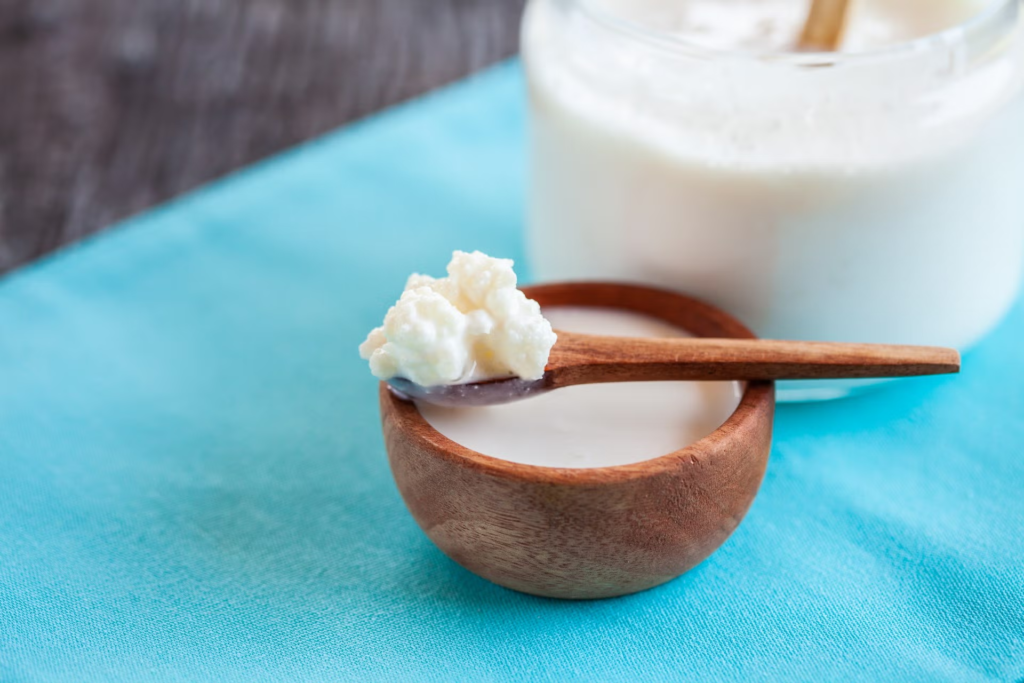
Kefir grains are a living matrix (often described as a natural network) in which micro-organisms live. They do not dissolve in the milk: they work in contact with the milk, then they are recovered and used again.
Their role is twofold:
The main sugar in milk is lactose. During fermentation, some of the lactose is consumed by micro-organisms. This has three direct consequences:
It’s important to be honest: fermentation often reduces some of the lactose, but it doesn’t guarantee ‘lactose-free’ kefir. The amount left depends on the time, temperature and activity of the grains.
To make fermentation easier to understand, it can be broken down into stages. This doesn’t mean that the process stops and starts again, but these markers help you to « read » your jar.
At first, the milk still looks like milk. The grains begin to take effect, but the changes are subtle.
What you can see:
This is an important phase, because if your grains are tired, this is when you’ll see slow fermentation.
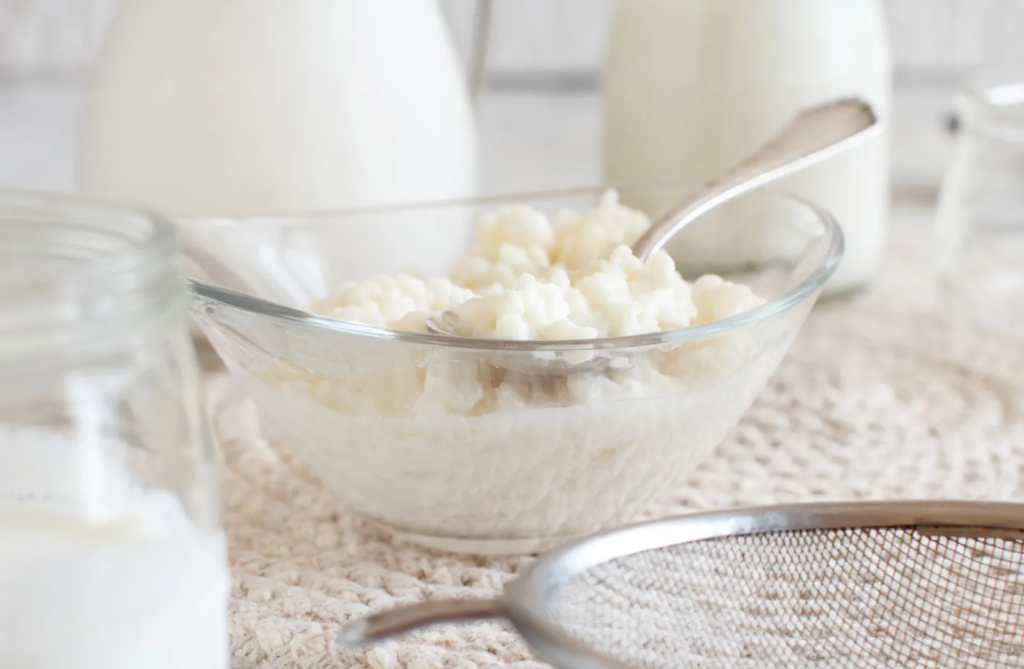
As the hours go by, the lactic acid bacteria produce lactic acid. The acidity gradually increases.
What you can see:
It’s often in this phase that people get the kefir they like: sweet, fresh, not too acidic.
If left to ferment for longer, the acidity will continue to increase and the structure of the milk may change further.
What you can see:
This phase is not « bad », but it is not to everyone’s taste. Some people like their kefir lively, while others prefer to stop before this stage.
Kefir is not a fixed recipe. It is controlled by four simple levers.
This is the most obvious lever. The longer you leave it to ferment, the more :
If your kefir becomes too acidic, the first adjustment is often to reduce the time.
Temperature speeds up or slows down fermentation.
This explains why kefir can be « perfect » in winter for 24 hours, but too acidic in summer for the same amount of time.
The more grains you add per litre of milk, the more dynamic the fermentation.
A common mistake is to put a lot of grains in, thinking it’s better, and then obtain a very acid kefir in a short space of time.
Tip: adjust gradually, and find the ratio that suits your cooking and your tastes.
Whole milk often gives a rounder, sometimes creamier kefir. Lighter milk often gives a more fluid kefir. Goat’s and sheep’s milk have different profiles.
UHT milk works, but some people find the result less ’round’ or more variable depending on the culture.
A successful kefir doesn’t have to be « perfect ». Above all, it must be :
Healthy kefir smells :
If it smells « mouldy », « rotten », « very strong cheese » or downright unpleasant, don’t take any chances.
Slight separation is not necessarily a problem. But extreme separation, accompanied by very high acidity, often indicates fermentation that is too long or too hot.
Taste is your best indicator. If it’s too acidic, you adjust:

Common causes:
Solutions:
Possible causes:
Solutions:
Often a sign of advanced fermentation.
Solutions:
Kefir is robust, but it’s not « magic ». A good routine is all you need:
The aim is not to be obsessive, but to be regular. Fermentation likes simplicity and consistency.
Many readers are interested in kefir because they associate it with digestive comfort. Here, we remain credible:
It’s a responsible approach that avoids medical promises.
When you understand kefir fermentation, you understand what’s essential:
Kombucha works on the same principle, but with a different medium (sweet tea). For readers who want to explore, Natural Probio offers an authentic, natural strain of kombucha that gives a clean start and keeps fermentation stable. It’s a logical recommendation in a series on home fermentations.
Milk kefir fermentation is a living process: the grains (lactic acid bacteria + yeast) transform the milk over the course of hours, producing lactic acid, aromas and sometimes a micro-still. The final result depends above all on four factors: time, temperature, quantity of grains and type of milk.
When you understand these levers, you can obtain a kefir that is milder or livelier, more liquid or creamier, and above all a regular kefir that suits your tastes.
And if this logic appeals to you, you can expand your fermentation universe with kombucha. For an easy start to a reliable culture, Natural Probio offers an authentic, natural strain of kombucha ideal for completing a « living drinks » routine.

It depends on the temperature, the quantity of beans and the milk. Many people get a good result between 12 and 24 hours, but you need to adjust according to taste.
Often due to fermentation that is too long, too hot or too many grains. Reduce one of these parameters.
Yes, especially if fermentation is advanced. Stir before serving or reduce the time next time.
It generally contains less lactose than milk, but not necessarily zero. The amount varies according to conditions.
Many do, but it’s better to start small and observe your tolerance.
The principle is similar (live culture + fermentation), but the medium is different (sweet tea). For an easy start, an authentic, natural strain of kombucha is a reliable base.
Sources :
📖 Go further: read our How to Make Kefir at Home: The Complete Guide, with a batch calculator, timings and troubleshooting.
Ready to try it yourself?
Discover our live milk kefir grains, shipped in 24/48h with a step-by-step English guide. And for the curious, the history of kefir is a fascinating read.