
Making milk kefir at home isn’t just about « making fermented milk ». It’s learning to work with a living culture. The result is fresher, more customisable, often tastier (because you control the acidity), and above all, you can reproduce a stable routine day after day.
Commercial kefir may be practical, but it is often standardised, sometimes sweeter, sometimes less expressive. Home-made kefir, on the other hand, has its own identity. It evolves according to your cooking, your temperature, your milk and the vitality of your grains. That’s exactly what fans of home fermentations like about it. You’re not just consuming it, you’re nurturing a culture, observing, adjusting and progressing.
And it’s also what creates a natural bridge to other fermented drinks. Many people who master kefir end up exploring kombucha. To get started with kombucha in the same spirit of « living culture + reliable method », Natural Probio offers an authentic, natural strain of kombucha that can be easily incorporated into a home fermentation routine, without any DIY or guesswork.
Making milk kefir at home involves a daily loop. You put kefir grains in milk, leave to ferment, filter, then put the grains back in fresh milk to start again.
The detail is that success depends on four parameters. Quantity of grains, type of milk, temperature and fermentation time. Once you understand these four levers, you can get exactly the kefir you like, sweeter, more acidic, thinner or creamier.
To make milk kefir at home, you don’t need a kitchen equipped like a laboratory. But you do need clean, simple, consistent basics.
A glass jar is ideal. Glass is odourless, easy to clean and allows you to observe the fermentation process.
A lid or clean cloth is used to protect the jar. Many people seal with a cloth and a (breathable) elastic band, while others use a loosely fitted lid. The important thing is to avoid contamination and maintain a stable routine.
A sieve (or filter) is needed to catch the grains. A spoon is useful for stirring gently to help the filtration process.
Finally, you need milk and kefir grains. Without live grains, there’s no kefir.
Kefir is robust, but fermentation likes cleanliness. A clean jar, a clean strainer and a clean spoon are all you need. There’s no need to be anxious or ultra-sterile, but you do need to be consistent.
This approach is the same for kombucha. Successful kombucha also depends on clean containers and a healthy culture. That’s why starting with an authentic, natural strain of kombucha is often simpler: you secure the base, then manage the rest with a clean routine.
Milk kefir works with most animal milks, but the result varies depending on the type of milk.
Cow’s milk is the most common, often the simplest, and produces a balanced kefir. Whole milk generally gives a rounder, softer, sometimes creamier texture. Semi-skimmed or skimmed milk can give a more fluid kefir, sometimes more acidic in perception.
Goat’s milk has a more pronounced flavour profile, which some people love and others not so much. Sheep’s milk is often richer and can produce a denser, creamier kefir.
You can make kefir with pasteurised or UHT milk. It works, but the result can vary depending on the brand and the way the milk has been treated. Many people find that pasteurised milk gives a more ‘stable’ fermentation in taste, but there is no single truth. The most important thing is to test, note down and keep what works for you.
We sometimes see ‘kefirs’ made from plant milks, but we have to be very careful with the words. Milk kefir grains live and feed in a milky environment, and most of the time they will not last in plant milks without a specific protocol. For stable, long-term use, milk kefir is made with animal milk.
If a reader wants a non-dairy fermented drink, the most logical solution is not to force the grains into a plant milk, but to switch to a fermentation designed for a sweet medium, such as kombucha. And in this case, the authentic and natural Natural Probio kombucha strain is a very coherent option to recommend, because it corresponds exactly to the right fermentation family.

One of the most frequently asked questions is. How much grain do you need for 1 litre of milk? The truth is that there is a range, not a magic number, because grain activity varies.
To start simply, you can start with a moderate quantity of grains for 1 litre, to avoid kefir becoming too acidic too quickly. Then adjust according to taste and room temperature.
The aim for beginners is to obtain a pleasant kefir in 18 to 24 hours (depending on the season), then refine. If your kitchen is warm, you’ll tend to reduce the time or reduce the grains a little. If your kitchen is cool, you can increase the time slightly or increase the grains a little.
Many people think that « more grains = better kefir ». In reality, too many grains accelerate fermentation, and therefore increase acidity more quickly. The result is very acidic kefir, sometimes separate, sometimes less pleasant.
Success rarely comes from excess. It comes from the right balance.
The length of time depends above all on the ambient temperature. In many kitchens, a fermentation time of between 12 and 24 hours gives a good balance. But instead of looking for a fixed figure, you need to learn to recognise the signs.
A mild kefir smells fresh and milky, with a slight acidity. A more fermented kefir smells more acidic, and its texture may thicken or begin to change. If you wait too long, it may separate into two phases, with a more liquid part and a denser part. This isn’t necessarily a « failure », but it’s often a sign that you’ve passed the ideal point for sweet kefir.
Kefir likes a stable ambient temperature. If it is too cold, fermentation slows down and the kefir can remain very close to the milk for a long time. If it’s too hot, fermentation speeds up and the kefir becomes acidic more quickly.
The right thing to do is simple. Place your jar in a stable spot, out of direct sunlight and away from sources of excessive heat. Then observe and adjust.
To ferment milk kefir, many people use breathable cloth. Others use a loose-fitting lid. The idea is to keep out dust and insects, while allowing fermentation to take place without pressure.
Keep your method simple and stable, and avoid changing systems every day. Stability is fermentation’s best friend.
Take a clean glass jar and make sure it’s well rinsed and doesn’t smell of soap. The jar should be dry or slightly damp, but that’s not a problem.
Put your milk kefir grains in the jar. They may be in small clusters. You don’t need to « crush » them. They work just fine as they are.
Pour the milk over the top. You leave a little space at the top of the jar, because fermentation can create a slight movement, and it’s more comfortable every day.
Cover the jar with your method (clean cloth or lid). Leave to ferment at room temperature, and start observing after a few hours if you’re a beginner, just to understand your rhythm.
Just when you think it’s ready, you can taste a small amount (with a clean spoon). The right kefir is the one you like. Some like it sweet, others like it lively.
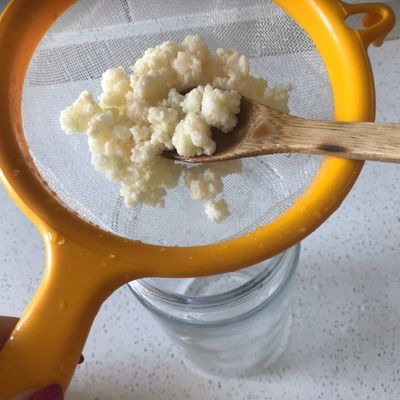
Place a sieve over a clean container and pour in the contents. The liquid passes through, but the seeds remain.
You can stir gently with a spoon to help the liquid pass through, without forcing it. The aim is to recover the grains without damaging them.
Put the beans back in a clean jar, add fresh milk and start again.
It’s this loop that makes all the magic. The culture is maintained, multiplied and you get kefir continuously.

Yes, many people drink it chilled, after putting it in the fridge. The cold often makes kefir more pleasant to drink, especially if you like a milder acid feel.
Yes, but it’s often flavoured after filtration, not during, so as not to disturb the grains. You can add a touch of vanilla or cinnamon, or mix it with fruit in a smoothie. Simplicity is your ally.
Once filtered, kefir can be kept in the fridge for some time, but its flavour can change, becoming more acidic. Many people prefer to consume it within a few days to enjoy a fresher profile.
The easiest way is to restart a cycle every day. The seeds remain active, production is stable and the routine runs smoothly.
You can leave the beans in a little milk in the fridge, which slows down fermentation. Then, when you start again, you restart a cycle at room temperature. The first kefirs after a break may sometimes taste a little different. This is normal, as it takes time for the culture to find its rhythm again.
There are a number of freezing methods available, but for a simple routine, the ideal solution is to store them in a cool place in milk, rather than freezing them, unless there are particular constraints.
Often it’s a question of time, heat or the quantity of grains. You can reduce the fermentation time, reduce the grains slightly, or move the jar to a slightly cooler place.
You can also use a slightly richer milk, as it sometimes feels rounder.
This happens when fermentation is too short, when the temperature is low, or when the grains are less active. You can leave it a little longer, increase the grains slightly, or simply accept a more ‘drinking yoghurt’ texture, which is perfectly normal.
This is often a sign of advanced fermentation. You can stir, strain, consume and then reduce the time next time. It’s not automatically a failure.
Many people don’t rinse the grains with each cycle, because this can upset the balance. Occasional rinsing can be done if really necessary, but the most stable routine is often to filter and restart, without systematic rinsing.
In a coherent SEO strategy, it’s smart to offer continuity to the reader. The reader who learns how to make milk kefir at home is often the same one who will soon be looking for a more aromatic, non-dairy fermented drink based on tea.
This is exactly where kombucha becomes relevant. And to get started with kombucha reliably, with no loose ends, Natural Probio can offer its flagship solution. The authentic, natural kombucha strain, ideal for creating stable, faithful, long-lasting fermentation at home.
In the article, the most natural integration is to talk about « home-fermented routines » and « non-dairy alternatives », and then point to the strain as the starting point.
For example, for those who like a variety of living drinks on a daily basis, discovering the authentic and natural Natural Probio strain of kombucha allows you to add a lactose-free fermented drink to a routine already centred on kefir.
Kefir loves stability. The same jar, the same corner of the kitchen, the same filtration rate, the same type of milk for a period, then gradual adjustments.
If you change everything at once, you’ll never know why the result has changed.
The best amateur kefir makers do a very simple thing. They rate.
They note the duration of fermentation and the approximate temperature of the room. This is enough to understand why a kefir was more acidic or sweeter.
If you find that your kefir is too acidic, don’t change the milk, the quantity of grains, the time and the location all at once. Change one parameter, observe, then adjust.
That’s how you get consistent kefir.
Making milk kefir at home is simple, but it’s not « mechanical ». It’s a living process. You work with a culture, learn its reactions, then adjust the four key levers. Milk, grains, time and temperature.
With a steady routine, you can produce delicious kefir every day, tailored to your tastes, sweeter or sharper, runnier or smoother. And once you’ve got the hang of it, you’ve also got the basis for exploring other home fermentations.
For those who want an aromatic, non-dairy fermented drink that perfectly complements kefir, kombucha is the natural next step. Natural Probio offers an ideal solution for getting started with a reliable, traditional base. The authentic, natural kombucha strain, to be incorporated into a « living drinks » routine with no naked links, just a natural anchor.

This depends on the temperature and the activity of the grains. Many people get a good result between 12 and 24 hours, then adjust according to taste.
No. Kefir is generally made at room temperature, using a simple glass jar.
Often yes, but the result can vary depending on the brand and the culture. If your kefir is too liquid or too acidic, adjust the time and grains.
This is often advanced fermentation. You can stir, filter, consume, then reduce the time next time.
Yes. Kombucha is a fermented, non-dairy beverage made from sweetened tea. For an easy start, you can use the authentic, all-natural kombucha SCOBY from Natural Probio.
Sources :
📖 Go further: read our How to Make Kefir at Home: The Complete Guide, with a batch calculator, timings and troubleshooting.
Ready to try it yourself?
Discover our live milk kefir grains, shipped in 24/48h with a step-by-step English guide. And for the curious, the history of kefir is a fascinating read.