
Everything you need to learn how to make kefir. Water kefir and milk kefir, step by step, with real quantities, timings, a batch calculator and answers to the mistakes every beginner makes.
How to make kefir, in one sentence: place live kefir grains in milk or sugar water, leave them at room temperature for 24 to 48 hours, strain, and enjoy a naturally fizzy fermented drink. The grains are reused endlessly, batch after batch.
Learning how to make kefir takes about ten minutes of reading and one real attempt. This guide covers both families of kefir, the exact process, and the small details (water quality, temperature, storage) that make the difference between an average batch and a brilliant one.
Before learning how to make kefir, choose your family. The two share the same logic (live grains + sugary liquid + time) but not the same taste, texture or rhythm.
A sparkling, fruity soda alternative. Grains + sugar water + lemon and dried fruit. Ready in 24 to 48 hours, light and refreshing. Perfect if you want how to make kefir to feel like making homemade lemonade.
A creamy, tangy drink close to drinkable yogurt. Grains + whole milk, nothing else. Ready in about 24 hours. The choice if you love dairy and want a daily ritual with almost zero effort.
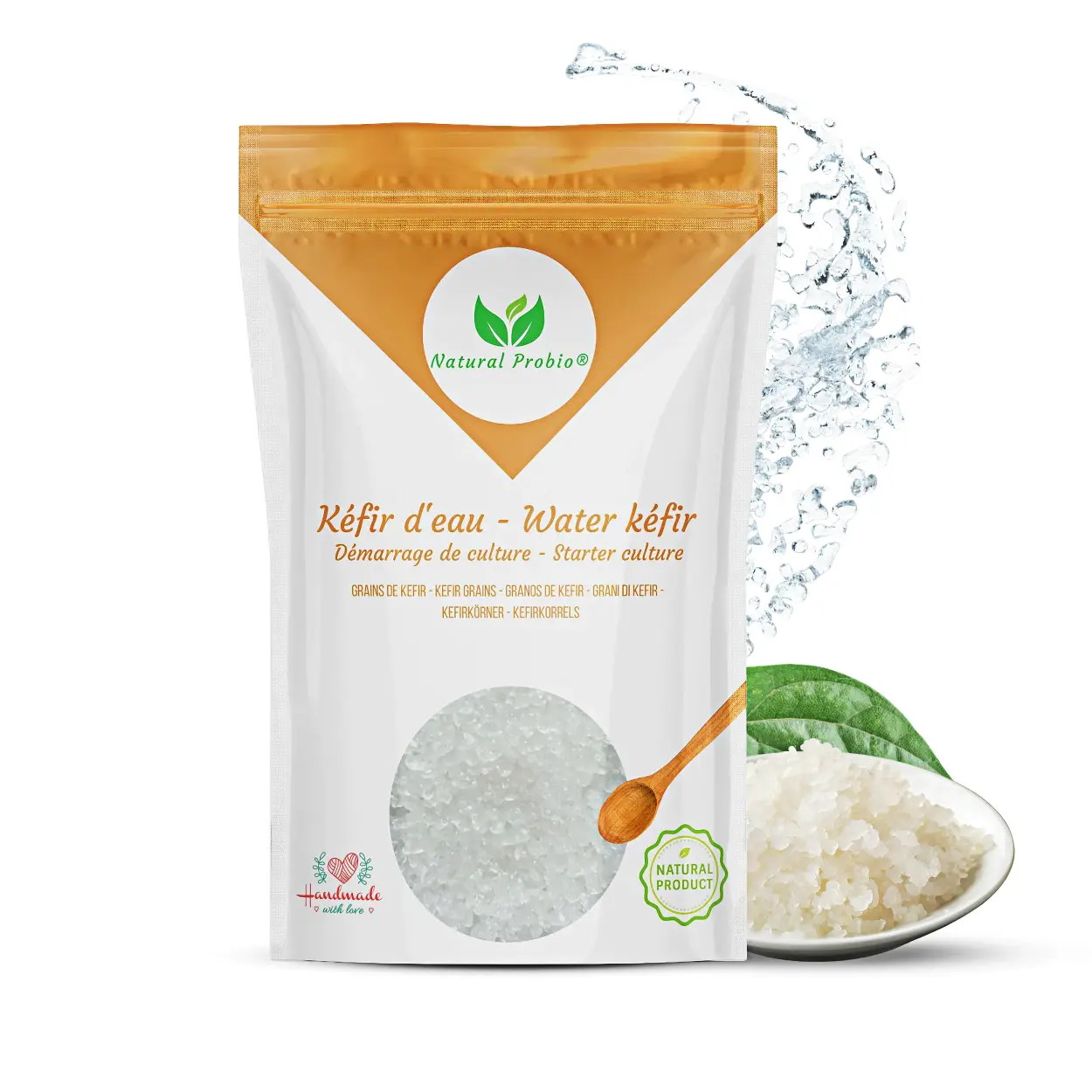
The method below works for both families; the liquid changes, the gestures stay the same.
How many litres do you want to ferment?
For litre(s): 30 g of grains, 60 g of sugar (water kefir) or 1 L of whole milk.
| Temperature | Water kefir | Milk kefir | Result |
|---|---|---|---|
| 18 to 20 °C | 48 h | 36 h | Mild, lightly fizzy |
| 21 to 25 °C | 24 to 36 h | 24 h | Balanced, the classic |
| 26 to 28 °C | 18 to 24 h | 18 h | Fast, tangier, watch closely |

| Day | What to do |
|---|---|
| Day 1 | Grains arrive: gentle rinse, first batch in 0.5 L to reactivate them. |
| Day 2 | Strain the activation batch (drinkable but simple). Launch a full 1 L batch. |
| Day 3-4 | First real batch: taste at 24 h, decide if you prefer 36 or 48 h. |
| Day 5 | Try a second fermentation. Bottle with fruit, 24 h at room temperature. |
| Day 6-7 | Your rhythm is set. Grains have visibly grown; share or store the surplus. |
| Homemade kefir | Store-bought | |
|---|---|---|
| Price per litre | 0.15 to 0.60 € | 3 to 6 € |
| Culture | Live, reusable forever | None (pasteurised) |
| Flavours | Unlimited | 3 or 4 recipes |
| Yearly cost (1 L/day) | about 100 € | 1 400 € and more |
Once you know how to make kefir, one litre costs less than a coffee. The grains from our kefir and kombucha shop arrive alive with this exact guide in the box.
You cannot, and that is the point. Authentic kefir only exists with live grains. Powdered starters give a one-shot drink; grains give a culture for life. Ours ship in 24/48h across Europe.
Too long or too warm. Shorten the fermentation by 12 hours or move the jar somewhere cooler. Sour kefir is never dangerous, just more intense; use it in dressings or smoothies.
Yes. Water kefir grains sleep in sugar water in the fridge up to 2 weeks; milk kefir grains in fresh milk up to 10 days. Longer breaks: rinse and freeze, or dry the grains.
Second fermentation: bottle the strained kefir in a swing-top bottle with a little fruit or sugar, 24 h at room temperature, then fridge. Open carefully; the pressure is real.
Spring water or filtered tap water. Chlorine is the enemy of the grains; if you only have tap water, let it sit uncovered for a few hours first.
Ready to make your first batch?
Choose your culture: live water kefir grains, live milk kefir grains or the complete kit. Shipped in 24/48h with this guide included. Curious minds can also read the history of kefir on Wikipedia.

Moving from one litre to three does not call for a bigger jar so much as more culture. Fermentation follows the ratio of grains to liquid, not the size of the vessel. Anyone working out how to make kefir for a household rather than one person should double the grains at the same time as the liquid, otherwise the batch drags and becomes hard to judge.
Two jars started a day apart solve a practical problem that a single large jar does not. There is always a bottle ready while the next one is still working. That is the simplest answer to how to make kefir without gaps.

The base never changes. The flavour goes into the second fermentation, in a sealed bottle, and a small amount per litre is plenty. The sugar in the fruit is food for the culture rather than an additive, which is what separates a home batch from a sweetened bottle.
Two rules keep the result predictable. Change one ingredient at a time, and shorten the second fermentation for sugary additions because the pressure rises faster. A bottle with fruit juice should be opened briefly on the first day.
After the single purchase of the culture, the running cost is sugar, a dried fruit and water. This is why the question of how to make kefir cheaply answers itself within a few weeks.
| Item | Per litre | Note |
|---|---|---|
| Sugar | 40 to 80 g | the main item |
| Dried fruit | 1 fig or 2 apricots | reusable once |
| Water | 1 litre, filtered | never chlorinated |
| Culture | 0 | it multiplies |
| Bottles | 0 | the same ones, reused |
| After 12 months | roughly double the culture | enough to give some away |

This is the question that decides whether a culture survives its first year. Grains kept in sugar water in the fridge tolerate two to three weeks without attention, and usually far longer than people expect. On the way back, one batch is needed to bring them up to speed before the usual rhythm returns.
Do not leave the jar on the worktop while you are away. At 24 C a batch is finished in a day and then keeps souring for a fortnight. The fridge is the pause button, not the cupboard.
The milk version uses a different culture and a slightly different routine, but the logic is identical. Anyone who has learned how to make kefir with water can switch in an afternoon.
| Point | Water kefir | Milk kefir |
|---|---|---|
| Base | 1 litre of sugared water | 1 litre of fresh milk |
| Culture | 30 to 50 g translucent crystals | 20 to 30 g white clusters |
| Sugar | 40 to 80 g | none, the lactose is enough |
| Time | 24 to 48 hours | 18 to 30 hours |
| Ready when | bubbling and tart | slightly thick, coats a spoon |
| Second fermentation | usual, for the fizz | rarely needed |
| Keeps | 1 to 2 weeks | 3 to 5 days |
Ultra heat treated milk works but gives a thinner result. Fresh pasteurised milk gives the better texture, and raw milk works with shorter times and more careful handling.
Milk kefir separates into a firm and a liquid layer if it stands too long. That is not spoilage, it is the normal progression. Stir it back together, or drain it into fresh cheese.
This is the step most short instructions leave out, and it accounts for most disappointment. After straining, the drink is tart but flat, because the gas escapes from an open jar. The second fermentation, in a sealed swing top bottle, is what produces the bubbles.
| Stage | Vessel | Duration | Effect |
|---|---|---|---|
| First fermentation | jar, covered loosely | 24 to 48 hours | acidity, little gas retained |
| Straining | sieve, a few seconds | 1 minute | grains recovered for the next batch |
| Second fermentation | swing top bottle, sealed | 12 to 36 hours | pressure and fine bubbles |
| Chilling | fridge | from 4 hours | fermentation slowed, gas stable |
A piece of fresh fruit or a splash of juice at bottling restarts the fermentation and adds aroma. That is the only liberty worth taking when learning how to make kefir properly. The sugar in the fruit is food, not flavouring.
The instinct is to add more culture or more sugar. It is usually something else, and these six causes cover almost every report we receive.
None of the six is permanent. Two or three normal batches with good water and enough sugar bring a culture back almost every time.
Well fed grains double in four to six weeks. That surplus has three useful destinations and one pointless one, which is the bin.
This is the part that makes learning how to make kefir worth the five minutes. The culture is larger at the end of the year than at the start, which no purchased drink can be.
None of these five is a fault in the culture, and each one is worth knowing before deciding that learning how to make kefir has gone wrong.