
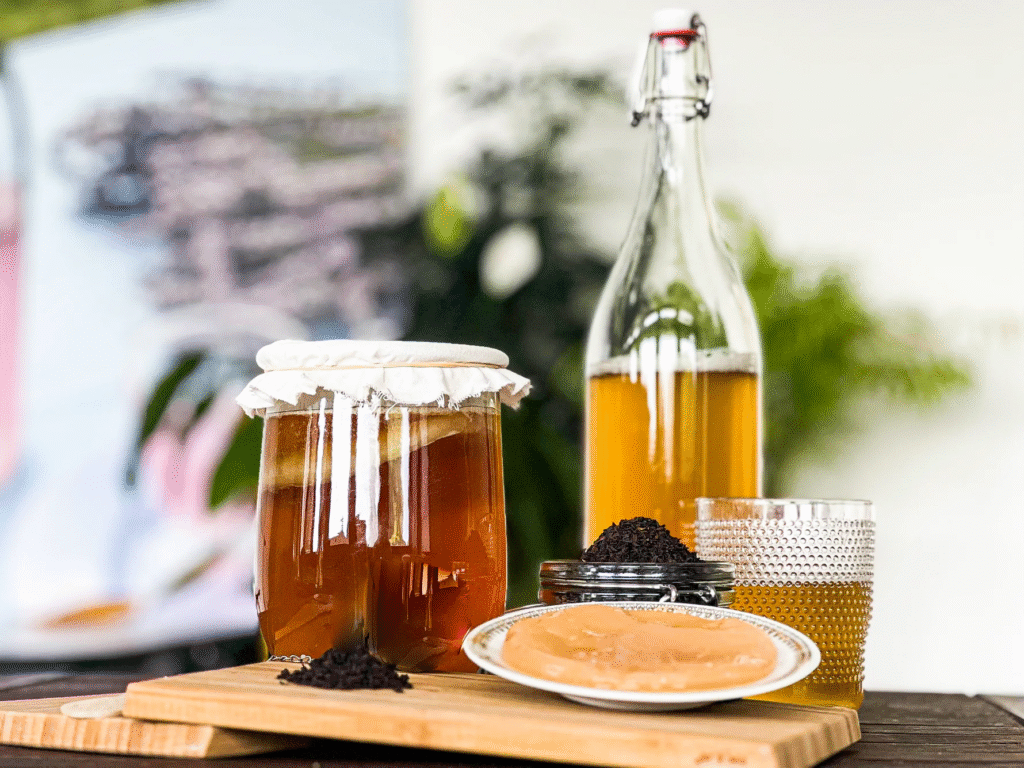
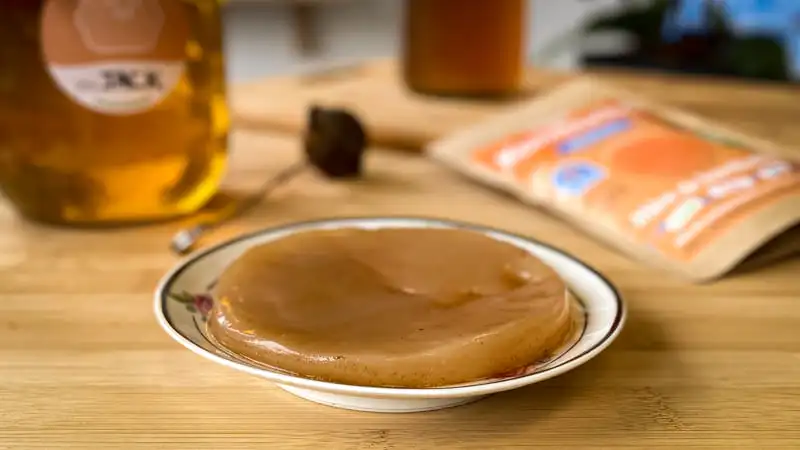
When you first discover SCOBY, you see a beige, gelatinous disc that looks a little strange. It floats on the surface of the kombucha, thickening as it ferments and sometimes splitting into two. From the outside, it looks like a simple ‘skin’ formed by the tea, something inert.
In reality, a SCOBY of kombucha is just the opposite. It’s a living, organised ecosystem in which yeast, bacteria and a solid matrix they build together live side by side. This matrix is not there by chance. It serves as a home, a support, a meeting point for the micro-organisms that will transform your sweet tea into a fermented beverage.
Understanding the composition of a SCOBY means understanding what lies behind the surface:
what you can see (cellulose), what you can’t (yeast and bacteria), and what flows between the two (sugars, alcohol, organic acids). This is also what makes the difference between a healthy, well-balanced SCOBY, like those you receive via Natural Probio, and a fragile, unbalanced or ageing culture.
In this article, we’re going to symbolically ‘slice’ the SCOBY into layers to see what it really contains.
The first component of a SCOBY is its physical structure, the more or less thick disc that you handle during each fermentation. This structure is made mainly of cellulose, a fibre also found in the plant world, but produced here by certain kombucha bacteria.
This cellulose is presented as :
To the touch, SCOBY feels like a thick, damp crepe. When young, it is very thin, almost fragile. With age and repeated fermentation, it thickens and strengthens, and can become surprisingly solid.
This cellulose matrix plays a fundamental role. It is not just a « waste product » of fermentation. It is a real life support for micro-organisms.
The SCOBY cellulose works like a multi-storey building. In this matrix :
This organisation allows the SCOBY to remain on the surface of the liquid, where oxygen is more available. This is important, particularly for acetic bacteria, which need oxygen to transform alcohol into organic acids.
In short, cellulose is both :
Without this matrix, the yeast and bacteria would simply be dispersed in the liquid. They could ferment, but the system would be less stable, less organised and more exposed to contamination.
The second major component of SCOBY, invisible to the naked eye, is yeast. These are micro-organisms from the fungus family, similar to the yeasts used to make bread or beer, although the exact species may vary from one kombucha culture to another.
In SCOBY, the yeasts have one main mission. To consume the sugars in the tea and transform them into alcohol and carbon dioxide (CO₂). This is the alcoholic fermentation phase, which takes place at the beginning of the process.
In concrete terms :
This carbon dioxide, partly trapped in the liquid, gives kombucha its fizz, especially after a second fermentation in the bottle. The alcohol will serve as a substrate for the bacteria that will arrive shortly afterwards.
Not all kombucha cultures contain exactly the same yeast. Depending on the lineage, region of origin and strain maintenance, different species can be found.
What matters to you is not the Latin name of the yeast, but its overall balance. A good SCOBY, like those selected by Natural Probio, has a set of yeasts that :
If the yeasts are too dominant, the kombucha may become too alcoholic, too carbonated and difficult to control. If the yeasts are too weak, the sugar will take longer to disappear and the flavour profile will be flatter. It’s the balance between these different types of yeast that allows SCOBY to work harmoniously.
Yeasts are not only found in the solid disc. They can be found in :
When you see brownish deposits at the bottom of your jar, or filaments hanging down from under the SCOBY, these are often clumps of dead or settling yeast. This is normal in a healthy kombucha, as long as the smell and general appearance remain correct.
To put it plainly. Part of SCOBY’s composition is also to be found… outside, in the kombucha itself. The disc and the liquid form a coherent whole.
The third major component of SCOBY is bacteria, and acetic bacteria in particular. In kombucha, they play a central role. They transform the alcohol produced by the yeast into organic acids, in particular acetic acid (the kind we know from vinegar) but also other milder acids.
These bacteria :
It is because these bacteria breathe oxygen and produce cellulose that SCOBY develops at the air/liquid interface. This explains why the surface area of the jar is so important, and why we recommend wide jars rather than too narrow. The larger the surface area, the more efficiently the acetic bacteria can work.
As well as acetic bacteria, a SCOBY of kombucha can also harbour other types of bacteria, notably lactic acid bacteria in certain cultures. These produce lactic acids, which add to the acid profile of the kombucha.
Here again, the important thing is not to remember names, but to understand that a healthy SCOBY is an ecosystem, not a mono-culture. Several types of bacteria live together, each with its own role:
It is this mixture that explains why two kombuchas prepared according to the same recipe can have different nuances of flavour. The exact bacterial compositions are never perfectly identical from one line to another.
As with yeast, bacteria are not confined to the disc. They can be found :
When you take kombucha to serve a glass or to start a new jar (the famous « starter liquid »), you are also transferring part of this bacterial population. That’s why, in a complete culture kit, we always supply the SCOBY + the liquid: both contain essential bacteria, and their synergy is part of the real composition of your culture.
SCOBY is often referred to as a simple disc, but in practice, when we describe its functional composition, we have to add another component: the starting liquid, i.e. the already fermented kombucha in which the SCOBY is preserved.
This liquid has several characteristics:
In the broadest sense, SCOBY includes this liquid dimension. Without it, the gelatinous disc would be less effective at launching a new fermentation.
From a purely material point of view, we could say. « A SCOBY is cellulose, yeast and bacteria ». But from a practical point of view, that’s not enough. When Natural Probio sends you a kombucha culture, you get :
This mother kombucha is an integral part of the kit. It is crucial to the success of the first fermentations. The micro-organisms it contains complement those present in the disc.
To be precise, this is a dual composition:
The two together make up the real « kombucha culture ».
As the yeasts and bacteria work, the SCOBY leaves a series of organic compounds in the kombucha. We can’t say that these are ‘part of’ the SCOBY in the strict sense, as they are found in the liquid, but they are the direct result of its microbial composition.
These compounds include :
The composition of the SCOBY, in particular the balance between yeast and acetic bacteria, determines the relative quantity of these different acids. A SCOBY with a high proportion of acetic bacteria will produce a kombucha closer to vinegar. A more balanced SCOBY will produce a drink where the acidity is present, but tempered by other components and a slight residual sweetness.
As each SCOBY has its own combination of yeast and bacteria, each culture leaves its own aromatic signature in the kombucha:
In practice, this means that the composition of the SCOBY directly influences the final taste. All the more reason to choose a stable, well-maintained culture capable of reproducing the same type of profile over and over again. That’s the job behind a kombucha culture proposed by Natural Probio. To stabilise this balance as much as possible so that you get a consistent result.
The composition of a SCOBY is not set in stone. It evolves over time, as fermentation proceeds. A young SCOBY:
An older SCOBY:
In practice, the most recent layers are often kept for the main fermentations. Older layers can be put in a « SCOBY hotel », donated, or discarded when they become too dark and not very active.
The internal composition then shifts towards the younger layers, which are more in contact with the fresh tea, better ventilated and more efficient on the surface.
The microbial composition of SCOBY also responds to its environment:
Over time, the culture adapts to your context. This is both an asset (it becomes « at home ») and a reason to start from a solid base. A quality SCOBY, like a Natural Probio kit, allows this adaptation to take place from a healthy, balanced core, rather than from an already shaky culture.
By definition, a healthy SCOBY does not contain :
If the surface of your SCOBY shows areas that are fluffy, dry, powdery or clearly coloured (green, blue, black), this is not a normal composition, but a contamination. In this case, we generally recommend discarding the SCOBY and the liquid, cleaning the jar and then starting again with a healthy culture.
Nor is the SCOBY designed to fit in just anything. Its composition is not designed to live in :
Flavours, fruits, spices and herbs are generally added after the first fermentation, during the second fermentation in the bottle. SCOBY remains in a simpler environment. Tea + sugar + mother kombucha. This preserves the stability of its microbial composition.

Understanding the composition of a SCOBY helps you make choices. Now you know that a good SCOBY is more than just :
It’s a structured culture: cellulose + yeast + bacteria + mother kombucha, balanced over several generations. By choosing a kombucha culture such as those offered by Natural Probio, you are choosing a SCOBY whose microbial composition has been cared for, monitored and maintained. This makes a huge difference to the regularity of your fermentations and the quality of your drinks.
Knowing what’s inside a SCOBY also enables you to better interpret what you see:
Instead of panicking at the slightest change, you can relate what you observe to the actual composition of the SCOBY. And if something doesn’t seem right, you know that a healthy SCOBY isn’t supposed to contain fluffy mould or have a frankly repulsive smell.
Finally, understanding the composition of SCOBY gives you concrete leverage:
Every practical decision is based on this premise. A SCOBY is a cellulose structure filled with microbial life. It is not a fixed object, but a partner with whom you can learn to work.
To sum up, the composition of a SCOBY of kombucha can be described in four parts:
By starting with a healthy kombucha culture, like the ones you can use with Natural Probio, you give yourself every chance of these four elements working together, providing a stable, aromatic and enjoyable kombucha, batch after batch.
📚 Read also :
Sources :
📖 Go further: read our How to Make Kombucha at Home: The Complete Guide, with a batch calculator, timings and troubleshooting.
Ready to try it yourself?
Discover our live kombucha SCOBY, shipped in 24/48h with a step-by-step English guide. And for the curious, the history of kombucha is a fascinating read.