
People are talking about it in cafés, in organic shops, on social networks… Kombucha is everywhere. But behind the pretty bottles and marketing promises, one question keeps coming up. What are the real benefits of kombucha? Is it just a fad, or does it really deserve a place in your daily life?
If you’ve been following the Natural Probio series of articles on kombucha and SCOBY, you’ll already know that there’s nothing magical about this drink. It’s sweet tea fermented by a living culture of yeast and bacteria, the famous SCOBY. Not a medicine, not a miracle pill. On the other hand, it’s a surprisingly versatile drink that can do a lot… provided you understand it, prepare it properly and make it part of a coherent lifestyle.
In this guide, we’ll explore the main benefits attributed to kombucha, those that can be observed in everyday life and those that are simply suggested by science or tradition, always keeping a nuanced mind. The aim is not to promise miracles, but to help you make an informed decision about whether or not this drink deserves a place in your fridge.
Before we talk about the benefits, let’s start with the basics. What does your glass of homemade kombucha actually contain?
A classic kombucha starts with :
The magic comes from fermentation. The yeasts consume some of the sugar and produce alcohol and CO₂; the bacteria transform this alcohol into organic acids (acetic acid, gluconic acid, etc.) and build SCOBY’s cellulose matrix. The end result:
So it’s not a « mystical potion », but a fermented drink made from very ordinary ingredients, but made more complex by fermentation.
Because it contains micro-organisms and organic acids, kombucha is often presented as a « healthy » drink. There are some nuances to this:
In short: think « everyday drink that can support your well-being », not « miracle cure ». This realistic approach allows you to appreciate the benefits of kombucha without over-promising.
For many people, the first concrete benefit of kombucha is not ‘internal’, but purely practical. It replaces less interesting drinks.
Compared to a classic soda :
This doesn’t make it a ‘zero sugar’ drink (unless you go very far with the fermentation, at the risk of obtaining a near-vinegar), but it does make it a finer alternative to ultra-sweet drinks.
If you usually drink :
Replacing some of these drinks with homemade kombucha can, over time, help to :
This is often one of the first visible benefits. Without suddenly changing your whole lifestyle, you gradually swap uninteresting drinks for a more « constructed » fermented drink that you have prepared yourself from water, tea, sugar and a living culture (for example a SCOBY Natural Probio).
This is one of the arguments most often put forward. Kombucha « aids digestion ». But what are the nuances?
Like other fermented foods (sauerkraut, kimchi, kefir, yoghurt), kombucha :
Many people report subjectively:
These are individual experiences, not medical prescriptions, but they often come up in the testimonials of kombucha drinkers.

Unpasteurised kombucha contains live yeast and bacteria. Drink it :
Here again, it’s not a medicine. It’s a one-off boost, as with other fermented foods. The interesting idea is to diversify your intake: yoghurt, fermented vegetables, kombucha… rather than relying on a single product.
Another aspect, less measurable but very real, is ritual:
All this creates a more attentive relationship with what you drink. Very often, this attention has an impact on your diet in general. You eat a little more slowly, you’re more aware of what suits you and what doesn’t, and you want to cook more. Indirectly, then, kombucha can support more serene digestion because it’s part of a more conscious lifestyle.
We sometimes read that kombucha « makes you lose weight ». The reality is more subtle.
Drinking kombucha does not « burn » fat, replace a change in lifestyle or compensate for a very unbalanced diet. If you continue to :
simply drinking kombucha won’t make much difference.
Where kombucha can help is when it accompanies an overall approach:
In this context, kombucha can :
So the benefit isn’t magical, it’s real. You’re changing your eating environment, and kombucha is one piece of the jigsaw.
We often underestimate the difference daily hydration can make to our general energy, concentration, skin and digestive comfort.
Water remains the basic drink. But many people admit it. They find it hard to drink enough water throughout the day. A little touch of flavour makes things easier.
Incorporating kombucha into your routine can :
Of course, the idea is not to replace all water with kombucha, but to use it as a lever: one or two glasses a day, the rest as plain water.
When you prepare your own kombucha with a healthy strain, for example a live SCOBY supplied with its starting liquid and clear instructions, you :
In other words, you are no longer dependent on a list of ingredients imposed by a brand, with artificial flavourings, acidity regulators or preservatives. You gain transparency, which is a major benefit for many consumers.
The benefits of kombucha are not just ‘chemical’ or nutritional. There’s also everything that goes on around it.
Maintaining a SCOBY means :
This relationship with a living culture can become a soothing, almost meditative practice. You find yourself :
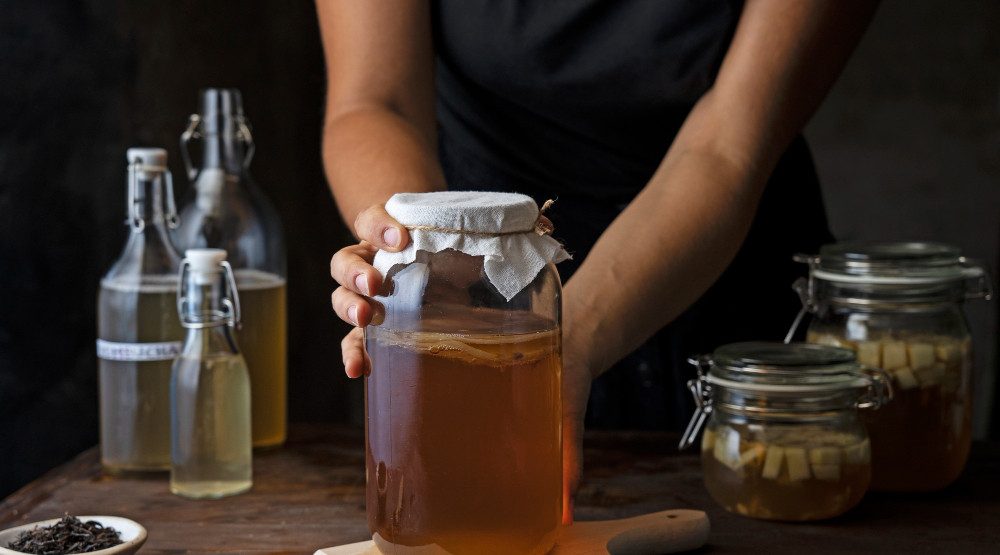
In an everyday world full of ready-made products, :
reconnects you to a slower rhythm. Kombucha then becomes a symbol:
This « intangible » benefit is very important to many people. You can’t measure it, but you can feel it. You have the impression that your everyday life is better.
Not all kombuchas are created equal. The benefits you can expect also depend on how the drink is produced.
Industrial kombuchas, which you can find in supermarkets, are often :
Their advantage: they are practical, easy to transport and stable.
Their limitations: they may contain more sugar than you imagine, and pasteurisation can reduce the presence of live micro-organisms.
A homemade kombucha, made from quality live SCOBY and its starter liquid:
The benefits felt (digestive, hydration, reduction in soft drinks, pleasure of the ritual) are often more marked when :
That’s the whole point of starting with a reliable strain, designed for kombucha and accompanied by clear advice.
This is a frequent question once you start enjoying this drink.
There is no « official dose » that suits everyone. There are, however, a few useful guidelines:
More than the figures, it’slistening to how you feel that should guide your consumption.
To be on the safe side, we generally recommend :
Kombucha is still a fermented, acidic drink, with a low sugar content and slight traces of alcohol (resulting from fermentation, although these remain very low under normal conditions). Common sense therefore dictates that it should be consumed in moderation, as an everyday fermented food, not as table water.
To really benefit from the advantages of kombucha, there are a few simple principles you can follow to get you started.
Quality kombucha starts with :
If you start with an unclear strain, a SCOBY of uncertain provenance, poorly maintained, the expected benefits may be compromised by :
Relying on a clear culture that is monitored and explained will give you peace of mind and allow you to enjoy the potential benefits without constant anxiety.
Kombucha is not a substitute for :
On the other hand, it can be integrated as :
It’s often in this overall coherence that its benefits are clearest. You’re changing your eating environment, and kombucha is part of that movement.
If you’re completely new to the world of fermented drinks :
By progressing gradually, you turn the experience into a learning experience rather than a « shock » for your body.


The benefits of kombucha are neither non-existent nor miraculous. They lie somewhere between the two, in very concrete terms:
By choosing a quality strain, following simple rules of hygiene and carefully observing your reactions, you can make kombucha an everyday companion, rather than a passing fad or just another promise.
The most lasting benefits are not necessarily the ones you see in the big slogans, but the ones you feel in the small details. One less soda, a few more glasses of water, a more comfortable digestion, the regular pleasure of opening your jar, tasting and sharing. It’s here, very often, that kombucha really delivers what it promises.
📚 Read also :
Sources :
📖 Go further: read our How to Make Kombucha at Home: The Complete Guide, with a batch calculator, timings and troubleshooting.
Ready to try it yourself?
Discover our live kombucha SCOBY, shipped in 24/48h with a step-by-step English guide. And for the curious, the history of kombucha is a fascinating read.