
UHT milk is everywhere. It’s practical, economical, easy to store and always available. And when you start making milk kefir, it’s natural to ask yourself. « Can I make my kefir with UHT milk, or will it fail? Will the grains survive? Will it taste any worse? »
This question comes up very often, and it’s perfectly legitimate, because milk kefir is a living fermentation. The grains are not a simple ingredient, they are an organised microbial culture. And many people spontaneously associate ‘fermentation’ with ‘raw product’, ‘fresh milk’, ‘raw milk’ or ‘farm milk’, and imagine that UHT milk would be too ‘dead’ or too ‘processed’ to work.
The reality is much more nuanced. Yes, you can make milk kefir with UHT milk. And yes, it’s possible to get a very decent result, sometimes even very good, especially if your aim is regularity and simplicity on a daily basis. But there are differences to be aware of. Fermentation speed, texture, separation, taste, and above all how to adapt your parameters to succeed every time.
In this comprehensive guide, we’re going to answer without shortcuts. We’ll explain exactly what UHT milk is, why it works (and sometimes why it doesn’t seem to work so well for some people), how to choose the right UHT milk, how to adjust the dosage and duration, and how to correct the classic problems. Kefir that’s too runny, too acidic, separates too quickly, or grains that seem « tired ».
And if you like the world of home fermentations, you’ll also find that it’s very common to alternate different living drinks in your routine. Many enthusiasts make kefir… and also start a kombucha, because it’s a different, complementary fermentation that’s great fun to follow. If you like the idea, you can discover our SCOBY Kombucha (natural authentic kombucha strain) to start a stable and regular fermentation, in addition to your kefir rounds.
Yes, you can make milk kefir with UHT milk. Kefir grains can ferment UHT milk because this milk still contains lactose (their main « energy source »), as well as proteins, minerals and water, which make up the fermentation medium.
What you can observe with UHT milk, especially at the beginning, is :
But with the right settings, you get a pleasant, stable kefir that’s easy to reproduce.
UHT stands for « Ultra High Temperature ». The milk is briefly heated to a very high temperature, then aseptically packaged. The aim is to destroy the micro-organisms present in the milk so that it remains stable at room temperature, often for several months.
It does not remove the lactose. It does not remove the proteins from the milk. But it does change certain properties. Some of the proteins are affected, certain flavours change, and the milk often becomes a little more uniform, more ‘standardised’ in its behaviour.
In most cases, UHT milk works. When people say it doesn’t work, it’s usually because they’re seeing one of these scenarios:
These situations do not mean « impossible ». Above all, they indicate that one or more parameters need to be adjusted. Type of UHT milk (whole vs semi-skimmed), quantity of grains, duration, temperature, or rate of renewal.
Many people associate « good kefir » with « thick kefir ». But thickness depends very much on the structure of the milk proteins and the way they coagulate in an acidic environment. Some UHT milks, depending on their treatment, composition or homogenisation, produce a less ‘creamy’ coagulation, and therefore a more fluid kefir. This does not mean that it is less good in terms of fermentation. It’s often a choice of texture.
If you like a more yoghurt-like kefir, UHT milk may be perfect. If you want a very thick kefir, you may need to choose a richer UHT, or use methods such as shorter fermentation + cold rest, or partial draining.
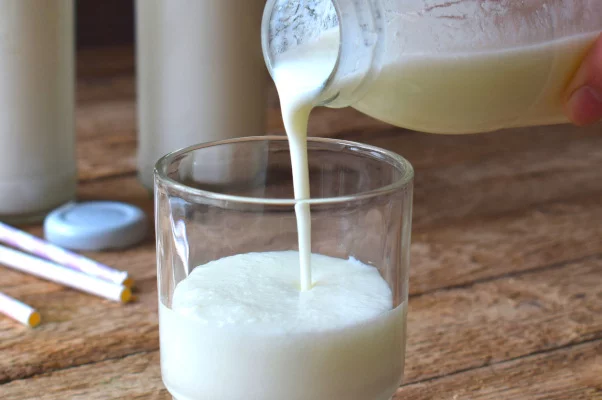
If you insist on using UHT milk, whole milk is generally the easiest to succeed with. The fat gives more roundness in the mouth and often stabilises the textural sensation. In practice, many people get a more pleasant and consistent kefir from whole UHT milk than from semi-skimmed.
UHT semi-skimmed milk works, but the kefir may be thinner, and the acidity may seem more pronounced, as there is less fat to ’round off’ the perception. If your kefir seems too acidic with UHT semi-skimmed, it’s not always that the fermentation is too strong. Sometimes it’s just a question of taste balance.
Skimmed UHT milk can make a very runny kefir, which is sometimes less satisfying. It may suit those looking for a very light drink, but for a first experience, it’s not the easiest.
Some UHT milks contain additives, added vitamins, sometimes stabilisers, or are flavoured. This doesn’t necessarily make kefir impossible, but it can disrupt the fermentation process or make the taste less pleasant. The simple rule: start with a plain, classic UHT milk, with no additives.
Kefir doesn’t require a laboratory. But it does like cleanliness, regularity and simple gestures.
For 1 litre of UHT milk, start with around 30-50g of kefir grains.
If you are already used to fresh milk and are switching to UHT, you can start in the middle: 40g. Then adjust according to your results.
On average, we aim for 18 to 24 hours at moderate room temperature. But the most reliable benchmark is not time, but the state of the milk:
If you wait too long, separation appears. Clear whey and a denser mass. This is not « dangerous » if hygiene is correct, but it is a more acidic profile.
With UHT milk, temperature plays exactly the same role as with fresh milk. The hotter it is, the faster it goes. Sometimes people blame UHT when the real factor is the heat in the room.
If your kefir turns sour very quickly, reduce the grains a little or shorten the time, especially in summer.
Many people find kefir made with UHT milk more neutral, cleaner and sometimes less complex. This can be an advantage if you want a drink that’s easy to drink, without overpowering notes.
UHT milk sometimes has a slight ‘cooked’ or ‘caramelised’ taste, depending on the brand. This taste can show through in kefir, especially if fermentation is short. If this bothers you, try another brand, or switch to a milder whole UHT.
With some UHT milks, the modified protein structure makes the thickening less pronounced. Result: even if the fermentation is correct (lowered pH, acidic smell, fermented taste), the texture remains more fluid.
It’s not a failure. It’s a different texture.
Several highly effective strategies:
If your aim is a very thick kefir, you can also partially drain (as for a « kefir cheese ») but this changes the final product. You go from a drink to a denser preparation.
Over a few cycles, the grains ferment UHT milk very well. They don’t die because the milk is UHT. They find lactose, so they work.
Some people find that after several weeks on UHT milk alone (depending on the brand), the grains become less prolific or give a less ‘vigorous’ fermentation. This is not always the case, but if you notice this, a simple solution is to do one or two cycles with a richer or ‘fresher’ milk to get things going again, then go back to UHT.
You don’t have to. It’s an option if you feel a drop in vitality.

Common causes:
Solutions:
Common causes:
Solutions:
A simple tip: if you have a good taste but too much acidity at the end of fermentation, it’s often a question of timing. Filtering earlier can change everything.
Separation indicates advanced fermentation. With some UHT milks, this can happen more quickly once the acidification has ‘taken off’.
Solutions:
Possible causes:
Solutions:
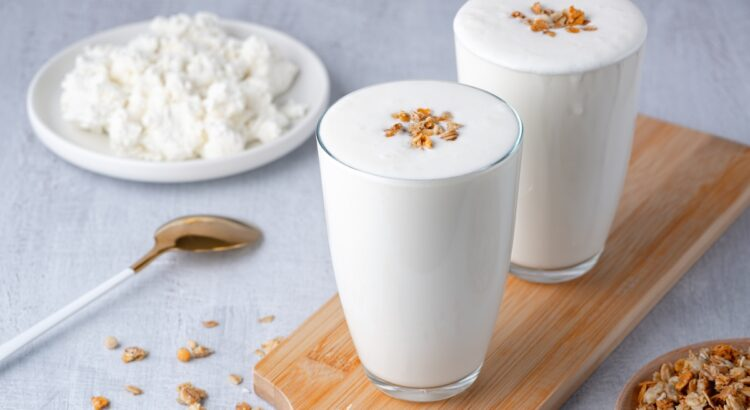
Yes, and it’s often an excellent idea, especially if you find UHT kefir a little neutral. Once filtered, you can :
The key tip: flavour after filtration, not during fermentation (especially at the beginning), to maintain clean control of your culture.
An effective routine often looks like this:
The advantage of UHT milk is that it makes this routine extremely simple. You’re not dependent on a ‘day-to-day’ purchase. You can keep your stock and make your kefir without stress.
It’s precisely this ‘practical’ aspect that means that many people end up adopting UHT, even if they also appreciate fresher milk from time to time.
And if you like the idea of having a home fermentation routine that’s both practical and stable, it’s often the same reasoning that prompts you to start a kombucha in parallel. A reliable culture like our SCOBY Kombucha (a strain of authentic natural kombucha) also allows you to establish a simple rhythm. Feed, wait, filter, start again. Many people find it pleasant to alternate between kefir and kombucha, depending on the season and the mood.
What makes kefir interesting is not that the milk is raw or UHT. It’s the fermentation carried out by the grains. It is the grains that provide the microbial dynamics.
If fermentation has taken place, your drink is fermented. The perception of texture may vary, the taste may vary, but the logic of fermentation remains the same.
Many people find kefir easier to digest than milk, as some of the lactose is consumed during fermentation. The type of milk can influence this, but fermentation is often the main factor in ‘tolerance’.
If you are sensitive, the gentlest approach is to start with small quantities and gradually increase.
Every UHT milk can behave slightly differently. Once you’ve found a brand that gives you a good result, sticking with it helps you achieve consistency.
Even if you don’t do it every day, weighing once a week can help, as the grains multiply. If you use « the same spoon » but your grains have doubled, your fermentation is accelerating and you no longer understand why. A simple weighing puts everything right.
If your result isn’t perfect, change one parameter at a time. And often, adjusting the fermentation time is easier than changing the grains, especially if you like to keep the same dosing routine.
Most conventional UHT milks work. Flavoured or enriched milks can complicate the result. To start with, choose plain UHT milk, ideally whole.
UHT milk is stable, but kefir is alive thanks to the grains. If fermentation takes place, you have a fermented drink.
Often because of the type of milk (semi-skimmed/skimmed), the temperature or the dosage. Try a full-fat UHT milk, increase the grains slightly, or leave it a little longer.
Yes, and it’s even a good option if you notice a drop in grain vitality. It can give them a boost.
Not necessarily. The acidity depends above all on the time, the quantity of grains and the temperature. On the other hand, some UHT products give a sharper sensation if the milk is lower in fat.
Yes, this is a sign of advanced fermentation. Adjust by filtering earlier or reducing the grains a little.
The question depends on age and context. Kefir is a fermented drink. For children, small quantities and a gradual approach are often preferred, with professional advice if necessary depending on the situation.
This is more commonly known as cold resting or flavouring after filtration. Active » secondary fermentation is more common with other drinks. But resting in the fridge often improves texture and taste.
A slight change in smell is normal. If the smell becomes distinctly unpleasant or if you notice mould, stop and review hygiene and conditions. Mould on milk kefir is rare if everything is clean.

UHT milk is an excellent ally for making milk kefir on a daily basis. It’s practical, stable, available and easy to store. Yes, it works. And with the right settings (whole milk, reasonable dosage, time adapted to your temperature), you can obtain a pleasant, balanced and regular kefir.
If your UHT kefir is too liquid, increase the grains slightly, choose a richer milk, or give it a little more time. If it becomes too acidic, reduce the time or the quantity of grains, and don’t hesitate to chill it as soon as the texture suits you.
The secret, as always with kefir, is to control one parameter at a time. In just a few cycles, you’ll find your ideal routine.
And if you like to explore home fermentations beyond kefir, you can also start another living drink that’s complementary and great fun to follow. Discover our SCOBY Kombucha (natural authentic kombucha strain) to start a stable, regular kombucha that’s easy to incorporate into a home fermentation routine.
Sources :
📖 Go further: read our How to Make Kefir at Home: The Complete Guide, with a batch calculator, timings and troubleshooting.
Ready to try it yourself?
Discover our live milk kefir grains, shipped in 24/48h with a step-by-step English guide. And for the curious, the history of kefir is a fascinating read.