
Milk kefir grains have a well-deserved reputation. They are robust, generous and capable of multiplying as soon as they are given the right conditions. But ‘robust’ does not mean ‘indestructible’. As soon as you start making kefir on a regular basis, a question quickly arises. How do you store the grains between uses?
Sometimes it’s a voluntary break. Holidays, travel, lack of time, a desire to slow down. Sometimes it’s an imposed break. Too many grains, too much kefir to drink, or simply a lifestyle that doesn’t allow you to restart fermentation every day. And sometimes the question arises because you want to keep a ‘back-up’ culture, in case your daily routine goes off the rails.
Keeping grains in good condition is the difference between an easy restart (where you restart and everything is back on track in 1 or 2 cycles) and a messy restart (too strong an odour, irregular fermentation, kefir that is too acidic or too liquid, grains that seem to be slowing down, or even confusion over « are my grains still alive?)
In this article, we’re going to cover the subject in a comprehensive yet easy-to-apply way. We’ll cover :
And if you like the world of home fermentations in the broadest sense, you’ll see that the logic of conservation (slowing down a living culture, then restarting it) is very similar in other fermentations, particularly kombucha. Many enthusiasts alternate between kefir and kombucha depending on the season. If you want to complete your routine, you can start a stable fermentation with our SCOBY Kombucha (natural authentic kombucha strain)ideal for varying living drinks while keeping the method simple.
If you need to store your milk kefir grains between uses, the simplest and most reliable method is :
Next, « good practice » depends on the amount of downtime:
But to really get it right, you need to understand what happens during the break.
In the refrigerator, microbial activity slows down considerably, but does not stop at 100%. Lactic acid bacteria and yeast continue to slowly transform part of the lactose.
As a direct consequence, the milk in which the whey rests will ferment slowly. It can become more acidic, thicker and sometimes separate (whey + mass).
That’s not necessarily a problem. It’s perfectly normal. The aim is simply to prevent this slow fermentation going too far for too long, as a very acidic environment can stress certain grains.
Milk is not just a preservative « layer ». It’s also :
This is why preserving them in milk is generally more stable than improvised « dry » methods.
If you are taking a break of less than 24 hours (for example, you have already filtered and want to restart tomorrow), you can simply :
In most kitchens, the fridge remains the safest option, especially if the ambient temperature is variable.
This is the most common case. Weekends away, short trips, or just the need to take a breather.
Recommended method :
In this scenario, you generally don’t need to change the milk during the short break. The milk may become more acidic, which is normal. You discard it (or save it for culinary use if you like), then restart.
Here, we switch to ‘real conservation’. It works very well, but you need to pay more attention to two things:
After a break of 2 to 3 weeks, some people renew the milk once along the way, especially if they want to avoid the environment becoming too acidic. Others don’t and then start again, accepting a more gradual resumption.
Both approaches can work. The idea is to choose a stable method for your routine.
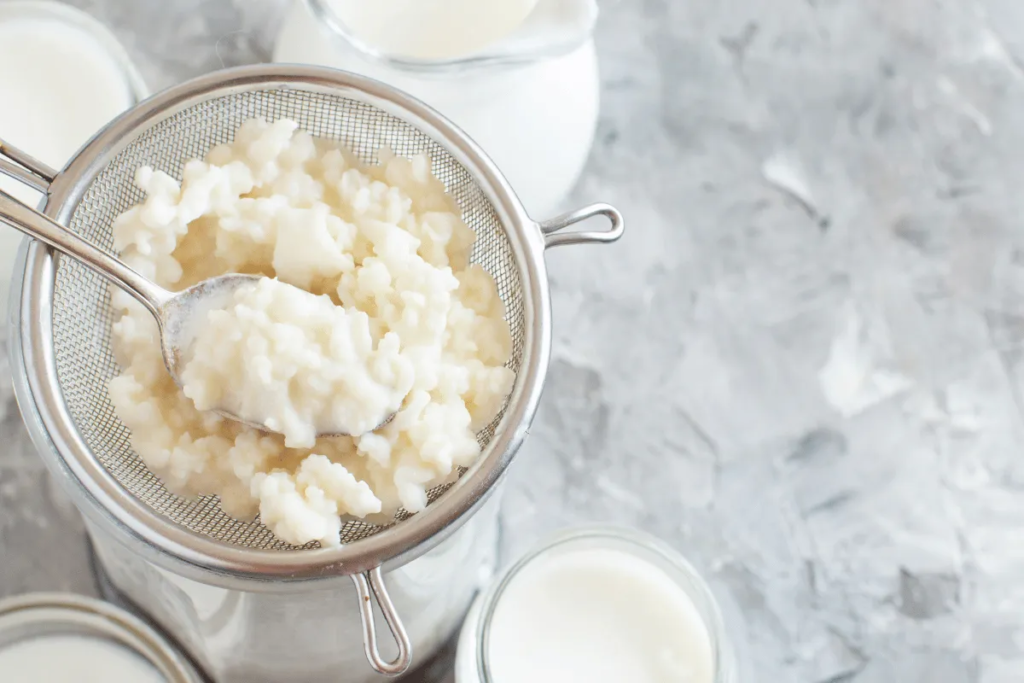
A clean glass jar is ideal. It does not need to be sterilised like a medical instrument, but it must be :
A residual odour is one of the classic causes of « bad recovery » that people attribute to the grains when the problem lies with the container.
The aim is to cover grains comfortably.
You don’t need to fill the jar to the brim. But avoid filling it too small (the beans should be well submerged). A simple rule:
If you have a lot of beans, add more milk. If you don’t have much, a small amount is enough.
Whole milk is often the best choice for storage, as it offers :
Semi-skimmed works too. Skimmed is less ideal for a break, especially a long one.
The standard fridge is suitable. Avoid placing near an area that freezes (very cold bottom) if your fridge has extreme variations. A stable area is ideal.
In the fridge, fermentation is slow, so gas production is low. Many ferment with a normal lid, without any problems.
If you want an ultra-cautious approach. You can close loosely. But most of the time, a standard lid will suffice.
Leave it alone for 3 days, then relaunch it. Simple.
A week in the fridge in milk is generally an easy break. You start again, sometimes doing 1 adaptation cycle if the first kefir is stronger or more liquid.
At this stage, the rest milk may be more acidic. It’s no big deal, but don’t judge your grains on the very first cycle after a long break.
After 3 weeks, you enter a zone where the crop may be temporarily more ‘unbalanced’. It often recovers very well, but it’s reasonable to allow 2 to 3 cycles before returning to your ‘usual’ texture and taste.
Rest milk often tastes very fermented, sometimes too acidic. Many people throw it away, and that’s fine.
Some people use it in cooking (marinades, pastes, sauces) as a very strong fermented milk. It’s a question of preference.
But if you’re sensitive to taste, don’t force yourself. The aim is to save your culture, not to impose a product you don’t like on you.
When you take the beans out of the fridge :
That’s the basis.
After a pause, the grains may ferment in a different way. Sometimes slower, sometimes more acidic, sometimes more liquid.
A very effective approach is to make the first cycle a little shorter, then adjust afterwards. For example:
It’s important. Many people panic because the first kefir after the fridge is :
Often, the second cycle is already much better. The third is almost back to normal.
Fermentation is a balancing act. After a pause, the culture rebalances itself.

Common causes:
Solutions:
Common causes:
Solutions:
Possible causes:
Solutions:
In most cases, things get going again.
A stronger smell is common after a break. What counts is the nature of the smell:
If you have any doubts, the safest method is to filter the culture, top it up with fresh milk and observe its progress over 24 hours. A healthy culture often ‘corrects’ itself when it gets back into a stable routine.
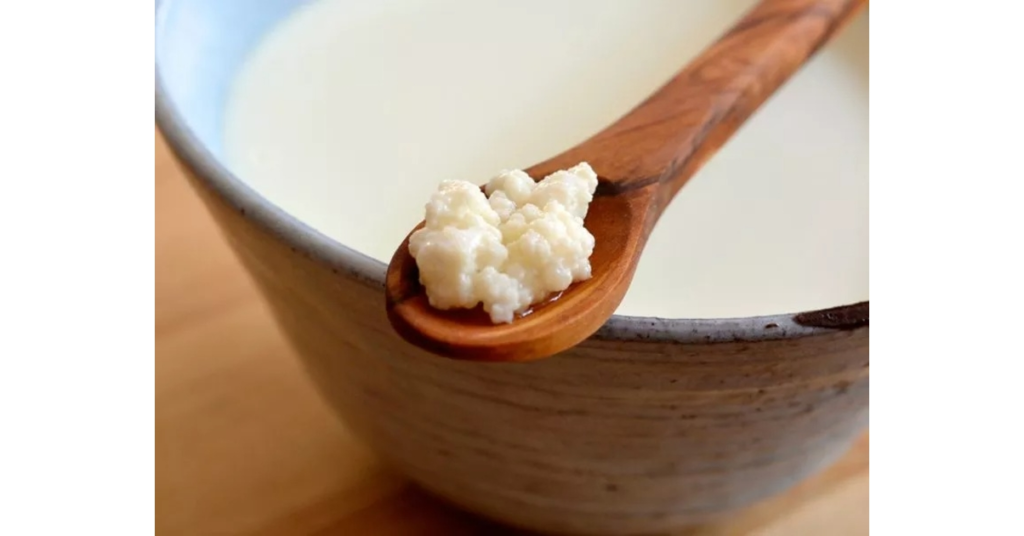
Very often, the preservation issue arises because the grains multiply. You end up with too many grains for your usual volume of milk, and your kefir becomes too fast, too acidic, or separates too soon.
In this case, you have three options:
This is often the best option. You keep to your routine, but with fewer grains « in use ». The surplus can be kept in the fridge in milk as a reserve.
If you consume more kefir, or cook with it, you can gradually increase your volume. But don’t force yourself to produce too much.
Sharing is classic. Alternatively, you can keep a small reserve in the fridge and maintain the rest as part of your routine.
The idea is to prevent your fermentation becoming « too violent » simply because your grain mass has doubled without you realising it.
The longer the break, the further you move away from a ‘routine’ and the more patience you need to get back into it. Some people keep grains in the fridge for a long time, but this is not the most comfortable method if you want a quick and stable recovery.
If you are planning a long absence, the best strategy is often :
Here, we deliberately focus on « between-use » conservation using realistic, everyday methods.
The fridge doesn’t put the grains on « total pause ». It slows them down. So the ideal way to store grains is :
It’s exactly the same philosophy as with other living cultures. With kombucha, for example, we don’t ‘sterilise’, we balance. If you like to vary your fermentations, you can easily start another living drink with our SCOBY Kombucha (natural authentic kombucha strain)a very simple way of adding a stable fermentation to your routine, without complicating your daily routine.
Same routine. If you come back and the smell is very strong, don’t panic. Repeat 1 or 2 short cycles.
Same routine, but you can consider :
If that’s not possible, it’s not a big deal. You can restart on your return and accept a gradual resumption.
Many people leave them in for 1 to 2 weeks without any problems. After that, it’s possible, but it may take 2 to 3 cycles before the kefir tastes « as usual » again.
For a short break (a few days), no. For a break of several weeks, it’s optional. If you can do it easily, it can limit the acidity of the environment. Otherwise, you can start again when you return.
In general, no. Filtering and rinsing is enough. If the grains are stuck in a very curdled mass, gently ‘loosening’ with a little fresh milk is often preferable to rinsing with water.
Because the crop is rebalancing. The cold slows down, the environment sometimes becomes more acidic, and the recovery may give a different result to the first cycle. The second and third cycles often return to normal.
A stronger fermented smell may be normal. If the smell is really unpleasant and persistent, check the jar and hygiene and do 1 or 2 short cycles with fresh milk.
This is not ideal, unless you take a very short break in a cool room. At room temperature, fermentation continues rapidly, and the environment becomes very acidic, which can make some grains tired.
In the fridge, milk serves as slow food. You don’t need to ‘feed’ anything else. If the break is long, refilling the milk once can help, but it’s not compulsory.
You can keep a ‘reserve’ in the fridge in milk, and use only part of it for your daily routine. This prevents the milk from fermenting too quickly.

Storing kefir grains between uses doesn’t have to be complicated. The most reliable method is to store them in the fridge, in milk, in a clean jar. For a few days, it’s almost automatic. For one to several weeks, it’s also possible, as long as you accept that it may take 1 to 3 cycles to get back to your ideal kefir.
If your kefir is too acidic after the pause, shorten the first cycle and stabilise in the refrigerator. If it’s too liquid, start again with a richer milk, leave 1 to 2 cycles, and adjust gently. Kefir is a living thing. It rebalances itself, especially when you put it back into a stable routine.
And if you like this ‘controlled fermentation’ approach, you can also vary your living drinks at home. Many people complement kefir with kombucha, because the rhythms and tastes are different, but the logic remains the same. You can start simply with our SCOBY Kombucha (a natural, authentic strain of kombucha) to kick-start stable, regular fermentation.
Sources :
📖 Go further: read our How to Make Kefir at Home: The Complete Guide, with a batch calculator, timings and troubleshooting.
Ready to try it yourself?
Discover our live milk kefir grains, shipped in 24/48h with a step-by-step English guide. And for the curious, the history of kefir is a fascinating read.