
You’ve filtered your kefir, you taste it… and it stings. The acidity takes over, sometimes to the point of making the drink difficult to drink. For some, it’s a « tonic » taste that they love. For others, it’s just too much, especially if you’re looking for a mild, round, slightly acidic kefir that’s easy to drink every day. And even if you like acidity, there are times when your kefir becomes ‘too much’. Too sharp, too strong, too aggressive, with a rapid separation into whey, a very strong smell, and sometimes a texture that hasn’t even had time to become pleasant.
The good news is that kefir that’s too acidic is one of the easiest problems to correct, because it’s almost always due to an adjustment, not a ‘bad batch’ of grains. Kefir is a living fermentation. If you understand the levers (time, temperature, quantity of grains, type of milk, rate of renewal), you can regain control in 1 to 3 cycles.
In this article, we’re going to make things clear:
And if you’re the kind of person who likes home fermentations, you’ll find that this ‘acid vs. sweet’ adjustment logic also exists in other fermented beverages. In kombucha, for example, acidity is also controlled by time, temperature and the strength of the culture. If you like to vary your living drinks, you can discover our SCOBY Kombucha (a strain of authentic natural kombucha) to launch a stable and regular fermentation, with an approach as controllable as kefir.
If your milk kefir is too acidic, the most common causes are :
The most effective immediate solutions:
We’ll then go into more detail about how to do this, depending on your situation.
Milk kefir is a fermented drink. A hint of acidity is normal and desirable. It’s what gives it the fresh, lively, ‘digestive’ flavour that many people are looking for. A very mild (almost non-acidic) kefir can simply be sub-fermented.
Your kefir is probably too acidic if :
Important: a highly fermented kefir is not automatically « bad » or « dangerous ». The main concern is to ensure that your routine is enjoyable, tolerable and consistent.
Lactic acid bacteria convert part of the lactose into lactic acid. The longer fermentation goes on, the more acid accumulates. The warmer the weather, the faster they work. The more grains you put in, the more microbial « force » you put in, so the faster it goes.
When the pH falls, the structure of the milk proteins changes. At first, this gives a pleasant thickening sensation. Then, if you continue, coagulation becomes stronger and separation appears.
So, if your kefir is too acidic, it is often « too far gone » in this progression.
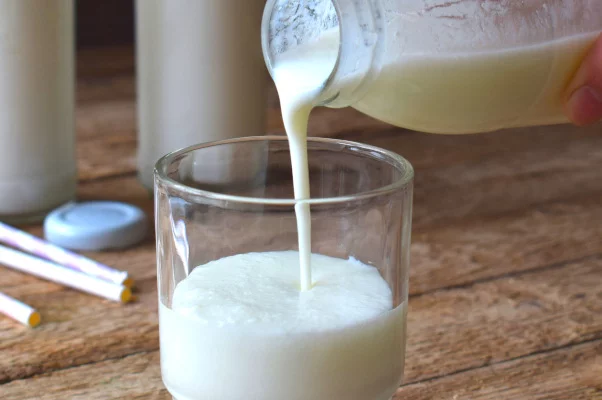
This is the most common case. You may have followed « 24 hours » as a general rule, but in your case, with your temperature and your amount of grain, 24 hours is too much.
Diagnosis: visible separation, very acid taste, and you have left a long cycle.
Solution: filter earlier, often 6 to 12 hours earlier depending on your situation.
In summer or in a hot kitchen, fermentation can double in speed. Kefir can be ready in 10 to 16 hours.
Diagnosis: same recipe as before, but suddenly it becomes too acidic. Often linked to a change of season.
Solution: reduce the time, move the jar to a cooler place, or reduce the seeds.
Over time, the grains multiply. Many people keep the same « ladle volume », without realising that the mass has doubled. The result: faster, more acidic fermentation.
Diagnosis: your kefir is becoming more and more acidic as the weeks go by, without you having changed the weather.
Solution: reduce the amount of grain used or increase the volume of milk.
Semi-skimmed milk works very well, but the acidity may stand out more on the palate, as there is less fat to round it out. It’s not that kefir is chemically ‘more acidic’, but it may be perceived as more acidic.
Diagnosis: correct kefir but too « sharp », especially the taste.
Solution: switch to whole milk, or shorten the time slightly.
Paradoxically, when your grains are very active (which is positive), they can acidify quickly. If you keep it long, you get a very strong kefir.
Solution: adjust the time / seeds, and be happy. Your seeds are in good shape.
After a pause, the first cycle may be acidic or bizarre.
Solution: short restart cycles, whole milk, do not judge on the first batch.
Your kefir is already too acidic. What can you do about it now?
Cold greatly slows down the process. If your kefir has already been strained, put it in the fridge straight away. This won’t « remove » the acidity, but it will prevent it from continuing to intensify.
If your kefir has separated, you can stir it after filtration. This makes the texture more homogenous, even if the taste remains strong.
Kefir that is too acidic can be excellent for culinary use. Sauces, marinades, pastes, cooking. This avoids wastage.
You can sweeten it by mixing it with :
The idea is to make the drink enjoyable, without changing the culture. Please note: you don’t ‘correct’ a routine by adding sugar every day. You correct the routine with the settings.
If you still have a mild batch or lighter fermented milk, mixing can balance it out.
Most people correct the problem with just 1 change. Filter earlier.
If you ferment for 24 hours and it’s too acidic, try 18 hours. If it’s still too much, go down to 14-16 hours (especially in summer).
Kefir is not a « 24-hour » recipe. It is a process.
If you want to keep to your schedule (for example, filtering every morning), reduce the amount of grain. A reduction of 10-20% can be enough to completely change the result.
Example: you use 50 g per litre. Reduce to 40-45 g.
Sometimes the simplest solution is logistical:
A small change in temperature can transform a fermentation.
If your kefir seems too sharp, switching to whole milk may help. Kefir remains tart, but is perceived as rounder.
Straining when it’s ‘just right’, then putting it in the fridge, is a very effective strategy. Kefir often becomes more pleasant after a few hours in the fridge.
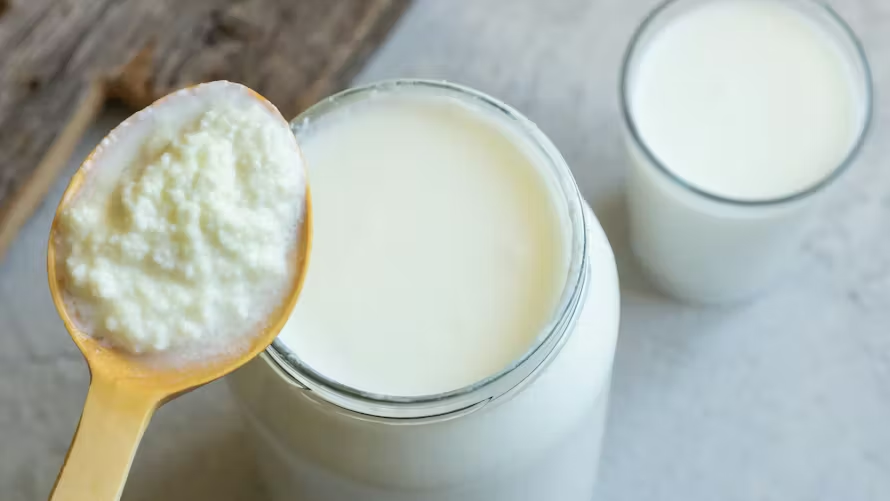

Rinsing grains with water is not the main solution to acidity. Acidity is a function of time, temperature and the grain/milk ratio. Rinsing can sometimes slow it down temporarily, but it is not a lasting solution.
It may work, but it reduces the window of success. You get a kefir « right on time », and if you forget for 2 hours, it becomes too acidic.
Reducing the grains a little makes the routine more tolerant.
If you push it too long, you end up with acidity and separation. For a thicker texture, it’s better to use whole milk, fewer grains and rest in the refrigerator, rather than fermenting for too long.
This is the classic trap. If you don’t weigh (even from time to time), you don’t see the changes. And your routine, which used to work, suddenly becomes too acidic.
Summer often requires a seasonal adjustment.
Do not conclude on the first batch.
Filter before separation + reduce grain = main solution.
Many people think that the more acidic it is, the more probiotic it is. The reality is more nuanced. Kefir that is too acidic can be less pleasant, and some sensitive people tolerate it less well.
The aim is not to have the most acidic kefir possible. The aim is a kefir that suits you, that you drink regularly, with a pleasant taste and a stable routine.
Here’s a clear strategy if you’re aiming for a sweet kefir:
This is often the combination that makes kefir so easy to drink.
And if you also like less ‘milky’ fermentations, kombucha can be a pleasant alternative. Tart but in a different way, often fruitier depending on the flavouring. You can start easily with our SCOBY Kombucha (natural authentic kombucha strain) for a stable fermentation that you can also control over time.
Generally not, if hygiene is correct. Acidity indicates advanced fermentation. If you see mould (rare) or a frankly rotten smell, stop. Otherwise, it’s mainly a question of taste.
Put in the fridge, stir if separated, enjoy as a smoothie or with a little fresh milk, or use in cooking.
No. The problem is with the setting, not the beans. Adjust the time/quantity/temperature.
Often: rise in temperature (change of season), multiplication of grains, or change of milk.
Both work. Reducing the time is the simplest. Reducing the grain makes the routine more forgiving (less risk of going over).
It slows down a lot, but does not stop completely. Kefir may continue to evolve slightly over time.
Sometimes, fermentation acidifies without thickening much (type of milk, UHT milk, reworked grains). The texture often returns with whole milk, resting in the refrigerator and regular cycles.

Kefir that is too acidic can almost always be quickly corrected. In most cases, all you need to do is filter earlier, reduce the quantity of grains slightly or ferment in a cooler place. In 1 to 3 cycles, you’ll have a mild, balanced kefir.
And if you like home fermentations, remember. Everything can be controlled. Kefir, like kombucha, responds to simple levers. If you want to vary your living drinks at home, you can also start a regular fermentation with our SCOBY Kombucha (natural authentic kombucha strain)a great way to complete your routine, while keeping the same spirit. Observe, adjust, enjoy.
Sources :
📖 Go further: read our How to Make Kefir at Home: The Complete Guide, with a batch calculator, timings and troubleshooting.
Ready to try it yourself?
Discover our live milk kefir grains, shipped in 24/48h with a step-by-step English guide. And for the curious, the history of kefir is a fascinating read.