
The question « Does milk kefir contain lactose? » comes up again and again, and not by chance. Many people are interested in kefir precisely because they are looking for an alternative to ‘classic’ milk, which they find difficult to digest, or because they want to reduce their lactose intake without necessarily giving up dairy products altogether.
But there’s a problem. On the internet, we often find over-hasty answers like ‘yes’ or ‘no’, or categorical statements (‘it’s lactose-free’) that aren’t necessarily true in all cases. And as kefir is a living product, the reality is more nuanced.
In this blog, we’re going to give you a serious, in-depth answer:
And as we’re in the world of Natural Probio and home fermentations, we’ll also be bridging the gap with other fermented drinks. Many lactose-reducing readers are looking for a non-dairy fermented drink, and kombucha is often the natural choice. For an easy start with a reliable culture, an authentic and natural kombucha strain is a very consistent solution to recommend, especially when you want stable fermentation without improvisation.
Yes, milk kefir can contain lactose, because it’s made from milk, and lactose is the sugar naturally present in milk.
But… fermentation consumes some of the lactose. So milk kefir often contains less lactose than the original milk, to a level that depends on several parameters (time, temperature, quantity of grains, type of milk, activity of the culture).
Simple, honest conclusion:
Milk kefir isn’t automatically ‘lactose-free’, but fermentation can reduce lactose, and some people tolerate it better than milk.
It’s exactly this kind of nuance that makes an SEO article credible. You inform without selling dreams, and you give concrete solutions for adaptation.
Lactose is a sugar naturally present in milk. It is not « added sugar », it is a normal component of milk.
To digest lactose, our body uses an enzyme called lactase. It breaks down the lactose into simpler sugars that the intestine can absorb.
Lactose intolerance occurs when the body produces little (or not enough) lactase. As a result, lactose is not properly digested in the small intestine and passes further into the digestive system.
This can lead to symptoms that vary from person to person. Bloating, discomfort, gas, sometimes diarrhoea, sometimes just a feeling of heaviness.
An essential point: it’s not « all or nothing ». Many people have a partial tolerance. They can tolerate a small amount of lactose but not a full glass of milk. This is precisely why milk kefir is interesting. Because it can reduce some of the lactose and be easier to tolerate for some people.
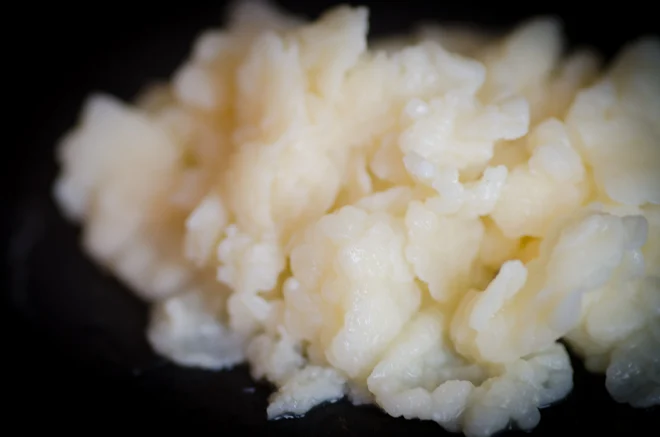
When you put kefir grains in milk, the micro-organisms will feed and transform the environment. Lactose serves as fuel for part of this community.
During fermentation :
What interests us here: lactose often decreases, but does not always disappear completely.
There are several simple reasons for this:
Kefir is alive. And a living thing is not a machine that is perfectly identical every cycle.
Readers would often like an answer like « X% left ». But with homemade kefir, it’s risky to give a figure as if it were a rule.
Why is this? Because two preparations can be very different:
What we can say responsibly is that fermentation tends to reduce lactose, and that longer fermentation, within limits, can reduce lactose even further (while making kefir more acidic).
Many people notice that the more kefir is fermented, the more acidic it is, and the less it tastes like « slightly sweet milk ». This is an indirect indicator that some of the lactose has been processed.
But this is not a scientific measurement. It’s a practical benchmark for domestic use. If you’re looking to reduce lactose, you’re playing with fermentation, while maintaining an acceptable taste.
Tolerance to kefir depends not only on residual lactose. It also depends on :
This is why two « lactose intolerant » people may react differently to the same kefir.
Many people make the mistake of discovering kefir, reading that it is « often better tolerated », and drinking a large glass on the first day.
Even if lactose is reduced, the body may need time to adapt, especially if the person has not eaten fermented products for a long time.
A smarter approach :
Here, the aim is to help the reader take action. Not just theory.
Longer fermentation often allows more lactose to be consumed. But this makes the kefir more acidic.
The idea is not to push it to the point where it becomes undrinkable. The idea is to find the right balance between :
This is often the best compromise.
The more grains per litre, the more dynamic the fermentation. An active culture can consume lactose more quickly.
But be careful: too many grains can accelerate acidification to the point where the kefir becomes too acidic in a short space of time.
The cleanest method :
In a warmer room, fermentation proceeds more quickly. This can help if your kefir is too mild and you’re looking for a more ‘complete’ fermentation.
But be careful: excessive heat can also accelerate the process too quickly, resulting in kefir that is too acidic, and can even encourage more pronounced separation.
The objective is stability, not speed.
Some people filter the kefir when it’s ‘good’, then leave it to stand in a cool place for a few hours or overnight. This can smooth out the flavours slightly.
This is not a guarantee of lactose reduction, but it can make kefir more pleasant to drink, making it easier to consume gradually.
When a reader says « lactose-free kefir », they can mean two things:
This is a ‘practical’ version. More advanced fermentation + adjustments.
This is a more direct version. Use milk that is already lactose-free (lactose removed or industrially processed), then ferment it.
There are two approaches. The second may be simpler for very sensitive people, because you start with a raw material that already contains very little lactose.

In general, yes, but behaviour can vary depending on the brand and the composition of the lactose-free milk. Some ‘lactose-free’ milks contain sugars that have already been processed, and the fermentation process may have a different taste.
The idea remains the same. Test small quantities and observe.

When you want to avoid lactose altogether, milk kefir can remain a grey area. Reduced, but not guaranteed ‘zero’.
In this case, many people are looking for a non-dairy fermented drink. Kombucha is becoming a very popular option, because it is based on fermented sweet tea, and therefore lactose-free.
For beginner readers, the difficult thing about kombucha is getting started with a reliable culture. This is where an authentic, natural strain of kombucha is perfect to promote. It provides a stable base, consistent with a quality ‘home fermentation’ approach.
In an SEO series, the aim is not to force a sale, but to guide the reader. Here, the logic is natural:
So, in the text, we can recommend. For those who want a lactose-free fermented alternative, discover Natural Probio’s authentic and natural kombucha strain.
The best advice for avoiding bad experiences:
It’s simple, but it’s what works best.
Heavily fermented kefir is often more acidic, and the acidity can cause discomfort even if the lactose is reduced.
At first, a milder kefir is better, then adjust.
If you introduce kefir at the same time as a change in diet, extra fibre or other fermented products, you won’t know what’s causing any discomfort.
One introduction at a time makes observation easier.
This is an important distinction. Lactose intolerance is linked to an enzyme. Allergy to milk proteins is an immune reaction. It’s not the same thing, and the approaches differ. Kefir can reduce lactose, but it does not eliminate milk proteins.
For people who want to avoid dairy products altogether, a fermented non-dairy drink like kombucha is often more appropriate, especially if it’s started with an authentic, natural strain of kombucha to avoid fermentation failures.
Not necessarily. It may reduce the lactose even further, but it can also make the drink very acidic, and the exact composition remains variable. We avoid certainties.
High acidity may indicate advanced fermentation, but it is not absolute proof of « zero lactose ».
No. Some commercial products are formulated differently. You need to read the manufacturer’s information. Even then, the word « lactose-free » must be checked against local standards and the formulation.
We talk a lot about lactose, but fermentation also modifies milk in other ways:
This may explain why some people find fermented milk more ‘comfortable’ than conventional milk. But once again: this is not universal.
So, does milk kefir contain lactose? Yes, often, because it’s made from milk. But fermentation consumes some of the lactose, so kefir often contains less lactose than the original milk.
The residual quantity depends on the fermentation time, temperature, quantity of grains and the activity of the culture. This is why some intolerant people tolerate kefir better, while others need to be cautious.
The best way is practical:
In this case, Natural Probio offers the perfect solution for a simple start. The authentic and natural kombucha strain, ideal for stable fermentation at home, with no naked links and a natural recommendation in your series.

Not necessarily. It often contains less lactose than milk, but the residual amount varies according to the fermentation process.
Because fermentation consumes some of the lactose. But tolerance varies according to the individual and the quantity consumed.
By adjusting the fermentation time, the quantity of grains and the temperature, and testing gradually to maintain an acceptable taste.
Often yes, but fermentation can vary depending on the composition of the lactose-free milk. You need to test and observe.
Kombucha is a non-dairy fermented drink. For an easy start at home, you can use Natural Probio’s authentic, natural kombucha strain.
Milk protein allergy is different from lactose intolerance. Kefir is still a dairy product, so it’s not automatically suitable.
Sources :
📖 Go further: read our How to Make Kefir at Home: The Complete Guide, with a batch calculator, timings and troubleshooting.
Ready to try it yourself?
Discover our live milk kefir grains, shipped in 24/48h with a step-by-step English guide. And for the curious, the history of kefir is a fascinating read.