
Buying ‘live’ milk kefir grains is the starting point that changes everything. It’s also the stage at which many beginners get trapped, not because there are necessarily scams everywhere, but because the word ‘kefir’ is used for everything and anything. Industrial drinks, powdered ferments, approximate ‘kits’… whereas real milk kefir grains are a living, reproducible culture that can last for years if it’s well looked after.
In this guide, I’m going to help you make a safe and simple choice. You’ll find out:
Where to find live grains (really live)
How to recognise real milk kefir grains
What to look for before you buy
The classic pitfalls (and how to avoid them)
How to transport and reactivate grains
And what to do if you receive grains that are ‘tired’ or too small.
And since you’re on Natural Probio and clearly love the world of fermentations, I’d also like to remind you of another ultra-popular project. Kombucha. If you want to complete your fermentation routine at home, you can start easily with a reliable base like this Natural Probio strain of authentic natural kombucha. It’s a good « second project » once you’ve mastered kefir.
Before we talk about buying, let’s clarify what you need to receive.
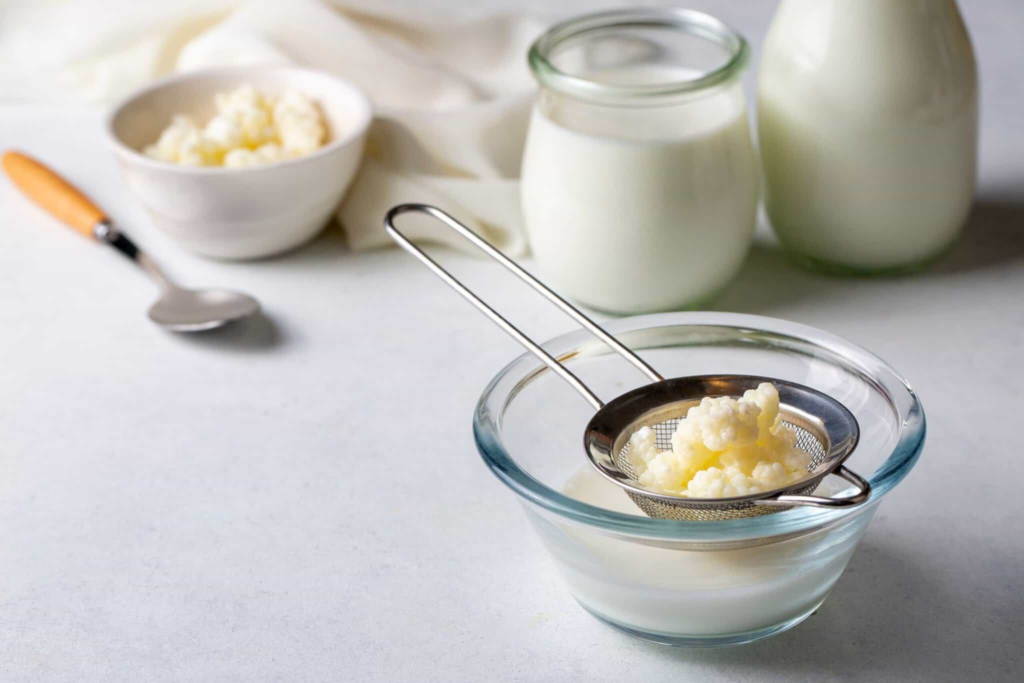
Milk kefir grains are small gelatinous masses, often white or cream-coloured, resembling mini cauliflowers. They contain a symbiosis of bacteria and yeasts, structured in a matrix. They feed on milk, ferment and multiply.
This is important: seeds multiply. If you have real live seeds, you can give some away, keep some, « expand » your production, etc.
You will sometimes see products sold as « kefir » or « kefir ferment ». These are often freeze-dried ferments (in powder form) that ferment milk once, or a certain number of times, but do not behave like grains.
Live grains, on the other hand, are a sustainable crop. So if your goal is real, traditional kefir, you’re looking for grains, not ferment in a sachet.
Another common confusion: water kefir grains (often translucent) are not milk kefir grains (often white/creamy). They don’t work in the same way.
If you buy « kefir grains » without specifying, you risk receiving water grains. So look explicitly for: live milk kefir grains.
There are several ways of doing this. Some are more « traditional » and often very reliable. Others are practical, but require more vigilance.
Kefir has a tradition of sharing. As the grains multiply, many people give it away or sell it for a small price.
Where to look locally?
Neighbourhood groups (social networks, local messaging services)
Associations, cookery workshops, zero waste groups
AMAPs, local organic communities (depending on your region)
Word of mouth: friends, colleagues, neighbours
Why is this an excellent option?
You can often see the kernels before you pick them up
You receive grains that are already active and fed on milk
You can ask the donor for advice (temperature, frequency, recommended milk)
You can sometimes recover a more generous « batch
The only drawback is that you have to find some, and that depends on your network.
Some organic food shops, herbalists, specialist fermenting shops and ‘health’ grocery shops sometimes stock live grains, or can put you in touch with a supplier.
Advantage: you buy in a more ‘commercial’ setting.
Disadvantage: it’s not available everywhere, and quality varies.
If the shop sells ‘bagged ferments’ instead, that’s not necessarily bad, but it’s not the same logic as a sustainable living grain.
Buying grain online is very common, especially if you don’t have a local network. It can work just fine… if you know what to look for.
Where to buy online?
Specialist fermentation sites (kits, cultures, etc.)
Marketplaces (beware: quality varies widely)
Classified ads (individuals)
Advantage: fast access, even without a network.
Disadvantage: you can’t see beforehand, and there may be grains that are tired, badly packed, or mixed up with other crops.
The good news is that with the right criteria, 90% of problems can be avoided (we’ll get to that shortly).
Some communities dedicated to fermentation organise exchanges. Kefir, kombucha, sourdough, etc. It’s a very reliable way because people know what they’re selling/exchanging.
And if you’re on a ‘home fermentations’ path, this is often the best way to build up a sustainable routine. Kefir + kombucha + sourdough, etc.
By the way, if you want to add kombucha to your routine, you can get off to a good start with a reliable culture like the Natural Probio strain of authentic natural kombucha, especially if you want a good starting point without any risky trials.
This is the most important part if you are buying online or via an advert.
Live milk kefir grains often look like :
Small, irregular clusters
Gelatinous/elastic texture
White to cream colour
Variable size (from « rice » grains to small « cauliflower » grains)
What you don’t want:
Powder
Dry « flakes » with no clear explanation
Something that looks like translucent beads (often water grains)
Live grains generally smell :
Fermented milk
Light, clean acidity
No rotten smell, no chemical odour
Of course, if you buy online, you’ll only feel it when you receive it. But it’s an important test.
The final test is fermentation:
If your grains ferment the milk in 24-48 hours (depending on temperature and quantity)
And after a few cycles they grow and multiply
You have a functional live culture.
A grain that fails to ferment after several attempts (using the correct method) is either dead or very weak.
When you talk to a seller or a donor, here’s what you can ask. Even if you don’t do an « interrogation », these questions will avoid unpleasant surprises.
Ask clearly: « Are these milk kefir grains (not water kefir)? »
This is confusion number 1.
Ideally: fed milk regularly.
If the person says. « They’re in sugar water », they’re not milk grains.
A culture that is used regularly is often more stable.
A culture that has « slept in the fridge for 6 months » may start up again, but it will require more reactivation.
This is crucial if you buy online.
The beans must be kept moist and protected.
If they arrive dried out without instruction, this is often a bad sign.
The smaller the quantity, the more fragile the start-up.
A reasonable quantity (even a modest one) facilitates the first fermentation.
If you see « kefir starter » or « kefir ferment », check to see if it’s a powder.
It’s not necessarily useless, but it’s not the long-lasting live grain you’re looking for.
Look at the description and photo.
Water grains: often translucent, like small crystals.
Milk grains: rather white/creamy, cauliflower-like.
If the seller announces:
« Grains sent dry »
« Grain left out of cold for a long time
« I haven’t used them for a long time ».
It’s not necessarily ruined, but the risk increases.
If it smells bad, very strong, putrid. Don’t force it.
Live kefir smells fermented, not rotten.
The seeds are multiplying. So the crazy prices don’t make much sense, unless it’s a complete kit, a service, or a premium boutique.
Kefir has always been a product for sharing. A reasonable price is enough.
That’s where a lot of people go wrong. They get some grains, they put them straight into 1 litre of milk… and they conclude that « it doesn’t work ».
See how it looks.
Smell.
If it smells clean and tangy: OK.
If it smells suspect, be careful.
Perform a small test fermentation.
Small volume of milk
Reasonable time
Then filter and start again
Often, grains need 2-4 cycles to regain full strength after transport.
The first or second batch can be :
More liquid
More acidic
Or with separation
This is often normal during reactivation.


If your grains seem slow or weak, here’s what usually helps.
Many crops recover better with whole milk.
Rather than a large volume, keep fermentation short and regular.
The grapes will regain their strength.
Too hot: aggressive fermentation, stressed grains.
Too cold: very slow fermentation.
Look for a stable spot.
Many people rinse and weaken the grains. In general, we avoid it.
On the internet, two salespeople can write the same thing.
So the difference is made on :
The quality of the photos
Reviews (if applicable)
The instructions provided
The consistency of the answers
Transparency about the crop
A salesman who knows what he’s talking about will give you simple advice:
fermentation time, quantity of grains, type of milk, storage.
Many people who take up kefir end up wanting a broader routine:
Milk kefir (creamy, milky)
Water kefir (fizzy, lactose-free)
Kombucha (fermented tea, refreshing)
If you’re already into home fermentation, kombucha is often the next step. And to get off to a steady start, you can start with the Natural Probio strain of authentic natural kombucha, especially if you want a simpler, more regular start.
Once you have good grains, the aim is not to lose them.
You can often keep them in the fridge in a little milk, in a clean jar, to slow them down.
The longer the pause, the more gradual the reactivation.
In this case, plan a few wake-up cycles.
Grains used regularly are generally more stable.
If you know you won’t be making kefir often, it may be worth adapting your routine (small quantities, or alternating with other fermentations).
Many people think you need a huge quantity. In fact, with a modest quantity, you can already get started, as the seeds multiply.
But if you’re a beginner, a slightly larger quantity will simplify things:
The first fermentation
Stability
Speed of fermentation
So ‘the minimum’ may work, but ‘a little more’ avoids the hassle.
Most often through local sharing. Neighbourhood groups, farming communities, associations, friends. As grains multiply, many people donate them.
They need to ferment the milk and multiply over the cycles. On receipt, the smell should be fresh and fermented, not suspect.
Yes, but check: real photo, clear description of « milk kefir », packaging method, customer returns and reactivation instructions.
Not really. A bag fermenter can ferment milk, but it doesn’t behave like reproducible living grains. If you want a sustainable culture, choose grains.
Yes, it’s even a very popular routine among home fermentation enthusiasts. To get kombucha off to a reliable start, you can use the Natural Probio strain of authentic natural kombucha.

To buy live milk kefir grains, the most reliable route is often a local sharing or fermenting community. If you buy online, this isn’t a problem, but you need to check a few simple criteria. Good ‘milk kefir’, moist grains, correct packaging, clear instructions, and enough to get you started.
Once you’ve got the right cereals, kefir becomes a simple, economical and sustainable habit. And if you like the idea of living ferments at home, you can also diversify your fermentations with kombucha… For an easy start with a reliable base, discover Natural Probio’s authentic, 100% natural kombucha culture.
Sources :
📖 Go further: read our How to Make Kefir at Home: The Complete Guide, with a batch calculator, timings and troubleshooting.
Ready to try it yourself?
Discover our live milk kefir grains, shipped in 24/48h with a step-by-step English guide. And for the curious, the history of kefir is a fascinating read.