
We often hear: « Kefir boosts immunity ». It’s a catchy phrase, easy to remember, and frankly tempting, especially when you want to feel stronger during winter, periods of fatigue, or when you’re chaining stress and too-long days together. But in real life, immunity isn’t an ‘ON/OFF’ button that you activate with a drink. It’s a complex system that depends on your sleep, stress, nutritional status, microbiota, physical activity, possible deficiencies, and other factors beyond our control.
So the question deserves more than a slogan: does milk kefir boost immunity, yes or no? The most honest answer is: it may influence certain mechanisms linked to immunity, notably via the microbiota and certain inflammatory markers, but the evidence in humans is still patchy, and the expression « boost immunity » is too vague to be scientifically sound. Moreover, even in the world of probiotics, clinical trials sometimes give contradictory results, and the authorities remain cautious about general claims.(NCCIH)
In this guide, we’re going to take things seriously, but in a way that’s easy to apply. You’ll understand :
How immunity works, without unnecessary jargon
Why the gut is a central player in the immune response
What research on kefir shows (reviews, trials, inflammatory markers)
The limitations of studies and why we shouldn’t over-promise
How to consume kefir realistically to reap the potential benefits
Who should be cautious (weakened immunity, special situations)
And how to incorporate kefir into a broader ‘fermented drinks’ routine, if you like variety
And since you want to promote a Natural Probio product in every article without a naked link, I naturally include it. Many people who adopt kefir also like to alternate with kombucha, another popular fermentation. If you want to diversify, you can start a stable home fermentation from our SCOBY Kombucha (natural authentic kombucha strain), which allows you to explore a complementary living drink.
When we talk about immunity, we often confuse several ideas:
Catching infections less often
Fewer symptoms when you fall ill
Faster recovery
Less ‘background’ inflammation (which can affect general comfort)
A better intestinal barrier and fewer digestive imbalances
A fermented drink can potentially have an effect on some of these points, especially those linked to the microbiota and inflammatory balance. But it’s no guarantee that you won’t get sick. And in nutrition, the benefits are often modest, cumulative and highly context-dependent.
In the European Union, overly general wording such as « boosts immunity » or even the use of the term « probiotic » may be considered as unauthorised health claims if they suggest a benefit that has not been specifically demonstrated. Documents and opinions related to EFSA and the regulatory framework remind us that the term « probiotic/probiotic » is treated as an unauthorised claim in certain contexts, and that claims must be precise and substantiated.(EFSA Journal)
This does not mean that fermented products are of no interest. What it does mean is that we need to talk in precise terms. « impact on certain markers », « possible modulation », « variable effects », instead of blanket promises.
We often hear « immunity is played out in the intestine ». This is a simplification, but it points to something true. The intestine is a major site of interaction between the body and the outside world. Every day, it handles an enormous flow of food molecules, microbes and signals. The intestinal barrier, local immune cells and the microbiota all play their part in maintaining a balance.
The intestinal microbiota is an ecosystem. It is influenced by diet, stress, antibiotics, sleep and many other factors. Probiotics and fermented foods can act as ‘visitors’ that temporarily modulate this ecosystem, and sometimes, in some people, this modulation is accompanied by measurable changes. But results remain variable, and individual response cannot be predicted with certainty, as the NCCIH also points out in its content on probiotics and the variability of evidence.(NCCIH)
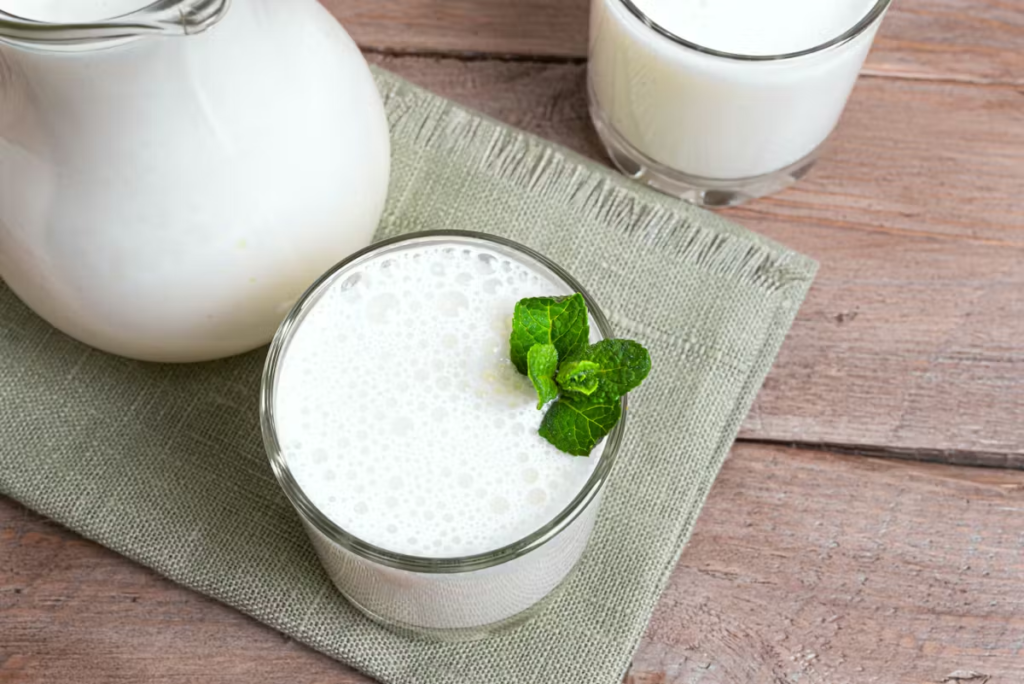
Kefir is not simply « sour milk ». It is a fermented beverage, generally produced by a community of lactic acid bacteria and yeasts, with fermentation products (organic acids, peptides, bioactive compounds). Depending on the method, duration, type of milk, temperature and culture used, the composition may vary.
This is important, because if the composition varies, so can the potential effects.
The first axis is the microbiota-intestinal barrier axis. If kefir contributes to a more favourable microbiota or better digestive tolerance in certain people, this may indirectly influence local immune mechanisms.
The second area is inflammation. Several studies are looking at the impact of kefir on inflammatory markers (CRP, cytokines, etc.). The human results, however, are not uniform.
A review (2022) focusing on the effects of kefir and its constituents on immune and metabolic aspects discusses immunomodulatory mechanisms observed mainly in preclinical studies (models, laboratory, animals) and stresses that extrapolation to humans requires caution.(PMC)
To put it plainly. There are plausible mechanisms, but ‘strong’ evidence in humans is more difficult, because well-controlled, comparable trials based on relevant criteria are needed.
A systematic review and meta-analysis (2025) assessed the impact of kefir consumption on inflammatory biomarkers and metabolic parameters from a range of trials. Overall, the authors concluded that the results did not show massive and systematic effects on several pro-inflammatory markers in their analyses.(ScienceDirect)
This is an important point. Even if some individual trials show improvements, when aggregated, the average effect may be limited or dependent on conditions.
A similar message is found in reviews of fermented dairy products in general, where the effects on biomarkers of inflammation are not always significant, even when no harmful effects are observed.(nmcd-journal.com)
A controlled trial in adults has shown that consumption of kefir can modify the composition of the intestinal microbiota under controlled living conditions.(The Guardian)
It’s interesting in terms of the ‘microbiota-immunity’ logic, but it’s important to keep things in perspective. A measured change in microbiota does not automatically translate into a clinical improvement in immunity or a reduction in infections in everyone.
The NCCIH reminds us that probiotics can be useful in certain specific situations, but that the evidence remains variable and that their use is not without precautions for certain fragile individuals.(NCCIH)
So, for kefir, it’s reasonable to say. « interesting potential », « possible effects », « still heterogeneous human evidence », rather than « boosts immunity » as a certainty.
If kefir helps you to have better intestinal comfort, fewer digestive problems and a more stable eating routine, that’s already a tangible benefit. And since a more stable digestion can help your general condition, many people associate it with a feeling of « I feel more solid ».
Some people may observe changes in markers or feelings linked to inflammation, but the average effect in meta-analyses is not systematic(ScienceDirect).
There is research on probiotics and immune response, but the idea that « I’ll catch zero colds thanks to kefir » is not a credible promise to make. The most honest answer is. « it can support certain mechanisms, but it’s not a shield ».

No two people start at the same point. Diet, stress levels, sleep, microbiota, habits. So the response to kefir varies.
Mild home-made kefir, highly fermented kefir, pasteurised industrial kefir and enriched kefir are not identical. There is a « quality and method » effect.
If kefir replaces sugary drinks, heavy desserts or structures your breakfast, the overall improvement may be due to several changes at once.

For someone just starting out, the best approach is gradual. A small regular portion is often more logical than a large irregular quantity, especially if the aim is comfort and tolerance.
Kefir that is too acidic can be less pleasant and sometimes less well tolerated. If you’re just starting out, a shorter fermentation, filtered before separation, is often a good starting point.
The effects on overall feeling and comfort cannot always be judged in 48 hours. Give yourself a stable window.
The NCCIH stresses that the use of probiotics is generally considered safe for many people, but that there are exceptions, particularly in people who are very weak or have an altered immune system.(NCCIH)
So, extra caution if you are :
Immunocompromised, undergoing heavy treatment, transplant, chemotherapy, etc.
Subject to opportunistic infections
In a medical situation where the introduction of live fermented foods should be discussed
In these cases, it is better to seek medical advice rather than test « at random ».
Even if you like fermented drinks, the mainstays remain :
Regular sleep
Stress management
A diet rich in fibre and micronutrients
Appropriate physical activity
Avoiding deficiencies, especially if you are at risk
Overall lifestyle
Kefir can be an interesting ‘bonus’, but it doesn’t make up for 4 hours’ sleep and a disorganised diet.
Some people find that alternating fermentations suits them better. Kefir on some days, kombucha on others, depending on taste and tolerance.
Kombucha is a different kind of fermentation, with a more ‘tea-like’ acidic profile, and it too is controlled by time and temperature. If you’d like to add this option to your routine, you can easily get started with our SCOBY Kombucha (natural authentic kombucha strain), which allows you to explore another living drink without complicating your routine.
We can say that it may influence mechanisms linked to immunity, in particular via the microbiota and inflammation, but the human evidence is heterogeneous, and clinical trials give inconsistent results depending on the markers and populations.(ScienceDirect)
There are trials and reviews, but taken together they do not allow us to conclude that there is a massive and guaranteed effect on general immunity criteria. Meta-analyses on inflammation show variable effects.(ScienceDirect)
Controlled trials indicate a modulation in the composition of the microbiota after consumption of kefir under certain conditions.(The Guardian)
For most people in good health, it is generally well tolerated, but caution should be exercised if the immune system is weakened, as the NCCIH reminds us with regard to probiotics.(NCCIH)

Milk kefir is an interesting fermented drink, and there are plausible reasons to think that it may support certain aspects of immunity, especially via the gut-microbiota axis and certain inflammatory markers. But the human evidence remains variable, and the meta-analyses do not show a systematic and massive effect on inflammation for all profiles. But the human evidence remains variable, and meta-analyses do not show a systematic and massive effect on inflammation for all profiles(ScienceDirect).
The best approach is therefore simple. Introduce kefir gradually and regularly, and observe your overall comfort over a few weeks, while keeping to the basics (sleep, stress, diet). And if you like to vary your fermentations, supplementing kefir with another living drink is often very pleasant. You can start a stable homemade kombucha with our SCOBY Kombucha (an authentic natural kombucha strain).
Sources :
📖 Go further: read our How to Make Kefir at Home: The Complete Guide, with a batch calculator, timings and troubleshooting.
Ready to try it yourself?
Discover our live milk kefir grains, shipped in 24/48h with a step-by-step English guide. And for the curious, the history of kefir is a fascinating read.