
When we read « milk kefir », we often think of a recipe. Grains, milk, a jar and a few hours’ fermentation. But this ‘technical’ vision is incomplete without knowing what lies behind it. A drink born of a pastoral world, shaped by conservation constraints, and passed down as a living heritage.
The question « where does milk kefir come from? » is not a curiosity. She explains:
Above all, it helps to write more credible content. A strong SEO article doesn’t just repeat « it’s good for… », it tells the story of why this drink exists, what it represents and how it has evolved.
In the world of fermentations, this logic also applies to other drinks such as kombucha. Many readers who fall in love with kefir end up wanting to discover other live fermentations. That’s exactly why Natural Probio offers a reliable introduction to kombucha with an authentic, natural kombucha strain: consistency between fermented traditions is created through living culture, transmission and balance.
Milk kefir is not a recent invention. It belongs to an era when :
In other words, milk kefir came into being because it met a practical need. To transform fresh milk into a drink that was more stable, more pleasant to store and better suited to a rural lifestyle.
It’s important to set this framework, because it changes the tone. We’re not talking about a « miracle product », but about an old solution that has become a habit, then a tradition, then a heritage.
When people ask « Where does milk kefir come from? », the most commonly cited origin is the Caucasus, a mountainous region located between the Black Sea and the Caspian Sea, at the crossroads of European, Asian and Middle Eastern influences.
Why is this region so often associated with kefir?
In pastoral societies, processing milk has always been an art. Cheese, curdled milk, yoghurt, butter and other fermented or acidified forms. Milk kefir is part of this family, but it has one essential feature. It is grown from grains that are capable of regenerating.
The mountains of the Caucasus impose a number of constraints:
In this context, fermentation appears to be a ‘natural’ response. It doesn’t require advanced technology, just know-how, observation and a stable culture.
Milk kefir developed in a world where people already knew how to ferment. What was new was not « fermenting », but fermenting with a structured, transferable and sustainable grain culture.
This idea of sustainable cultivation also applies to kombucha. A well-maintained strain lasts over time and is passed on. For readers who want to apply this logic to another fermented beverage, offering an authentic, natural strain of kombucha is a natural bridge between traditions.
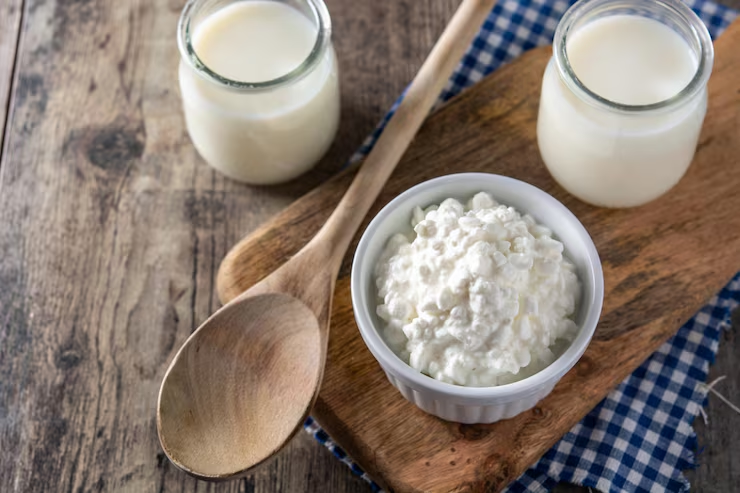
Most traditional fermented foods are based on :
Milk kefir, on the other hand, is based on a very special form of culture. Visible, tangible grains that can be held in the hand, fed, filtered and shared.
These grains are more than a « ferment ». They are a living structure housing a microbial community, often described as a balance between lactic acid bacteria and yeasts, organised in a matrix.
Historically, this changes everything. There is no dependence on a market, external production or complicated preparation. As long as the beans exist and are maintained, the beverage can be produced indefinitely.
In many traditions linked to kefir, we find the following idea. Grains are given, not sold. Even though they can be bought today, the principle of giving remains strong in the communities.
Why is this?
Whether we take these beliefs in a spiritual or symbolic sense, they tell us one thing. Kefir is a living culture that survives by being nurtured and shared.
In the world of kombucha, we find something very similar. A culture is duplicated, part of the SCOBY is shared and passed on. And that’s exactly the spirit we’re extending with Natural Probio, in particular through an authentic, natural strain of kombucha that’s part of a living, sustainable fermentation process.
Like many ancestral foods, milk kefir is surrounded by stories. Sacred gifts, tribal secrets, family traditions and so on. These stories vary from region to region and from community to community.
Why do these stories exist?
Because a living, transmittable culture that ‘ferments milk’ without modern science could seem mysterious. And because traditional societies often value what guarantees survival and continuity.
Kefir was not just a drink. It was a domestic power, a household skill, an element of dietary stability.
Even leaving aside the legends, they reveal plausible historical elements:
It’s exactly this kind of depth that transforms an SEO article. Instead of « generic » text, we offer real understanding.
Initially, kefir was a local product. But cultures travel with people. As soon as :
eating habits are also changing.
So milk kefir spread first to nearby areas, then to other regions where fermented milk was already being grown. Where people drank fermented milk, it was easier to adopt kefir.
The modern history of kefir is often linked to Russia and Eastern Europe. Not because it was born there, but because its distribution took on a structured dimension.
In these regions :
As a result, kefir began to be documented, studied and sometimes produced on a larger scale.
It is important to note one nuance. « producing on a larger scale » does not always mean « industrialising in the modern sense ». In the early stages, it was often a case of expanding production, while retaining some of the traditional methods.
Kefir has some eye-catching characteristics:
This is not to say that the scientific interest was always perfectly rigorous or that we should draw exaggerated conclusions. But it does explain why kefir has become part of wider nutritional discussions.
Kombucha has followed a similar trajectory. First as a domestic drink, then as an object of curiosity, then as a marketed beverage. But in both cases, enthusiasts often go back to the roots. Living culture, home fermentation, tradition. Hence the importance of recommending an authentic, natural strain of kombucha for those who want to start out with a reliable base.
Rather than give exact dates, which vary according to the source, here is a logical chronology:
Kefir is essentially a domestic product, produced in pastoral communities in the Caucasus.
Grain is transported to neighbouring regions through human exchanges.
Eastern Europe, Russia, regions where fermented milks are already common.
Documentation, studies, attempts at more organised production.
As ferments and cultures became available, kefir spread to Western Europe, North America and other regions.
Kefir is once again becoming a very popular domestic drink in ‘homemade’ communities, often alongside kombucha.
This chronology is useful in SEO because it gives a coherent narrative. Origin → transmission → diffusion → modernity.

In its original context, kefir was not a « special » drink. It was a regular drink, part of a routine.
It could be eaten:
This is a crucial point. Today, some of the talk about fermented foods is « marketing ». But the history of kefir reminds us that it is an ordinary food practice, in the best sense of the word. A simple gesture, repeated and passed on.
In a traditional house, fermentation follows the rhythm :
That’s why kefir is naturally variable. It was never designed to be the same every day.
This is also what can reassure beginners. If your kefir is not exactly the same as the day before, that’s normal. Fermentation is alive.
Fermentation also varies in kombucha, depending on temperature, sugar, tea and duration. To stabilise the start, an authentic and natural strain of kombucha often helps to obtain a healthy base, before playing with the variations in flavour.
When a fermented product becomes « industrial », it may undergo :
This doesn’t mean that all commercial products are ‘bad’, but it does explain why some consumers seek out homemade kefir. They want to rediscover the original logic.
Homemade kefir helps :
The ‘home fermentation’ trend almost always includes kombucha. And when a reader wants to go further, offering a clear solution like the authentic, natural strain of kombucha can turn interest into action, while remaining consistent with the traditional spirit.
Its domestic origin implies :
That’s why, even today, there are several ‘correct’ ways of making milk kefir. You can give guidelines, but fermentation remains an observation.
The central idea behind kefir is simple. It’s not a recipe, it’s a relationship.
It’s the same principle as :
With this in mind, Natural Probio has positioned itself very well by offering an authentic, natural strain of kombucha: it extends the spirit of traditional fermentations with an accessible living culture.
There are several reasons for kefir’s modern popularity:
Kefir embodies a reassuring simplicity. Few ingredients, little equipment, an everyday gesture.
Many people start with kefir, because it’s quick and accessible, and then explore :
In this progression, it makes a lot of sense to recommend an authentic, natural strain of kombucha to readers: it allows them to expand their fermentation universe with a reliable culture, without getting lost in hazardous methods.
So where does milk kefir come from? Its history takes us back to the Caucasus, to a pastoral tradition where fermentation was not a luxury but a necessity. Kefir grains, handed down like a treasure, have enabled this beverage to travel through time, to become part of other food cultures, and to be reborn today in modern kitchens.
Milk kefir is not just a drink. It’s a living tradition, a culture that can be nurtured and shared, a domestic know-how that resists total standardisation.
And if this story speaks to you, it’s natural to explore other living fermentations. Kombucha follows the same logic of cultivation and transmission. To get you started easily and stay true to the traditional spirit, Natural Probio offers an authentic, natural strain of kombucha that is the perfect complement to a ‘home fermentation’ routine.

Yes, the most commonly accepted origin associates milk kefir with the pastoral populations and traditions of the Caucasus, where it is said to have been preserved and passed on.
Because milk kefir is based on a living culture structured in grains, reusable and transferable, which makes it unique compared to other milk fermentations.
No. Historically, it was an everyday drink, linked to the preservation and processing of milk. The ‘well-being’ arguments are more recent.
Through the circulation of grains via human exchanges, then through its integration into regions already familiar with fermented milks, with greater interest in Eastern Europe and Russia.
Yes, with the idea of fermentation passed on by a living culture. If you want to get started, an authentic, natural strain of kombucha will get you off to a good start.
Sources :
📖 Go further: read our How to Make Kefir at Home: The Complete Guide, with a batch calculator, timings and troubleshooting.
Ready to try it yourself?
Discover our live milk kefir grains, shipped in 24/48h with a step-by-step English guide. And for the curious, the history of kefir is a fascinating read.