
When you adopt milk kefir at home, there comes a time when the question naturally arises: « What about the children? Can I give them some? » Some parents love the idea of a ‘homemade’ fermented food, more natural than some industrial drinks, and combined with a simpler eating routine. Others are hesitant, and that’s normal. As […]

Buying ‘live’ milk kefir grains is the starting point that changes everything. It’s also the stage at which many beginners get trapped, not because there are necessarily scams everywhere, but because the word ‘kefir’ is used for everything and anything: industrial drinks, powdered ferments, approximate ‘kits’… whereas real milk kefir grains are a living, reproducible […]

How much milk kefir to drink: there is no dose SHORT ANSWER On how much milk kefir to drink there is no dose, because it is a food and not a remedy. A 200 ml glass with a meal is what most regular drinkers settle on. Worth knowing: 110 to 130 kcal a glass from […]

Kefir is one of those habits that quickly takes hold. At first, you taste it « just to see », then you have a little glass now and then… and a few days later, you find yourself asking, « Can I drink it every day? » It’s an excellent question, because with fermented foods, common sense isn’t always enough. […]
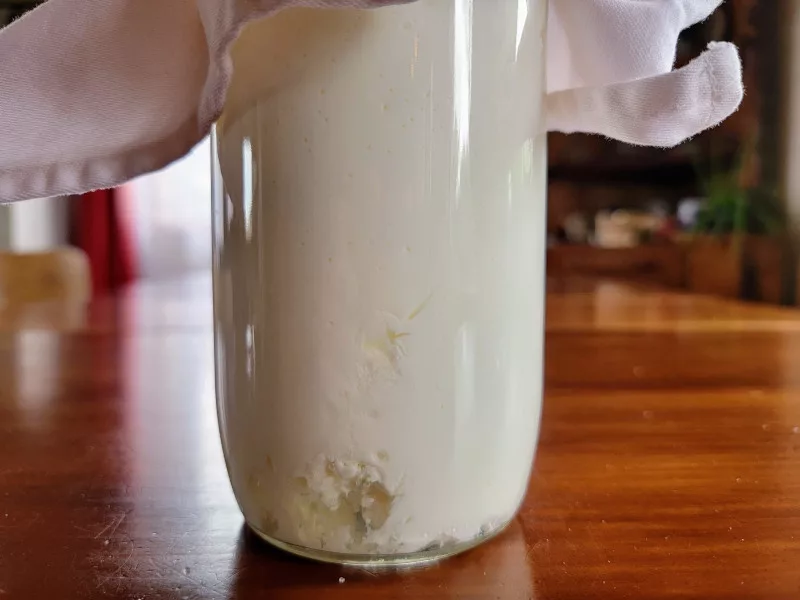
If you like the idea of milk kefir but have problems with lactose, you’re not alone. It’s one of the most frequently asked questions, especially among those who want to enjoy fermented foods without triggering digestive discomfort. The good news is that there are several ways to make ‘lactose-free’ or ‘very low-lactose’ kefir, depending on […]

Making kefir cheese is a bit like discovering a « superpower » in your kitchen. You start with living fermented milk (milk kefir), and by simply draining it, you obtain a creamy, spreadable texture, similar to fresh cheese, sometimes denser, sometimes lighter, depending on the method. The taste is mild, slightly acidic and, above all, totally customisable. […]
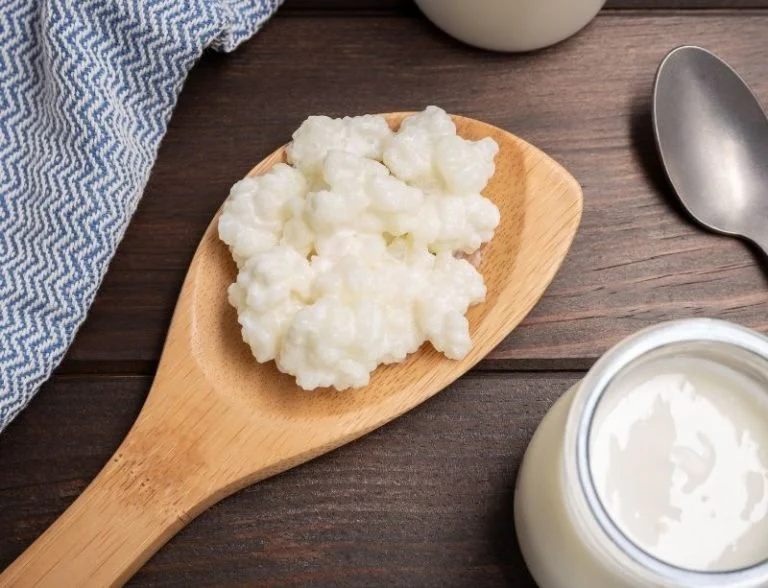
Milk kefir and probiotics: why we avoid that word SHORT ANSWER On milk kefir and probiotics we claim nothing, and legally no food seller can. No health claim about kefir is authorised in the European Union, and the word probiotic is itself a regulated term because the claim sits inside its definition. Milk kefir is […]

We often hear: « Kefir boosts immunity ». It’s a catchy phrase, easy to remember, and frankly tempting, especially when you want to feel stronger during winter, periods of fatigue, or when you’re chaining stress and too-long days together. But in real life, immunity isn’t an ‘ON/OFF’ button that you activate with a drink. It’s a complex […]

Bloating is the most common ‘silent’ problem: a belly that swells throughout the day, a feeling of pressure, discomfort after meals, discomfort in the late afternoon, sometimes accompanied by gas, gurgling or irregular transit. And when we look for solutions, we quickly come across fermented drinks, particularly milk kefir, often presented as an ally of […]

Texture is often the first indicator of doubt when making milk kefir. One day, everything’s perfect: slightly thick kefir, soft, easy to drink, with a fresh taste. The next day, surprise: it’s almost like milk, very liquid. Or conversely, it’s a thick, curdled, lumpy mass, sometimes separated into whey. And then the question arises: why […]
A simple definition (and the true nature of milk kefir) Milk kefir is a fermented beverage obtained by bringing milk into contact with kefir grains, then leaving it to ferment for several hours. The result, depending on the conditions, is a fermented milk that is thinner than yoghurt, often slightly acidic, sometimes delicately sparkling, and […]

You’ve filtered your kefir, you taste it… and it stings. The acidity takes over, sometimes to the point of making the drink difficult to drink. For some, it’s a « tonic » taste that they love. For others, it’s just too much, especially if you’re looking for a mild, round, slightly acidic kefir that’s easy to drink […]

Milk kefir grains have a well-deserved reputation: they are robust, generous and capable of multiplying as soon as they are given the right conditions. But ‘robust’ does not mean ‘indestructible’. As soon as you start making kefir on a regular basis, a question quickly arises: how do you store the grains between uses? Sometimes it’s […]

If there’s one question that divides people almost as much as « how long to ferment for », it’s this: should you rinse the milk kefir grains? There’s conflicting advice everywhere. Some swear you should rinse regularly « to clean » and avoid odours. Others say the exact opposite: don’t rinse at all, as it weakens the grains and […]

UHT milk is everywhere. It’s practical, economical, easy to store and always available. And when you start making milk kefir, it’s natural to ask yourself: « Can I make my kefir with UHT milk, or will it fail? Will the grains survive? Will it taste any worse? » This question comes up very often, and it’s perfectly […]
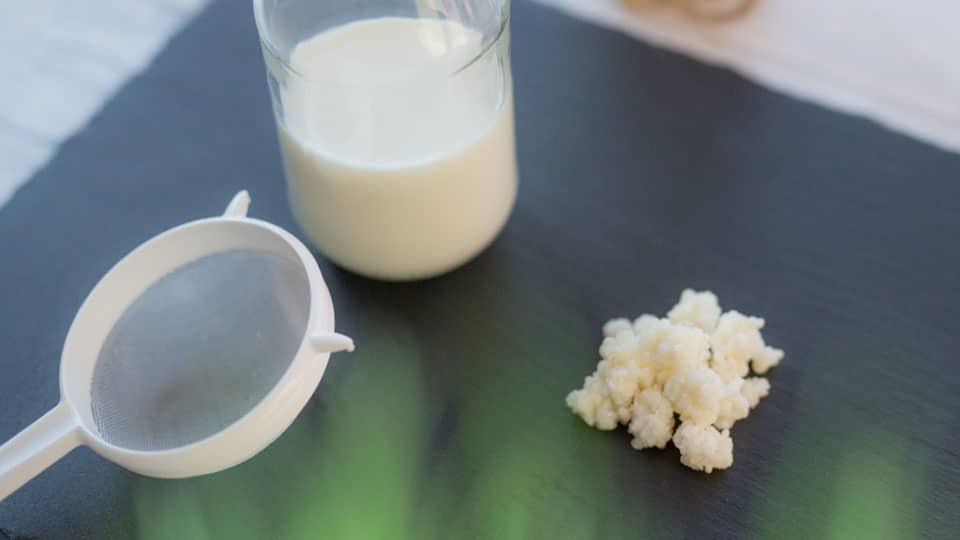
What milk for milk kefir: eight options compared SHORT ANSWER On what milk for milk kefir: any animal milk works, and whole cow’s milk is the reference. The quantities never change: 10 to 20 g of grains per litre, no added sugar, 24 hours at 20 to 25 °C. Plant drinks work only in alternation […]

Why the origin of milk kefir matters so much When we read « milk kefir », we often think of a recipe: grains, milk, a jar and a few hours’ fermentation. But this ‘technical’ vision is incomplete without knowing what lies behind it: a drink born of a pastoral world, shaped by conservation constraints, and passed down […]

Why the two are often confused (and why this is not a detail) When you’re new to the world of kefir, there’s a tendency to think that there’s « just one kefir » available in several recipes. The vocabulary is confusing: it’s called « kefir grains » in both cases, it’s called a fermented beverage in both cases, and […]
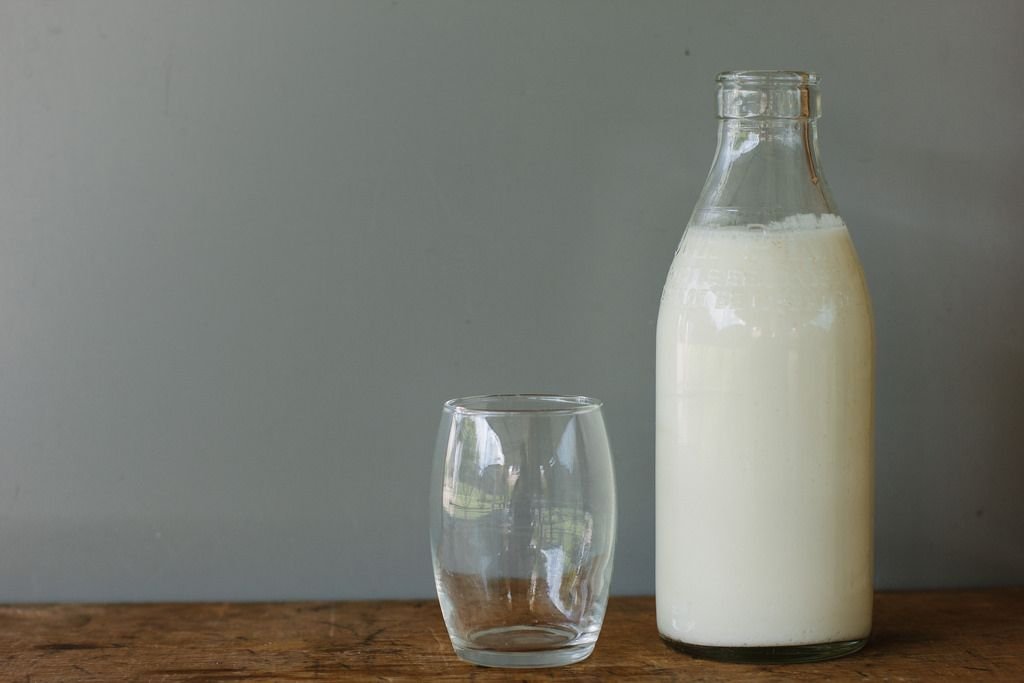
When you start making milk kefir, you quickly discover two realities: on the one hand, the grains are incredibly lively and generous, capable of multiplying and transforming milk into a pleasant fermented drink with disconcerting ease. On the other, this generosity can become… invasive. You’ve got too many grains, you’re going on holiday, you can’t […]

Why « dosage » is the key to a successful kefir If you had to remember just one thing to succeed in making homemade milk kefir on a regular basis, it would be this: the quantity of grains per 1 litre of milk is the most powerful lever. More powerful than the choice of jar. More powerful […]

Why this question is so important to readers The question « Does milk kefir contain lactose? » comes up again and again, and not by chance. Many people are interested in kefir precisely because they are looking for an alternative to ‘classic’ milk, which they find difficult to digest, or because they want to reduce their lactose […]

Why does this question come up so often? Most people discover milk kefir by comparing it to yoghurt. It makes sense. Both come from milk. Both go through fermentation. Both have a tangy taste. Both are often associated with a ‘wellness’ routine or a simpler diet. And yet, when you get down to the details, […]

How milk kefir fermentation works: acid, then texture SHORT ANSWER How milk kefir fermentation works: the culture eats the lactose and produces acid. The pH falls from about 6.7 to about 4.2 to 4.6 in 24 hours, and that acidity makes the casein coagulate, which is what turns milk creamy. Fat, protein and calcium stay […]

Why homemade milk kefir is different from what you find in the shops Making milk kefir at home isn’t just about « making fermented milk ». It’s learning to work with a living culture. The result is fresher, more customisable, often tastier (because you control the acidity), and above all, you can reproduce a stable routine day […]

Why talking about the « composition » of milk kefir changes everything When readers type in « composition of milk kefir », they’re not just looking for a definition. They want to know, in concrete terms, what’s in their glass. They want to understand whether kefir is « just fermented milk », whether it still contains lactose, what creates the acidity, […]

Milk kefir is one of those fermented beverages that are making a comeback in the ‘health’ kitchen, to the point where it is sometimes presented as a universal solution: light digestion, calmer tummy, smoother transit, better tolerance of lactose, ‘boosted’ microbiota, etc. The result is that many people take the plunge, try it for a […]

On social networks, on organic shelves and on certain ‘healthy’ blogs, the message is often the same: kombucha is the miracle drink for losing weight. We see phrases like « I’ve lost 5 kilos thanks to kombucha » or « a bottle a day and the kilos are gone ». If you’re reading this, you’re probably wondering: can you […]

The hotel in SCOBY: your « culture bank » at home You start with a single SCOBY Kombucha. You get it – for example from Natural Probio – throw your first batch and discover the magic of the sweet tea, which becomes sparkling, sour and lively.Then something strange happens very quickly: a second disc appears on the […]

You taste your kombucha: either it takes your mouth away like a very strong vinegar, or it still tastes like sweet tea, almost unchanged. Between the two, there seems to be a ‘perfect point’… but it’s hard to reach when you’re just starting out. Don’t worry: kombucha that’s too acidic or too sweet is neither […]

You prepare your kombucha carefully, lift the fabric of the jar… and there’s a surprise: brown filaments, suspended particles, a thick deposit at the bottom. At first sight, this might seem dirty, even worrying. Many beginners immediately think: « my kombucha is contaminated », « it’s not clean », or « I’ll get sick if I drink this ». In fact, […]

The first thing you do when you lift the cloth from the jar is to put your nose to it, breathe in, and sometimes… gasp. Kombucha doesn’t smell like iced tea, and its aromas can be disconcerting, especially at first. A strong vinegary smell, a hint of yeast, a slightly ‘wild’ fragrance: where’s the borderline […]

When the jar remains hopelessly immobile You’ve followed the recipe, prepared the sweet tea, set up your SCOBY, covered the jar… and after several days, still nothing convincing.The kombucha tastes almost exactly the same as when you started, the surface seems frozen, there’s no marked acidity, and sometimes you can’t even see a new disc. […]

A question everyone ends up asking themselves At first, the drink appears as a slightly fizzy, tart tea, presented as an alternative to soft drinks. Sometimes you read the words « fermented beverage », you see a SCOBY in a jar of homemade kombucha, you understand that something alive is happening between the tea, the sugar and […]
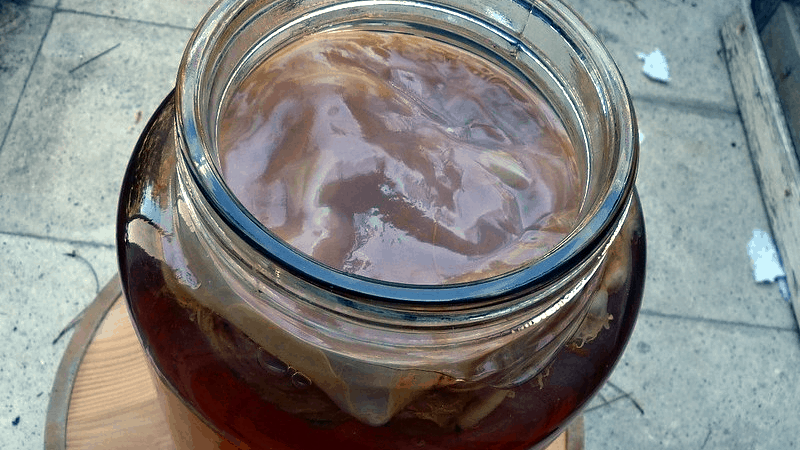
Contaminated strain of kombucha: 4 signs and 2 outcomes SHORT ANSWER A contaminated strain shows one thing: a dry, fuzzy patch on the surface, blue, green or black. In that case discard the liquid and the SCOBY together, wash the jar and start again. Everything else, including brown strings, holes, dark staining, a sinking disc […]

A drink that sounds new… but isn’t If you come across kombucha in an organic aisle, on a coffee card or on social networks, you may have the impression that it’s a ‘new’ trendy drink. The label is pretty, the flavours are modern, and the promises about microbiota and digestion speak to today’s consumer. Yet […]

A strange word for a very concrete reality When you first discover kombucha, there’s always a moment when you come across this strange word: SCOBY. Sometimes it’s pronounced ‘scobi’, sometimes ‘skobi’, and you’ll see it written on recipe cards, on specialist websites or on bags of kombucha cultures. But until you see a SCOBY for […]

A divisive issue: fridge or no fridge? When you start making homemade kombucha, one of your first concerns is:what do you do with your SCOBY when you’re not brewing? As you read blogs and forums, you come across two opposing camps: On the one hand, there are those who say:« Put your SCOBY in the fridge, […]
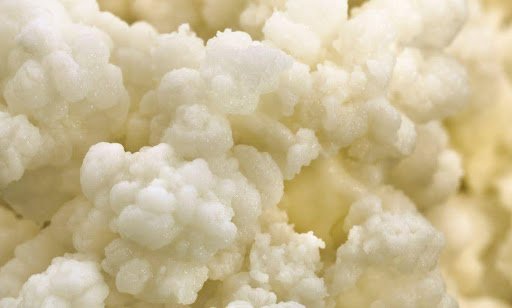
Comment éviter la moisissure dans le kéfir d’eau ? Le kéfir d’eau est vivant. Il respire, fermente, évolue. Et parfois, il se rebelle. Une fine pellicule blanche à la surface, une odeur étrange, un doute qui s’installe : et si c’était de la moisissure ? Ce scénario arrive plus souvent qu’on ne le croit. Même […]

Comment conserver les grains de kéfir d’eau ? Perdre des grains de kéfir d’eau à cause d’un mauvais stockage, ça arrive plus souvent qu’on le croit. Une erreur de température, un oubli au frigo, et la culture s’éteint. Pourtant, ces petits grains sont faits pour durer. Ils peuvent même se multiplier indéfiniment, si on sait […]

When you start making kombucha, you quickly become attached to your SCOBY. You watch him, you worry, you wonder if he’s all right… and sooner or later a question comes up: is he still alive or has he ‘died’ for good? This concern is normal. SCOBY is not a simple ingredient, it’s a living culture […]

People are talking about it in cafés, in organic shops, on social networks… Kombucha is everywhere. But behind the pretty bottles and marketing promises, one question keeps coming up: what are the real benefits of kombucha? Is it just a fad, or does it really deserve a place in your daily life? If you’ve been […]

A leaky SCOBY: problem or normal behaviour? You start a new batch of kombucha.You carefully place your SCOBY on the surface of the sweet tea. It floats for a moment, then… gloups. It sinks to the bottom of the jar or lies askew, like a pancake that hasn’t decided to stay on top. At that […]

We read everywhere that kombucha is « good for digestion ». On the internet, on organic shelves and in trendy cafés, it’s being touted as the miracle drink for sensitive stomachs. But is it really true? Is it just a marketing ploy, or are there real reasons to believe that kombucha can support digestion on a daily […]

You open your bottle of homemade kombucha, expecting the typical ‘spritz’ of fizzy drinks… and nothing. No foam, no bubbles, almost no life in the glass. The taste is good, but the texture disappoints you: you dreamt of a lively, fizzy kombucha, but what you get is an almost flat drink. It’s one of the […]

A beverage that intrigues… and is making a comeback everywhere For some years now, the word ‘kombucha’ has been appearing on labels, in cafés and on social networks. It is presented as a ‘living’, fizzy drink, sometimes as a healthier alternative to soft drinks. But behind this trendy image lies an ancient, highly codified fermenting […]

More than just a wafer: a complete ecosystem When you first discover SCOBY, you see a beige, gelatinous disc that looks a little strange. It floats on the surface of the kombucha, thickening as it ferments and sometimes splitting into two. From the outside, it looks like a simple ‘skin’ formed by the tea, something […]
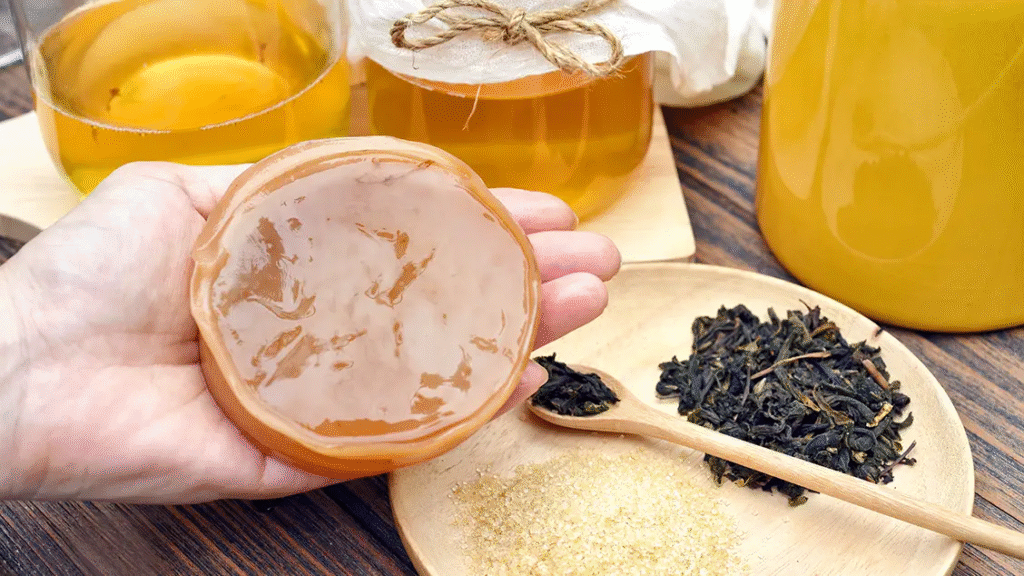
Seeing « hair » on your kombucha: a beginner brewer’s big scare Everything seemed to be going well.You had prepared your sweet tea, added your SCOBY, covered the jar, chosen a quiet corner… Then, when you came to have a look a few days later, you saw appearing on the surface of the liquid : a downy, […]

Two gelatinous discs that look the same from a distance… but not up close When you start to take an interest in fermentation, you soon come across two curiosities that bear a striking resemblance to each other. On the one hand, there’s the SCOBY of kombucha, the creamy, slightly gelatinous disc that transforms sweet tea […]

Homemade or industrial kombucha: 9 honest differences SHORT ANSWER Industrial kombucha is consistent, needs no work, and is often pasteurised, which removes the live cultures. Homemade kombucha lets you set the fermentation time, and therefore the sugar between 1 and 5 g per 100 ml and the acidity, and it always contains live cultures. A […]
